
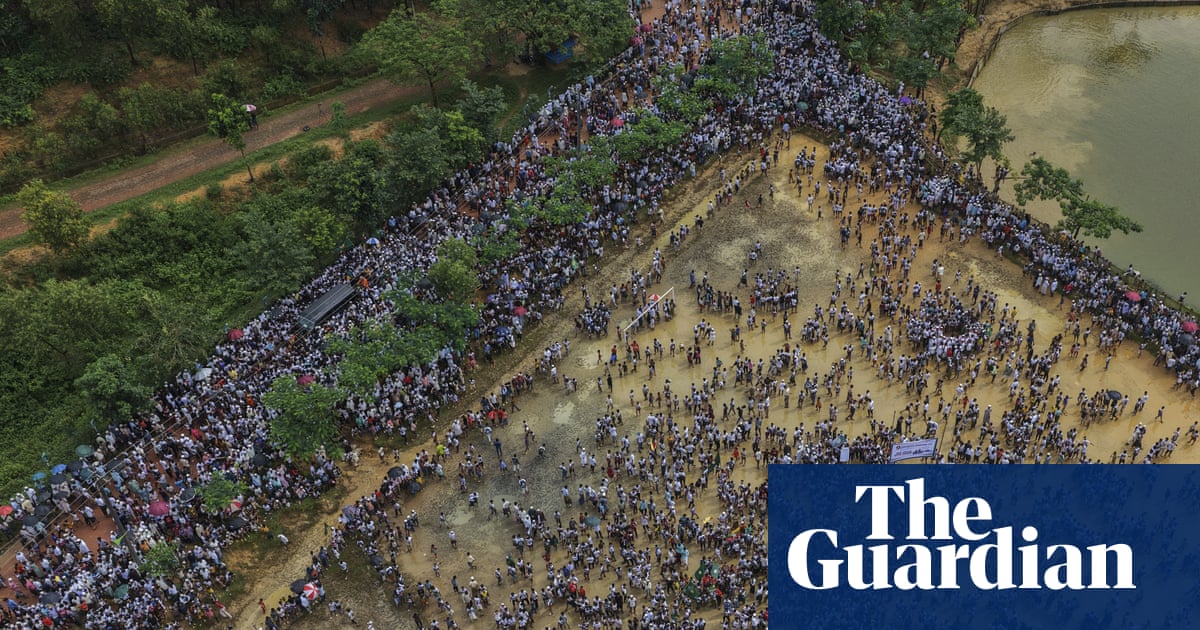
The International Court of Justice will deliver a judgment this Thursday on whether Myanmar committed genocide against the Rohingya. Yanghee Lee said, “The ICJ ruling will be historic for Rohingya survivors and their families around the world.” Judges spent seven years weighing accusations that Myanmar breached the 1948 UN convention.
The world’s top court will deliver a judgment this week on whether Myanmar committed genocide against its Rohingya minority, in a landmark case that will set a critical 21st-century benchmark for the gravest of all international crimes.
The closely watched judgment could become one of the most significant moments in international law since the end of the second world war.
The international court of justice (ICJ) has never found a state responsible for genocide, a crime defined after the Nazi-led Holocaust. The ruling will have implications for a separate high-profile genocide case against Israel.
Nearly a decade after a military campaign forced hundreds of thousands of Muslim Rohingya to flee across the border, the ICJ in The Hague will deliver its judgment on Thursday morning.
“The ICJ ruling will be historic for Rohingya survivors and their families around the world,” said Yanghee Lee, a former UN rights investigator to Myanmar.
“The international community failed to prevent Myanmar military atrocities against the Rohingya nine years ago. It must seize this opportunity to finally secure justice for the Rohingya and begin to reckon with these failings.”
ICJ judges have spent seven years weighing accusations by the Gambia, a Muslim-majority state, that Myanmar’s repression of the Rohingya breached the 1948 UN genocide convention.
A key issue in previous cases has been how to prove “intent” in a crime defined as acts committed with the “intent to destroy, in whole or in part” a national, ethnical, racial or religious group.
Antonia Mulvey, the founder of Legal Action Worldwide (Law), a group that represents hundreds of Rohingya survivors, said she was “cautiously optimistic” the court would hold Myanmar fully accountable.
Government actions showed “patterns of conduct” that proved clear attempts to destroy the group, she said.
“The attacks on the villages took place the same way,” she said. “They would attack the civilians, burn the villages, separate men and women, conduct sexual violence … and then as they fled, they would continue to kill them.”
Two other ICJ cases dealing with atrocities in the Balkans fell short of finding states directly responsible for genocide, although Serbia was found legally responsible for failing to prevent the genocide at Srebrenica.
Mulvey said a key part of the upcoming judgment will be how it handles the issue of rape and sexual violence as an act of genocide. Her team has collected accounts of soldiers mutilating women’s genitals and biting their faces. “That’s to mark people, to brand them … it is also to stop reproduction,” she said.
“Yes, we would say sexual violence is a critical part to show their intent to destroy the group,” she added.
“You don’t need to gang-rape people. You don’t need to kill their children in front of them. You don’t need to mutilate them. You don’t need to do it in public. What is the purpose of that? The purpose is to destroy the group.”
In January, the ICJ held closed-door sessions to hear directly from Rohingya survivors who travelled from camps in Bangladesh. One witness said her child was taken from her arms, stabbed and thrown into a fire, according to Law, while another described seeing piles of bodies in a mass grave.
During hearings, Gambian justice minister Dawda Jallow told the court the case was not “about esoteric issues of international law”.
“It is about real people, real stories and a real group of human beings,” said Jallow. “The Rohingya of Myanmar. They have been targeted for destruction.”
Myanmar, which has denied carrying out a genocide, claims its actions targeted a military uprising from insurgents.
For decades, Rohingya people have been stripped of their citizenship and targeted by increasing discrimination, amid a backdrop of communal violence with Buddhists in the country’s western Rakhine state.
The crisis reached a climax after a Rohingya militant group conducted guerrilla-style attacks in the summer of 2017. The Myanmar army responded with massive “clearance operations”.
Refugees who fled into Bangladesh in 2017 told the Guardian of a massacre in the village of Tula Toli, where survivors described systematic shooting of civilians, including the drowning of children in a river.
This testimony from Tula Toli – which satellite footage later showed had been razed – added to dozens of witness accounts collected over the years to build a case for genocide.
A ruling that Myanmar committed genocide would add international pressure on its leader Min Aung Hlaing, who headed the military during the 2016-2017 attacks and later overthrew the elected government of Aung San Suu Kyi in a 2021 coup, triggering a civil war that has left tens of thousands dead.
The former general is separately being investigated by the international criminal court (ICC), which prosecutes individuals and not states like the ICJ, on allegations of crimes against humanity. He was installed as civilian president in April after elections that were widely condemned as a sham, and has made efforts to rebuild diplomatic ties.
For many onlookers, the ICJ decision will hold relevance far beyond Myanmar, as it will provide the strongest hint of how judges might assess the seminal genocide case brought by South Africa against Israel over its campaign in Gaza.
The cases have much in common, with an ethnic group targeted by a powerful military, although Israel has far stronger diplomatic backing from the US.
The judgment comes as Washington has been on the offensive against international human rights bodies, including sanctioning the ICC. Washington technically already considers the Rohingya crisis to be a genocide, based on a decision by the Biden administration.
However, Trump’s UN ambassador, Mike Waltz, warned that the ICJ “must not be allowed” to establish a standard for genocide that could be used against “allied soldiers”, a statement that will be relevant for Israeli troops.
Supporters of the Myanmar case say the judgment should compel states to block arms transfers and jet fuel supplies. While the court does not have the means to enforce its decisions, they have been respected in the past, and the UN security council could give it strength, although divisions, especially between the US and China, make this unlikely.
More than 1 million Rohingya remain in Bangladesh, in the world’s largest refugee settlement. Fewer than 600,000 are estimated to remain in Myanmar.
A displaced Rohingya living inside Myanmar told the Guardian he hoped the judgment would “help end decades of persecution and discrimination”.
“We are not asking for sympathy alone,” he said. “We are asking for justice, recognition, equal rights and a future in which our children can live safely and with dignity in their own homeland.”