
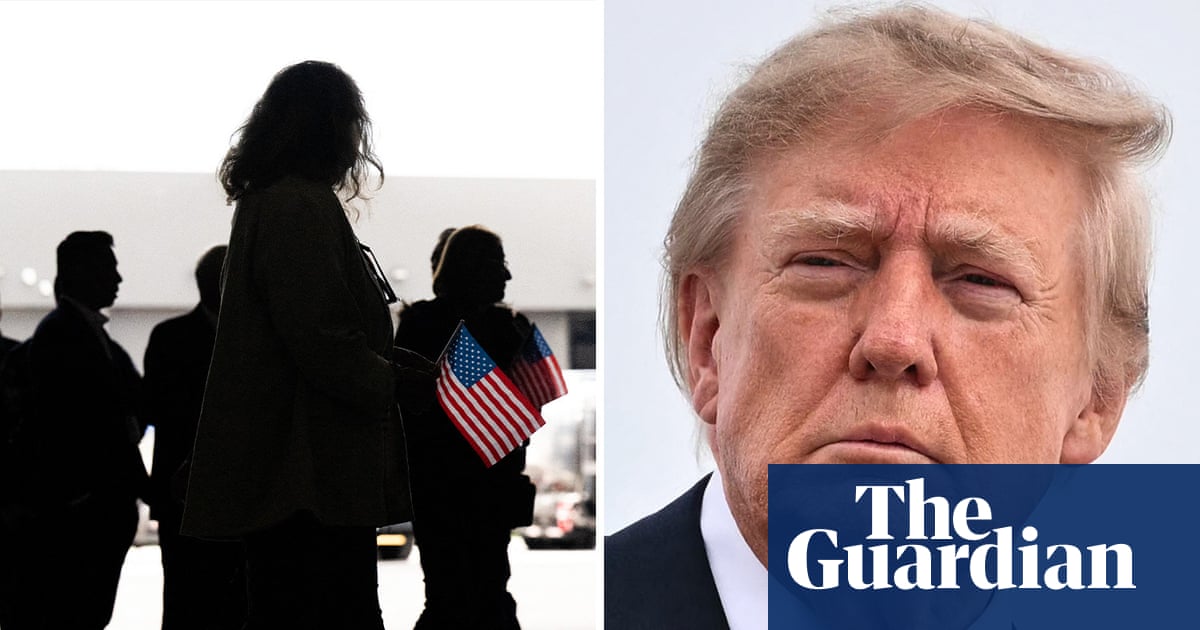
Donald Trump set a 17,500 refugee limit for fiscal year 2027, prioritizing white South Africans. Refugee groups said the move ignores humanitarian needs. Kennji Kizuka of the IRC noted, “What is lost is the focus on humanitarian need.” Many vetted people got stuck as the government pushed this specific policy.
Donald Trump plans to once more severely restrict the number of refugees admitted to the US, announcing a limit of just 17,500 people in fiscal year 2027 – and that, again, those let in will be “primarily” white South Africans.
Refugee rights groups are alarmed and infuriated at the decision last month by the US president to exclude almost every other demographic.
They claim the decision will continue to leave thousands of refugees stuck in dangerous situations around the globe, many of whom were already vetted and approved for entry, in favor of a very small quota dominated by Afrikaners, an Afrikaans-speaking white ethnic group descended from Dutch and French colonial settlers to South Africa.
This despite low take-up of US refugee slots by Afrikaners, prompting extraordinary measures from the government to attract them even in the face of apparent disinterest, the Guardian revealed this week, and the greatness of need in other countries.
During his first and second terms, Trump has signed various executive orders and his administration made significant policy decisions to halt nearly all refugee admissions, except for white South Africans. The refugee cap determination, published on 25 September, is just the latest move in undermining legal migration while also changing the demographics of who can come into the country.
“What is lost is the focus on humanitarian need,” said Kennji Kizuka, the director of policy for the International Rescue Committee (IRC), a global humanitarian and non-governmental organization headquartered in New York, which works with refugees worldwide. “We built up over decades this humanitarian system that was meant to try to avoid politicized decisions around which kind of refugees to admit.”
Some refugees slated to arrive to the US before Trump took office already “had travel plans that were canceled at the last minute”, Kizuka added. “They were ready to go and then everything was pulled out from underneath them.”
The Department of Homeland Security (DHS) referred all questions to the state department.
“President Trump has been very clear that we are prioritizing the resettlement of Afrikaners in South Africa who are escaping government-sponsored race-based discrimination, a US policy indicated in E.O. 14204,” a state department spokesperson said in a statement.
In a statement, White House spokesperson Anna Kelly said: “President Trump has provided a lifeline for Afrikaners, who are being raped, maimed, killed, and driven off their property across South Africa.
“While the South African government and many in the media have brushed off the horrific lived experiences of this community, the Trump administration continues to process applications for refugee status because the president has a humanitarian heart,” Kelly added.
For fiscal year 2026, which ended on 30 September, the Trump administration capped the refugee limit at 17,500. The US only accepted 16,292 refugees total during that time – nearly all were white Afrikaners, except for five from Afghanistan. The overall cap was 125,000 under Joe Biden.
Trump and his allies have falsely claimed there is a “white genocide” against the white minority population, which led South Africa during the apartheid years. In February 2025, Trump signed an executive order claiming that Afrikaners are victims of “unjust racial discrimination”. There is no proof that there is a “white genocide” in South Africa and the new South African ambassador to the US, an Afrikaner himself, has also said the phenomenon does not exist.
Groups in the US working with refugees view the administration’s moves as discriminatory.
“Hundreds of thousands of refugees who are in the US refugee admissions program pipeline are impacted,” said Mevlüde Akay Alp, senior litigation attorney with the International Refugee Assistance Project (IRAP), a legal non-profit based in New York that advocates for the human rights of refugees and displaced people. “It’s particularly cruel to see the way in which the government has prioritized new white Afrikaners to the program without even considering these people who had gone through years of processing and had been promised safety here in the United States.”
The refugee admission process can be excruciatingly long, with refugees required to undergo vetting, interviews and background checks – processes that can take years. Thousands of refugees were already in queue to be admitted to the US when Trump halted the bulk of refugee arrivals but started rushing Afrikaners through.
The US government said it will accept refugees on case-by-case exceptions, such as with the South Africans. But a lawsuit filed by IRAP last year, representing a number of refugees and refugee resettlement organizations, accuses the government of refusing to tell refugees and their attorneys what those exceptions would be and how a refugee could qualify.
“Nobody else, including any of our plaintiffs, have any way of requesting an exception for themselves, no matter how dire their situation or how strong their connections to the United States are,” said Alp.
An appeals court mostly sided with the Trump administration, but IRAP challenged that decision, bouncing the case back to a Washington state federal court. The legal battle continues.
For many families, the administration’s decisions have been a devastating blow.
Vartush and her family, who are being represented by IRC, are currently stuck in this limbo. Vartush, who requested that only her first name be used due to fear of jeopardizing her son’s refugee admission process, is a 70-year-old US citizen living in California.
Vartush is an ethnic Armenian Christian, who was living in Iran with her family. She said how she and much of her family fled Iran and arrived in the US in 2009 under the refugee admissions program due to religious persecution. But delays and the lengthy refugee admission process kept her adult son in Iran.
Finally in 2024, Vartush’s son and his fiancee were approved to take the next step in the refugee admission process. His fiancee went first and arrived in the US at the end of 2024. His trip was supposed to be next – he sold his belongings and prepared to leave, with IRC attorneys requesting to expedite his case, citing his clinical depression. But then Trump came back into office and radically changed policy, halting the possibility for Vartush’s son to arrive in the US and be reunited with the rest of his family.
“He suffers from depression,” Vartush said through an interpreter. “But obviously that got even worse.”
The current US war in Iran has only deepened the family’s stress and the son’s mental health. Vartush calls him daily to wake him up, she said. She said her son is despondent, with little hope of reuniting with his family as his case remains stuck.
“The war itself brought a lot of anxiety,” Vartush said. “We have fear and anxiety, especially with his depression, I’m very worried that one day he might do something to himself.”
Other people stuck in this limbo include some who are involved in the IRAP lawsuit against the administration. Their names have all been changed as part of the lawsuit, due to fear of jeopardizing their pending refugee case and, in some cases, for fear of violent retaliation by groups persecuting them:
From Iraq: Sara and her son
Sixty-year-old Sara and her 19-year-old son, who is disabled, are currently stuck in Jordan, despite being conditionally approved for US refugee resettlement, according to her court declaration. They desperately want to join Sara’s older son, now a US citizen who has been in Idaho since 2012 after arriving in the country as a refugee.
In January 2025, Sara and her teenage son sold some of their items for the trip, began taking an American cultural orientation course and even purchased some baby clothes, as Sara’s son in Idaho is married and preparing to welcome his first child.
“I wanted to make sure to be ready for the day that I received the call from the US government that we would travel to the United States,” Sara said in her court declaration.
She and the son who is now in the US lived in Basra during the US war in Iraq, before her second son was born. As fighting near their home was intensifying, Sara’s husband dropped her and her son at her parents for their safety.But when he drove away, his car was bombed, killing him.
Her brother-in-law, a member of an influential militia network, then demanded that she give him her house and custody of her son and fired a gun at her house, the court declaration says, and eventually Sara and the son fled to Jordan.
In Jordan she gave birth to her younger son, who suffers from a birth defect in his brain. They have lived in Jordan for years and had applied for refugee status back in 2014, but Sara said they face discrimination and extortion in Jordan as Iraqi refugees.
“I know that there are many other refugees prevented from traveling who are suffering through things that are even more difficult than my situation,” Sara wrote.
From the Congo: Miriam’s 10-year-old son
In the mid-2000s, Miriam and her family fled the Democratic Republic of Congo after being persecuted by paramilitary groups, a filing by IRAP attorneys said. They arrived in a refugee camp in neighboring Burundi and spent nearly 15 years there.
During that time, Miriam and her family were accepted to the US refugee admissions programs and began the lengthy process of vetting, background checks and interviews.
Meanwhile, she gave birth to her youngest son. According to a court filing, Miriam was “erroneously” advised by staff at the UN that adding the baby to their family’s refugee application at that point would delay the process.
In 2021, Miriam and her family finally received tickets to fly and settle in the US. But when they arrived at the plane, Miriam’s youngest son, who was five years old by then, was prevented from boarding. According to the court filing, his name was not listed on the flight manifest. Miriam had to leave her child behind and fly to the US with the rest of her family. The boy has remained without any relatives in the Burundi refugee camp. Miriam’s attorneys have been battling to bring him to the US, but the case has moved very slowly, partly due to delays caused by the first Trump administration’s anti-refugee policies, IRAP attorneys allege, and is stuck.
“Miriam speaks to her son every day, often multiple times, so that he knows that she is thinking of him and feels emotionally supported,” the filing reads. “But the separation has caused Miriam and her son unbearable frustration and emotional pain.
“Miriam believes the US government is purposely neglecting her and her family because they do not want her to be here and do not value her family in the same way that they value white Afrikaners, just because of her race,” the court filing reads.
From El Salvador: Marcos’s stepdaughter
Marcos, a 59-year-old Salvadorian man, has been in the US for more than 25 years and currently lives in California. For 10 years, he has been attempting to help his stepdaughter move to the US through the refugee program for Central American minors, according to his court declaration.
In 2010, he met his wife, who is also from El Salvador. According to his court declaration, Marcos’s wife had to flee El Salvador and leave her daughter behind, because of domestic violence at the hands of her daughter’s biological father.
Life has been difficult for his stepdaughter in El Salvador. When she was 12 or 13 years old, she had to abandon school for several years after being threatened by gangs – they tried to extort her family by threatening to hurt her unless her mother, already in the US, paid them, the lawsuit said.
In 2016, Marcos began the refugee resettlement process for his stepdaughter. But the process stalled due to the first Trump administration’s limits to refugee admissions. Marcos restarted the process in 2022 and finally, in early 2025, Marcos was informed his stepdaughter could enter the US in February.
“My wife and I started preparing for her arrival,” Marcos wrote in his declaration. “I started preparing her room in our home. I painted her room a dark pink color.
“My wife also bought our daughter new clothes to wear. We also bought her a new computer so that she could be prepared for her studies here in the United States,” he added.
But Trump suspended all refugee arrivals just before his stepdaughter’s arrival. Now, Marcos, his wife and his stepdaughter are in limbo, worried about her wellbeing and wondering whether she will ever be able to come to be with her mother.