
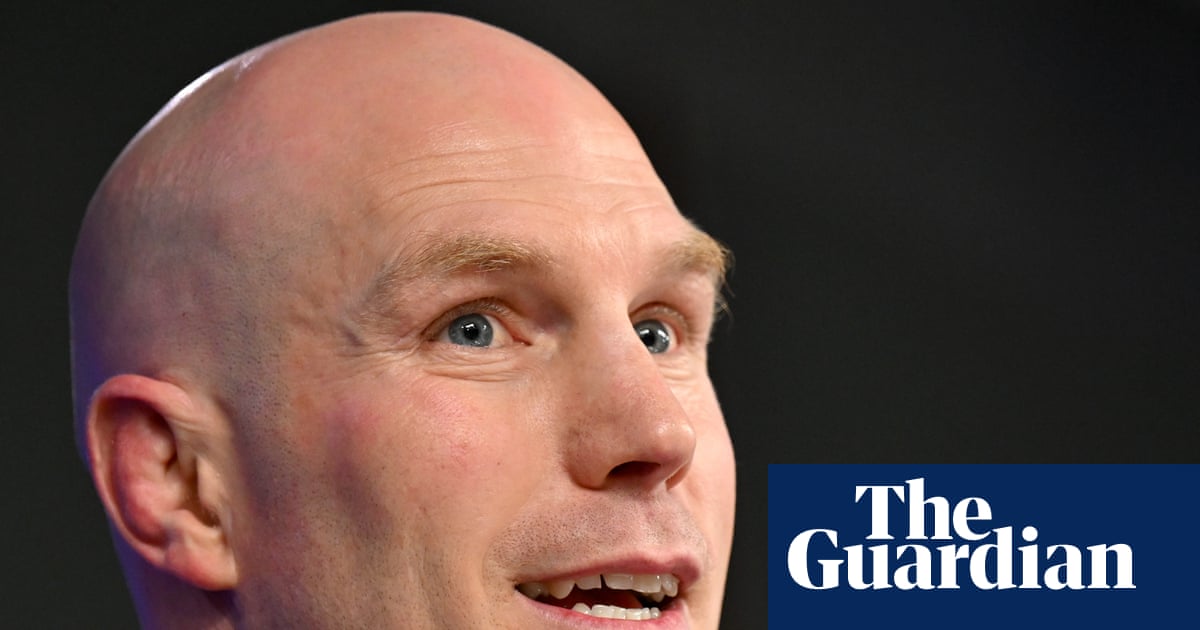
Senator David Pocock gave his first speech to the national press club on Wednesday. The former rugby star said he wants to build a political system that delivers for Australians. He urged colleagues to “double down on the values you represent” like kindness, transparency, and accountability in the federal parliament.
He’s six foot tall and full of muscle, but David Pocock’s real strength is often sounding like the most sensible, commonsense voice in the room.
At his first speech to the national press club on Wednesday, he said he wasn’t launching a bid for prime minister – no matter how much some people might like the softly spoken senator to have more say in federal politics.
Indeed, Pocock said he was already thinking about life after politics, admitting “you can’t do this for ever”. But before the full-time whistle on his parliamentary career, the former rugby star has a match against his toughest opponent yet: the two-party system.
“I want to be part of building a political system that actually delivers for Australians, no matter who is prime minister,” the ACT senator said.
“I see an opportunity at the next election for a new kind of community political collective … I want to use what I’ve learned over the past four-and-a-half years to help.”
He called for a higher calibre of politics after the alleged attack on the independent Indi MP Helen Haines. He branded parliament’s question time a “disgrace”, urging a “better standard” among colleagues “to take some of the edge off it”.
Speaking directly about Haines, he said parliament must “meet this [alleged] attack on you by doubling down on the values you represent” – listing transparency, accountability and kindness.
In front of staff and allies – the ACT politician Thomas Emerson, Pocock’s former staffer and lookalike, as well as the Cheek Media founder and Grayndler independent candidate, Hannah Ferguson – he called for three key policy reforms:
A 25% tax on gas exports, which he said could fund anything from boosting welfare to health reforms and aged care.
A 5% levy on datacentres to capture more benefits from the AI boom.
Just two months of gas tax revenue would pay for 100,000 home support packages, while prosthetic eyes and noses for cancer victims would be paid for in three hours, he said. Pocock recounted the moment a woman sat sobbing in his office, so destitute on the miserable jobseeker allowance that she ate dog food because she hadn’t eaten meat in so long.
“A 25% gas export tax could help change that, allowing us to have a social security system that keeps people above the poverty line,” he said.
All politicians have these stories, even if not all of them talk about them with such emotion. Politics is a series of choices and priorities and, presented by Pocock in this way, the choice not to fund welfare boosts or aged care or cancer care is hard to justify.
Asked later about calls for budget discipline and cutting spending, Pocock replied instantly: “You can make cuts, or you can grow revenue.”
“I don’t understand why we’re slugging everyday Aussies and yet we’re happy to export gas for free.”
Despite having only one vote in parliament, and no longer holding Senate balance of power, Pocock has been extraordinarily successful in drawing attention to his key issues. Labor members are not his biggest fans, but he has moulded the gas tax narrative to the point that government MPs’ social media feeds are flooded with comments demanding change.
Bending the national conversation around a complicated resources tax, to the point where the actual prime minister has to wade through swathes of comments from political normies on every post, shows some level of leadership. Not that Pocock is angling to win that position himself; for one, he said he’s staying in the Senate, not switching to the lower house.
For another, when he told the audience “don’t get ahead of yourselves with ‘Pocock launches bid for PM’ headlines”, it got only the second-biggest laugh in the room.
The biggest laugh came when he added: “My ambition is much bigger than that.”
His idea for a new “coalition” of independents was light on detail, but he said he wanted to “build” something alongside communities which were already organising. Pocock suggested an alliance of independents and collectives like the Community Strong movement headlined by Zali Steggall and Allegra Spender, going on to shout out independent tilts in ACT electorates of Bean, Canberra and Fenner, where his local campaign infrastructure could make a difference, but also the seat of Fisher and even Anthony Albanese’s, Grayndler.
The Greens leader, David Shoebridge, has said he wants his party to replace Labor. A Pocock-backed independent in Ferguson, replacing the prime minister in his own seat, would be a whole new level.
“I believe a model of smaller, community interest parties and independents working together in an alliance can succeed here and build the kind of future we want,” Pocock said.
Where that ends up, and if it gets off the ground, will be seen in coming months and years. Just don’t expect to see Pocock – rugby star, conservationist, senator, father – add prime minister to his CV anytime soon.