
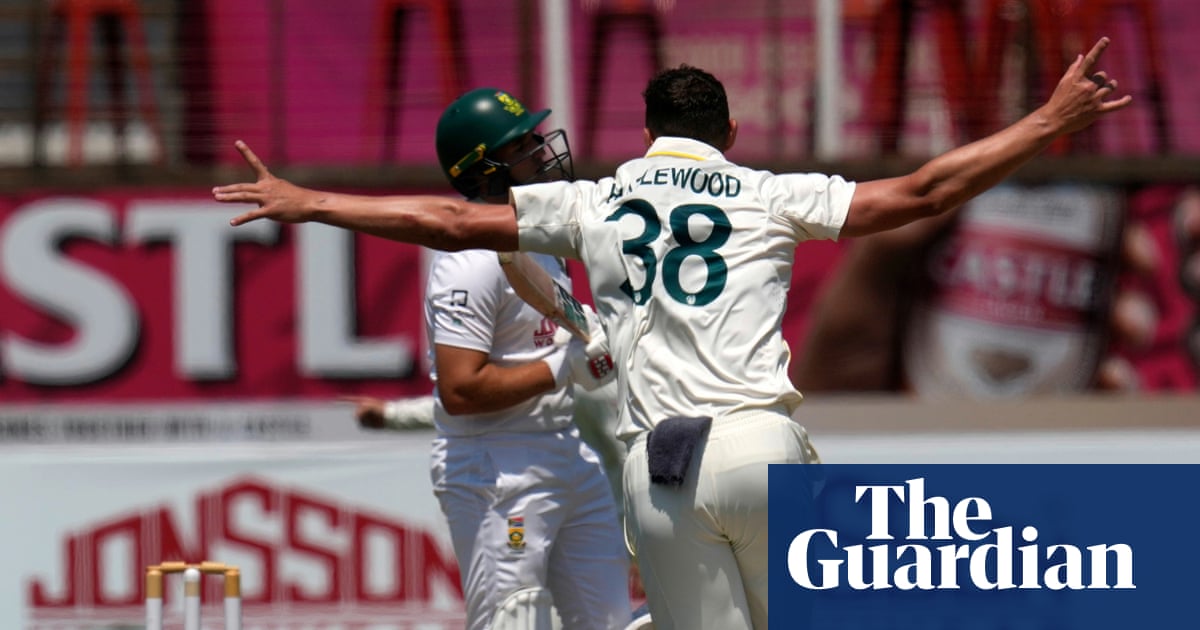
Josh Hazlewood took 6-49 to help Australia beat South Africa by 214 runs in the Durban Test. While other bowlers struggled to find breakthroughs, Hazlewood stayed consistent throughout the match. He broke key partnerships and dismissed the hosts for 206, proving his immense value to the Australian Test side.
After every stunning Scott Boland performance of recent years, many of them in place of an injured Josh Hazlewood, a reasonable question does the rounds: why isn’t Boland the automatic pick in the Test side, and why does Hazlewood take precedence when fit? In truth, Hazlewood has given a dozen years of answers, but the fifth day of the Durban Test allowed him to provide one more reminder with a career-best 6 for 49, overcoming South African resistance to bowl them out for 206, and seal an Australian win by 214 runs.
Boland is good enough for a full-time spot, and may have been influential if picked. But in the side selected, Hazlewood was essential as South Africa blunted his colleagues. In a noticeable dip given his brilliant last few seasons, Mitchell Starc had radar issues: better around the wicket, though without the swerving reverse swing from his last visit to the ground, but over the wicket he often went too steeply across the right-handers, or down the leg side.
Pat Cummins bowled well but didn’t produce danger in the second innings, his only blow being self-inflicted thanks to Tristan Stubbs’ loose drive. Nathan Lyon got some bite, and his overs cost nothing, but he was defended well and went wicketless. Three times, Australia needed something from somewhere. Hazlewood kept delivering.
It had started on the fourth evening, when Aiden Markram and David Bedingham looked completely comfortable, when Hazlewood bowled the perfect nip-backer length to hit Bedingham’s pad so plainly in front that the batter walked off without challenge. From a tough 73 for 1, Australia produced a rush that made it 86 for 4.
The next morning, South Africa resumed control. Markram is a fourth-innings specialist, with two hundreds against Australia in three prior attempts, and looked immovable. Wiaan Mulder defended with perfect compactness and clarity. They scored enough to avoid stagnation, but didn’t play unnecessary shots. Occasional balls tested them, including another nip-backer that nearly took Markram’s off stump, but they gave every appearance of being able to bat for a draw if bad light brought an early close.
After 25 overs of toil on the day, Australia needed something. And it wasn’t just a matter of Hazlewood getting lucky with a catch down the leg side. Bowling with a ball that had seen 66 overs, he brought in a leg slip to open up another mode of dismissal while targeting the pads. Mulder saw that line and wanted to flick square. A little reverse movement kept it tailing towards leg stump. So his flick became an inside edge, and Alex Carey took a one-hander diving left.
Skill had broken the most stubborn stand, one of 32 overs and 69 runs, with Mulder having batted over two hours for 29. That opening allowed Matt Renshaw to get a flirty edge from a decidedly unstubborn Kyle Verreyne in the next over. Then, another stretch of obstinacy. Markram was in a zone, footwork precise for the most reliable defence, collecting the odd single like a prisoner does bottle caps to keep himself from going mad. Marco Jansen allowed himself to clobber loose balls, but did his best to be good.
Another 17 overs, another rise of concern for Australia about an early finish. Another Hazlewood spell required, this time with a new ball. The one that nips back. This time, the length perfect. Jansen on 35, trying to defend on the front foot, the faintest gap, and the ball through to off stump. Enter Simon Harmer, county pro gnarled as a ti-tree, a couple of first-class tons and 36 fifties to his name. Exit Harmer, three balls later, edging a horrible lifter. Hazlewood had five.
At eight down in the 85th, with 201 on the board, the double strike was when Markram’s resolve dissolved. He inside-edged Starc in the next over, having batted two minutes shy of six hours for his 75, and will surely have more of a say in this series. Hazlewood had Nortje caught at midwicket to ice both the game and his personal cake.
In the process, he jumped up a significant stretch of the Test wickets list: passing Yorkshire legend Fred Trueman on 307, local boy Morne Morkel along with West Indies spinner Lance Gibbs on 309, and the fast and the furious Brett Lee on 310, levelling Indian pair Ishant Sharma and Zaheer Khan on 311. In Australian terms, with three more wickets to pass Mitchell Johnson, Hazlewood would have ahead of him only Dennis Lillee, Glenn McGrath, and Shane Warne, along with his three current colleagues. Fitness pending, next week could see four of Australia’s top seven wicket-takers in the same team. But this is fast bowling. Fitness also says that Boland, with 82 wickets to his name, will be needed soon enough. As in 2018, Australia leave Durban with a series lead. This time they need to keep it.