
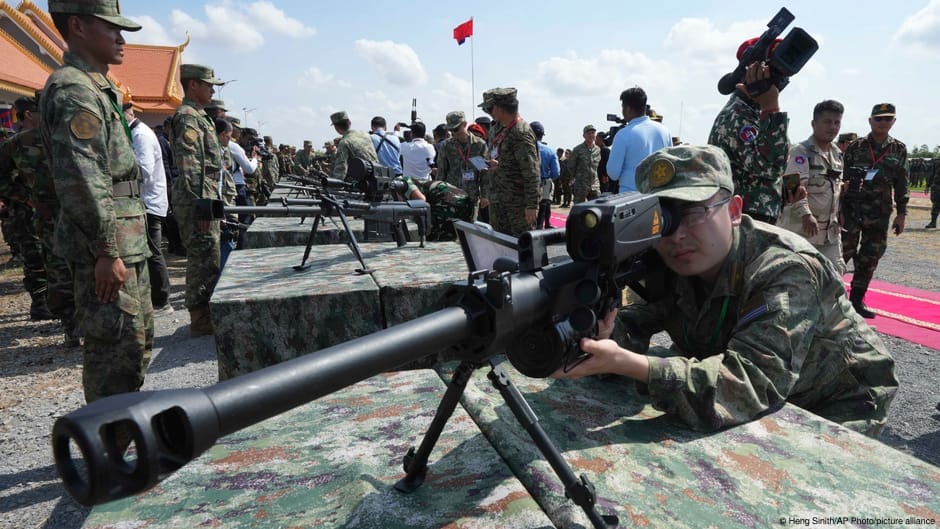
China invited ministers from five Southeast Asian nations to Beijing in early November to boost economic and security ties. China also opened a joint military training center in Laos this September. Expert Marco Bünte said, "China would gain strategic depth in mainland Southeast Asia," as its regional military influence grows.
It's often said that maintaining good relations with your neighbors is essential. So in early November, China's Foreign Minister Wang Yi invited his counterparts from Laos, Cambodia, Vietnam, Thailand and Myanmar to Beijing.
There the six countries agreed on closer economic and security cooperation.
The visit is just one example of China's growing influence on Southeast Asia. It's not just about trade or infrastructure either, it's also increasingly about military cooperation.
New airbase in Laos
For instance, at the end of September, China and Laos opened a joint military support and training center north of the Laotian capital, Vientiane. Initially Laotian air force pilots are to be trained at the Ban Keun airfield, China has said.
Earlier in 2025 China expanded its footprint at Cambodia's Ream naval base. China uses the facility on the Gulf of Thailand for logistics and training. And while Japanese and Vietnamese ships can visit the port, they're docked at a southern quay and it's unclear if other navies can use the same facilities under the same conditions as China.
"It remains to be seen how this [Ban Keun] will change China's military access to Southeast Asia," says Marco Bünte, a professor of Asian politics at the University Erlangen Nuremberg in Germany.
In recent years, China has significantly expanded its economic influence in the region.
The China-Laos railway and other infrastructure projects connect Laos more closely with its northern neighbor. Laos is also heavily indebted to China.
Bünte points out that Laos and Cambodia have been close military partners of China for some time and the new facility in Laos can be seen as another step towards deepening cooperation.
If that proves correct, "China would gain strategic depth in mainland Southeast Asia," Bünte explained. "It would also give China better military access to the South China Sea."
Johann Fuhrmann, head of the Konrad Adenauer Foundation's Beijing office, points out that one should distinguish between training Laotian pilots and any potential use of the facilities by Chinese armed forces later.
"China gains influence when it co-designs the training and operation of such facilities over several years," Fuhrmann told DW.
Chinese planes in Laos
But nobody should underestimate China's military positioning, Bünte continued. "China is expanding its military operational capabilities here although I wouldn't speak of military hegemony because China hasn't achieved that yet."
With regard to the Laotian airbase, China says that Laotian pilots will be trained there. But beside military transporters and helicopters, Laos actually only has three light combat aircraft by Russia's Yakovlev works.
According to the aviation media outlet FlightGlobal, four more K-8s, Chinese two-seat intermediate jet trainer and light attack aircrafts, are in service there. Satellite images analyzed by the Reuters news agency in early October show eight K-8s at the base — even thought this doesn't necessarily mean they are stationed there permanently.
Fuhrmann doesn't think anybody should jump to conclusions about this.
"The idea of a Chinese air corridor is more of a future scenario than something that has already been proven," he says.
For example, the runway at Ban Keun is only 2,000 meters (6,562 feet) long, which makes it too short for large Chinese bombers. These usually require 3,000 meters.
The crucial question is what rights China will be granted, Fuhrmann continues: "Will China have to obtain the approval of the respective government for every new use? Or are there longer-term commitments that both sides can invoke, even in times of crisis?"
Surrounding countries are reacting differently to what appears to be China's growing influence in Laos, Cambodia and Myanmar because these countries are already considered closer to China.
Other Southeast Asian nations are hedging, trying to expand their relationship with China without severing ties with the US and also maintaining economic links with other Western nations. China's involvement offers them additional options and Beijing wants to explore those possibilities. That's just pragmatic though, Bünte says of the smaller Asian nations.
"Overall, these states… try to keep as many options open as possible," he notes.
China: 'Not against third parties'
Vietnam and the Philippines are watching developments particularly closely. Both have territorial disputes with China in the South China Sea. But Vietnam also has close historical ties to Laos and trained its own military there.
In early November, the Vietnamese government declared that any military cooperation must serve peace and stability and referred to the Treaty of Amity and Cooperation in Southeast Asia, commonly known as the ASEAN Treaty. China is not an ASEAN member but has also stated that its activities are not directed against any third parties.
"So far, these are individual steps," Bünte adds. "We would have to wait and see if this leads to a broader military alliance in the years to come."
Fuhrmann says that Western nations should help strengthen the smaller countries in the region and take their interests seriously.
"Ultimately, a counterweight can only be achieved through tangible contributions, not through warnings or lectures from Europe," he says.
This story was originally published in German.