
Drought in Afghanistan forces families to sell young girls as brides to repay debts. Eleven-year-old Khatira, sold in Badghis province, said, “I am still a child, it cannot be good to be married.” Many families lost their income due to climate change, leaving them with no choice but this practice.
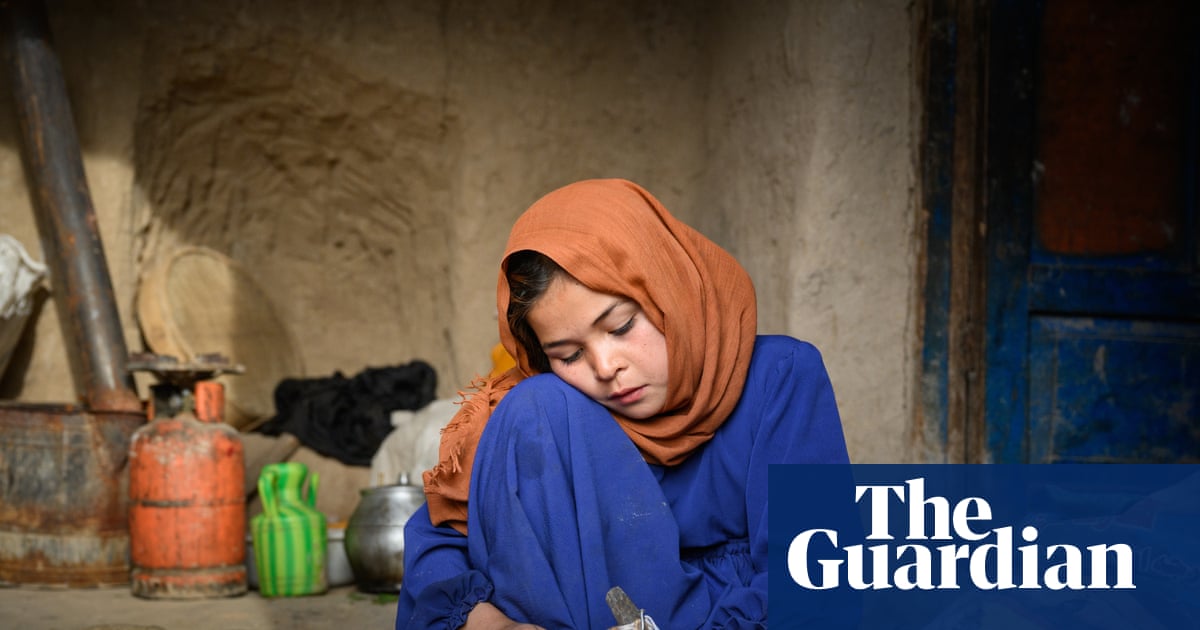
‘I’m not happy about this,” says 11-year-old Khatira, who was sold into marriage to repay debts, sitting in her home in Qala-e-Naw, capital of Badghis province in north-west Afghanistan. “She was healthy before her engagement, now she is worried and cries a lot,” says her 40-year-old mother, Noor Bibi.
When her 20-year-old husband-to-be comes to her home, Khatira runs away. Since her engagement, she has stopped going outside because she “is ashamed of having a husband in front of the other girls”, says her mother.
Khatira’s father grew wheat and herded cattle before the family was displaced from its rural village by drought.
In Badghis, 95% of the population relies on rain-fed agriculture and livestock to live. But droughts, made more frequent and extreme by climate breakdown, have robbed people of their incomes.
As a result, selling young daughters into marriage to repay debts, feed the family or pay for medical treatment has become a common way to cope.
“As a mother, I cried a lot, but I knew my husband had no choice,” says Gul Bobo, who does not know her own age, regarding her daughters, aged two and five, at her home in Tayz Nāwah, a village 12 hours’ drive from Qala-e-Naw. Both girls are engaged to be married.
Like many there, Gul Bobo’s husband used to buy seeds each year and rent a tractor or donkey to cultivate a wealthier man’s plot of land.
“I know they are too young to be engaged but we had no choice – otherwise we would have waited until after 18,” says Gul Bobo.
“I expect them to be beaten, but there is nothing I can do about it. And at 14, they will be pregnant.”
Underage brides are often expected to have children when they reach puberty, leading to well-documented health problems – in a country where maternal mortality is among the highest in the world.
They are also expected to know how to run a household. When they are unable to do so like adults would, domestic violence from in-laws is not unusual.
Five-year-old Nazila’s husband-to-be is 15. According to Gul Bobo, she could leave to live with her in-laws in two or three years.
‘I would have preferred for her to be dead rather than be married off to such an old man,” says Bana, the mother of Gulalai, 11, who is engaged to a shopkeeper in his late 40s. Her parents owed him money.
The story is always much the same. Gulalai’s father was a farmer and the family were displaced by crop failure from their remote village in Qadis, Badghis province.
“We have to sacrifice a family member to save the others,” says Gulalai’s father, Niaz Mohammad, who says he would have preferred to wait until his daughters turned 20 to marry them off – instead, four were married as children.
The family only eat homemade bread, tea and wild mallow leaves they gather and boil, using rubbish to make a fire.
When asked about climate change, most people in Badghis do not know what it means. In villages, most live in mud homes, with no electricity besides the occasional solar-powered battery, and little transport aside from an occasional motorcycle. The population relies on so little to live that notions of overconsumption or greenhouse gas emissions are completely alien.
In a desperate attempt to survive droughts over the past nine years, thousands have abandoned their ancestral villages to try to find work in Qala-e-Naw, often in vain.
To feed his family, Mohammad Yawaz, 55, sells ice-cream on the roadside for 100 afghanis (£1.20) a day, after spending his mornings with his six-year-old daughter Zubaida, collecting cans and bottles. They make, at best, 500 to 1,000 afghanis a month reselling them.
Yawaz eventually felt he had no choice but to marry off his first daughter, now 15, who has already left for her husband’s home, and Zubaida, who was engaged last year to a 12-year-old boy.
His neighbour, Surgul, is in the same situation. In the morning, he collects rubbish with his daughters Zartila, 10, and Bibi Aisha, seven, who are both engaged. The decision to sell Zartila into marriage was taken after the family had to endure “three days and three nights with nothing to eat”.
Recently, Surgul sold the only battery he had for lighting in his mud home to buy medications for one of his daughters. A few years ago, he and his wife lost an infant to illness.
But this was not always their life. Surgul once had cattle in his village. As droughts hit the area, he sold them.
Cattle markets in Badghis are full of men selling their precious animals because they cannot afford to buy fodder to compensate for the lack of grass. In some areas, villages have become ghost towns.
Some families go to Herat, the third-biggest city in Afghanistan, where the Shahrak-e-Sabz camp houses tens of thousands of displaced people. They come here in the hope of finding humanitarian aid – but it has dried up. Then they resort to selling their daughters into marriage to repay debts.
Darellah, 15, lives with her 30-year-old husband, Mollah. Her family was displaced from their village in 2018.
That year, Badghis suffered a historic drought, and since 2021, droughts have ruined harvests and starved livestock every year.
Now pregnant, Darellah is visiting her family. “I am still a child … it cannot be a good decision to be married at that age,” she says. Her sisters, Bibi Zat, nine, and Rahimah, 11, are both engaged but still live with their parents.
Their neighbours were all displaced by the drought as well. Bahahuddin, 40, had to sell his land.
When he found himself unable to feed his family by collecting rubbish and begging, he sold his 10-year-old son Ziauddin’s kidney for 100,000 afghanis. He wanted to sell his own but said he was not healthy enough for people to buy it.
In the camp, stories like these do not raise an eyebrow. Residents say children have often died from not being able to access health services.
Khomakha, 30, is another neighbour displaced by the droughts. Her husband made a deal to marry off their two-year-old daughter Fatemah only three months after the girl was born.
The urgency came as they could not afford the small fee for shared transport to take their eight-year-old son, Ehsanullah, who has blood cancer, to the hospital for a transfusion each week.
Khomakha may not see Fatemah ever again after she marries and moves to a village 15 hours’ drive away. “I will not be able to afford transport to visit my daughter once she leaves,” Khomakha says.
But life is not much easier for families who stay in their villages. In Khoshkian, Abdul Aziz’s wheat harvest failed seven times in eight years. Over the years of drought, he sold five of his daughters into marriage, for between 90,000 and 150,000 afghanis (£1,000-£1,750), to repay debts.
Mazari, one of Abdul Aziz’s daughters, left home at about 12 or 13. Now 16 or 17, she lives with her husband in his 40s, their two-year-old son, and a baby born just one day ago.
“Getting married at 12 was really hard; when I came to his home, I wasn’t able to cook, but my husband and in-laws have been really kind,” she says.
Her younger sisters, aged between three and 13, will live at home until their bride prices are paid. While they weed a field, they remember the years of war when soldiers from the previous government used to shoot from the mountains behind them.
“There was no difference – the previous government’s army shot whether we were Taliban or civilians,” says Shamael, Mazari’s 13-year-old sister. “We feel better now because we are not woken up by fighting.”
Sitting in the field, Shamael’s sisters nod as they continue weeding.
“People cultivate their land for several years. People invested a lot to do so, and there is no harvest, so they are in debt,” Shamael says. “Then some people sell their lands, some sell their daughters – to survive.”
There is no law regarding the age at which girls can leave home for marriage. Bride prices range from hundreds to a few thousand pounds and are paid in instalments. Once the dowry is paid in full, the in-laws are free to claim the bride. In many cases, it happens at the beginning of puberty.
“Everything that is happening to us is because of poverty,” Shamael says.
On her wedding day, in the village of Nookhil, Bibi Samia, 14, at first appears calm. She had cried a lot the night before, says her mother. She has remained stoical for hours but, just before she has to leave her home, bursts into tears. “I am not happy because I am very small,” she says.
As foreign aid dries up, programmes that should provide support for these girls are disappearing.
Mark Calder, advocacy director for Afghanistan at the aid organisation World Vision International, says: “Early marriage exposes girls to potentially deadly health risks, but the clinics treating them are disappearing as aid is cut.”
The psychological toll for child brides is immense. Despite her crushing poverty, Sara brings her daughter, Aisha, 12, to primary school every morning, walking from the same slum Khatira lives in, bordering Qala-e-Naw, since they fled droughts in 2021.
Still, Sara’s husband sold Aisha into marriage to a 20-year-old to repay debts; when it is paid, she will have to go.
The bride price has done little to alleviate the family’s poverty: their rent of 1,000 afghanis has not been paid for two months and the landlord has told the family to leave. When her last baby was born, Sara had to walk to the hospital, unable to pay for a lift.
Despite this, Sara says: “I try not to contact the in-laws to ask them for the rest of the bride price, so that Aisha will not have to leave.”
Sara cannot speak about her daughter’s impending marriage in front of her, as it makes Aisha cry. She prefers to let her continue quietly doing her homework while she still can.