
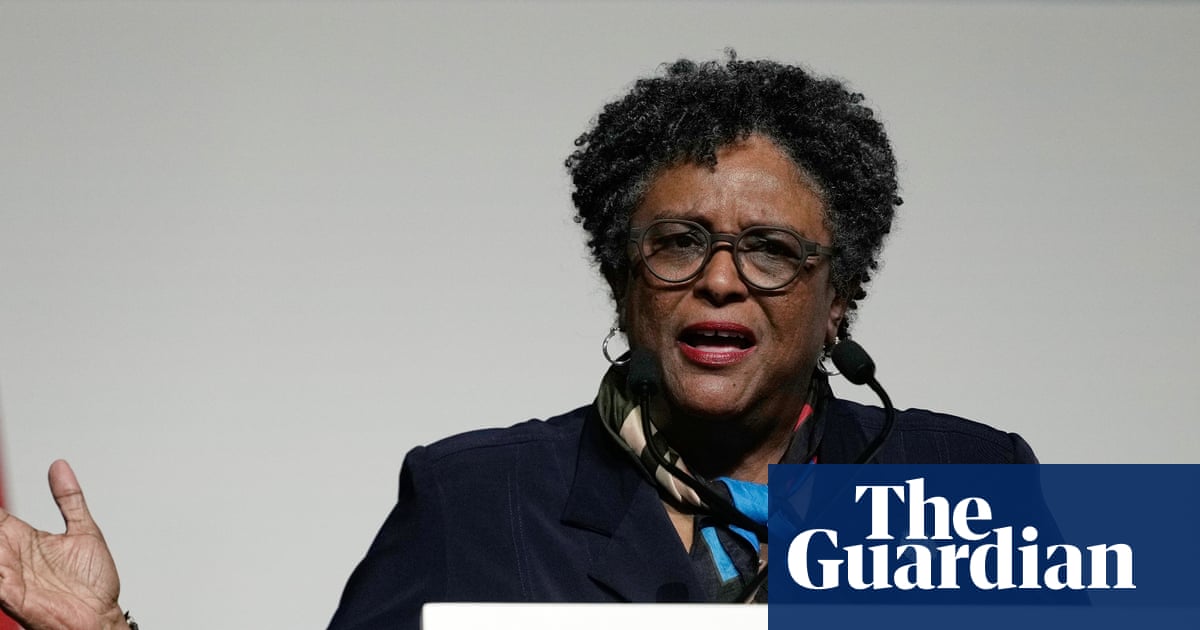
Barbados PM Mia Mottley urged global citizens to demand methane cuts at the Cop31 summit in Antalya, Turkey. She said, “If we can control methane, we can reduce temperature rises by 0.3C to 0.5C.” Mottley wants 1.5 billion signatures on a petition to force politicians to take urgent climate action.
Staying silent on the climate crisis is pushing the world closer to disaster, the prime minister of Barbados, Mia Mottley, has said, urging people around the world to force a confrontation with politicians who are failing to do what is needed.
Taking action on methane emissions could be the emergency brake that gives the world time to decarbonise, Mottley said. She is urging people to sign a global petition to cut the powerful greenhouse gas.
She hopes to gather 1.5bn responses to her petition, in an echo of the 1.5C temperature limit countries have pledged to protect. “We have to let them know the good news: that if we can control methane, we can reduce temperature [rises] by 0.3C to 0.5C,” she said during an interview at the Cop31 UN climate summit, which is taking place in Antalya, Turkey. “We can buy time to continue decarbonising.”
Mottley, a charismatic leader who has challenged former colonial powers over slavery reparations, gained global recognition five years ago when she criticised rich countries for failing poor and vulnerable people on the climate crisis.
“Ordinary people have to be able to say what their view is with respect to living on this Earth,” she said. “I hope that by calling on ordinary people to speak out where leaders have failed to lead, we can see the kind of momentum that will cause all of us to reflect on what we’re doing as countries, and prioritise – in ways that do not compromise other aspects of our development – the efforts that are needed [on the climate].”
The “cancer of indifference” to the climate crisis, she said, would push the world closer to the brink. “We need to break [the climate crisis] down into ordinary simple language, so people understand what is at stake, either by their silence, their inaction, or indeed by their actions.
“This [petition] is not to undermine any government. It is really for us to get a sounding as a global community about how ordinary people feel about their future, how ordinary people want to embrace their future, or be sensitive to the realities of what might be their future if they continue to be inactive or silent.”
Mottley is frustrated by the chasm between leaders’ promises to act on greenhouse gas emissions, and the reality of continued reliance on fossil fuels. “We are on a train track, and all we are doing is jumping on and off, when the train is coming, and at some point the train is going to hit us,” she said. “Is this good enough management?”
The Cop31 talks are now entering their second week, with a draft text expected on Monday for a “cover decision”, a final document drawing together the main outcomes from the discussions and a series of resolutions to take stronger action on the climate.
These could include: a pledge to derive 35% of global energy from electricity by 2035; recognition that the world will “overshoot” the target of limiting heating to 1.5C above preindustrial levels; and measures to make it easier for the poorest and most vulnerable countries to access the financial assistance they have been promised.
Discussions on methane are still on the table, and though no new comprehensive treaty of the kind called for by Mottley will be signed at Cop31, the final outcome could reinforce efforts to reduce emissions the gas.
Durwood Zaelke, president of the Institute for Governance and Sustainable Development, a thinktank, said it was essential to address the release of methane, a greenhouse gas 80 times more powerful than carbon dioxide at heating the atmosphere, which comes from coalmines, oil and gas extraction sites, animal husbandry and landfill facilities.
“There is one way, and one way only, to slow warming in the near-term, and that’s to cut methane emissions, according to the best available science,” he said. “It’s clear that voluntary measures are not enough. We need a binding international agreement to cut methane.”
Mottley also endorsed a proposal put forward by Ngozi Okonjo-Iweala, director-general of the World Trade Organization, after the Nepal glacier collapse in August: that when disasters strike, banks should waive the fees they charge on the remittances sent by overseas workers back to their families.
In many developing countries, remittance money sent home by migrants is a key source of income, but banks charge substantial fees for the service. Okonjo-Iweala estimates that if the banks had waived these fees for two months on money sent home by Nepalese migrants after the glacier collapse, an additional $126m to $144m could have been raised, more than double the $49m in immediate relief from the US and others.
Banks and fossil fuel companies should understand their social obligations, Mottley said. “I hope we can have a greater sensitivity from the financial community as to what is required of them. You can’t be making trillions of dollars in profits and not be standing up where major disasters happen like this.