
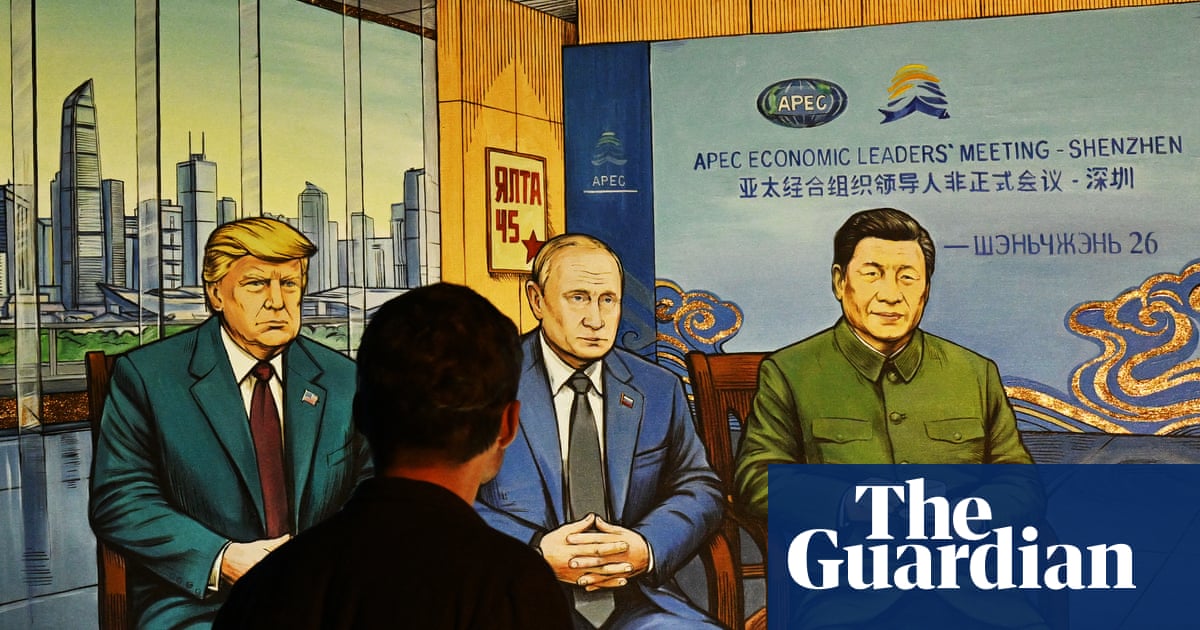
Australia endorsed the historic summit between Donald Trump, Xi Jinping and Vladimir Putin in Shenzhen this week. Prime Minister Anthony Albanese said, “We think that dialogue is a good thing and we await the outcome of that dialogue.” European leaders expressed reservations, fearing the talks might lead to unjust peace.
Australia has endorsed this week’s historic summit between Donald Trump, Xi Jinping and Vladimir Putin in China, even as European leaders warn that the US president must not make major concessions over the war in Ukraine.
The three-way summit is planned to take place in Shenzhen, where the leaders will gather for the Asia-Pacific Economic Cooperation (Apec) meeting. Likened to the 1945 summit at Yalta, the Ukrainian president, Volodymyr Zelenskyy, has warned the talks must not lead to a redistribution of influence among world powers or the abandonment of his country, more than four years into the war sparked by Putin’s full-scale invasion.
Speaking in Manila on Sunday, the Australian prime minister, Anthony Albanese, welcomed the talks taking place but insisted the clear message to Putin was that the war should end.
Albanese, in the Philippines before a meeting of Quad leaders and talks with south-east Asian leaders at the Asean summit, left open the possibility of joining an Apec group photo with Putin if China wished for it to go ahead.
“We think that dialogue is a good thing and we await the outcome of that dialogue,” he said.
“It’s obviously quite significant, the fact that President Trump will be at Asean as well as at Apec, and that we’ll have a Quad leaders meeting as well.
“We want to see something constructive come out of that, including we want to see a de-escalation in the conflicts around the world.”
German’s chancellor, Friedrich Merz, expressed hesitation about the talks at a meeting of EU leaders on Friday.
“I want to state our message to the US very clearly once again: please, no surprises,” he said. “Stay on Team Europe and Team Ukraine, and let us work together for a genuine peace in Ukraine.”
France’s president, Emmanuel Macron, warned against forcing “an unjust peace” on Ukraine and, by extension, all of Europe.
“That is the spirit of defeat,” Macron said. “That is a recipe for another war.”
Zelensky has warned that the meeting must not turn into “Yalta 2, 3, 4”, invoking the conference in Crimea when the then US president, Franklin D Roosevelt, Britain’s Winston Churchill and the Soviet leader Joseph Stalin carved up influence across war-ravaged Europe.
The historian Timothy Garton Ash has called the trilateral summit, organised after a proposal by Putin last month, “a sort of parody” of Yalta, even as analysts say decisions on the future of Ukraine or China’s ambitions to take control of Taiwan without their involvement is unlikely.
Albanese said the summit would not undercut a growing push by countries including Australia and Canada for middle powers to have greater influence in world affairs.
“We’ll continue to engage with like-minded countries,” he said. “There are two super powers in the world.
“What’s important about the struggle of the people of Ukraine is that they’re not just standing up for their own sovereignty; they’re standing up for the international rule of law.”
Asked if he would join the so-called “family photo” of Apec leaders if Putin took part, Albanese said he would consider the wishes of China as the host nation. But he said the Russian president should know Australia’s opposition to the invasion.
“If he’s in a room where I am, I’m sure they’ll hear my contribution,” Albanese said.
After the G20 foreign ministers’ meeting, Australia’s Penny Wong joined with European and Canadian counterparts to avoid a group photo. It was cancelled by US officials when a third of participants declined to stand alongside the Russian foreign minister, Sergei Lavrov.
Albanese signed a new defence agreement with the Philippines on Sunday, visiting the supply ship HMAS Stalwart in the Port of Manila. Australia is helping to strengthen the Philippines’ defensive capability against Chinese aggression.
More freedom-of-navigation naval exercises are planned in an attempt to counter Beijing’s efforts to influence the South and East China seas.