
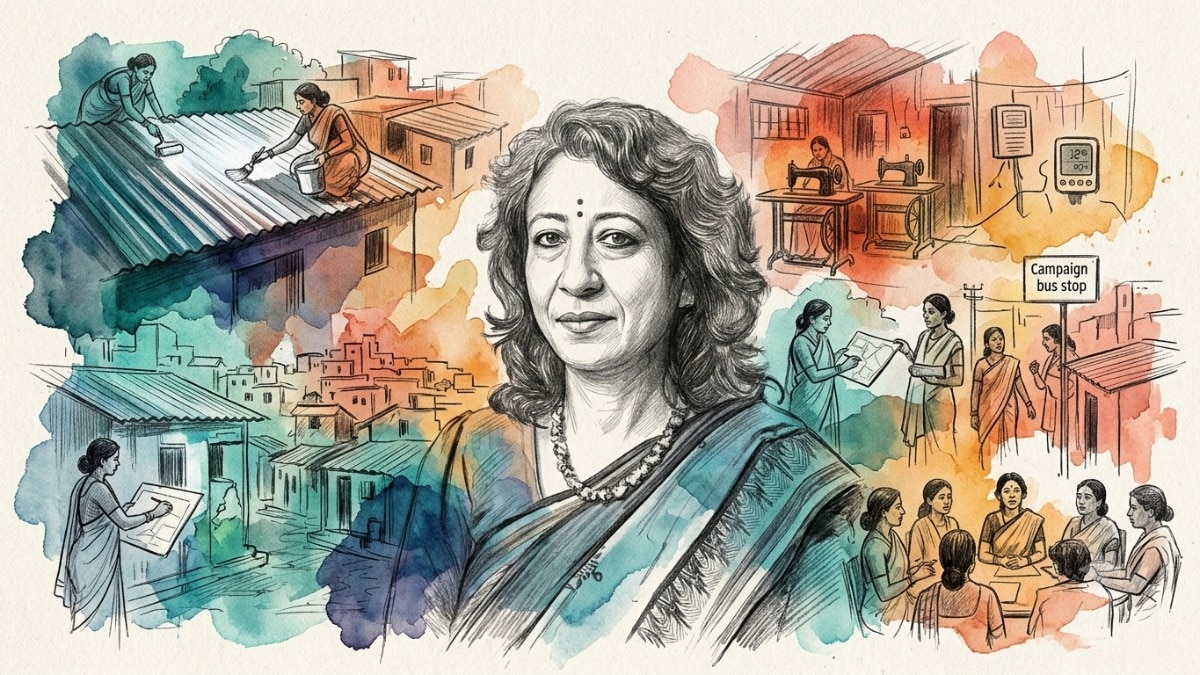
Bijal Brahmbhatt leads the Mahila Housing Trust, an Earthshot Prize 2026 finalist helping low-income women fight extreme heat. The trust uses cool roofs and climate insurance to protect residents. Brahmbhatt said, "I was young, rebellious and constantly questioning things." The five winners will be announced in Mumbai on November 17.
Bijal Brahmbhatt had no fixed career plan after graduating as a civil engineer in 1992. Today, she leads Mahila Housing Trust, an Earthshot Prize 2026 finalist helping low-income women tackle extreme heat through cool roofs, climate insurance and community-led action. Her journey transformed how she understands engineering and urban development.
When Bijal Brahmbhatt graduated as a civil engineer in 1992, she thought engineering happened on drawing boards and construction sites. More than three decades later, she knows some of the most important urban planning decisions can begin in a women's meeting in a slum, where residents decide which problem to take to the authorities first.
That change in perspective has shaped her life's work. As director of Ahmedabad-based Mahila Housing Trust (MHT), Brahmbhatt is helping low-income women tackle extreme heat through reflective roofs, community-led Heat Action Plans and climate insurance.
The organisation has been named one of India's two finalists for the 2026 Earthshot Prize, founded by Prince William.
The recognition comes as the environmental award arrives in India for the first time. The five winners will be announced in Mumbai on November 17.
But Brahmbhatt's story is not simply about an engineer who found her calling in climate action. It is about a professional who learnt that technical expertise means little if it ignores the people whose lives a solution is supposed to improve.
THE ENGINEER WHO HAD TO LEARN FROM MASONS
"Like most young people graduating at that time, I did not really know what I wanted my career, or my life, to look like. I tried different things," she says, in a conversation with India Today Digital.
After graduating in 1992, Brahmbhatt taught students preparing to become engineers before moving to construction sites. At a time when women engineers on-site were rare, employers hesitated to send her there, citing safety concerns. A smaller company eventually gave her the opportunity through a professor's reference.
"I was young, rebellious and constantly questioning things, particularly around what could make the world a more just place for women," she recalls.
Her two years with a private construction firm brought an education of their own. Conversations sometimes stopped when she entered a site. Some workers looked at her with curiosity, others with amusement.
She also discovered how much her degree had left out.
"I may have been the supervisor, but there were things I had to learn from the mason. If you are doing carpentry, the carpenter is your teacher. Your degree cannot teach you everything. That brought a lot of humility."
The experience left her questioning not just who got taken seriously in a male-dominated profession, but what engineering was supposed to achieve in the first place.
"In college, we learnt to calculate loads and design structures, but nobody really asked us who would live in those buildings or what their lives would be like."
That question would follow her into a very different kind of workplace.
A HOUSE IS MORE THAN WALLS AND A ROOF
In 1998, Brahmbhatt's father, an academic involved in the voluntary sector, introduced her to Renana Jhabvala of the Self-Employed Women's Association (SEWA). Jhabvala proposed that she join Mahila Housing Trust, an independent organisation working on the housing and habitat needs of low-income women.
"I still remember being surprised by how quickly she trusted me. By the end of our first conversation, she had asked me to join MHT," she says.
The organisation was then working in just three slum communities in Ahmedabad, with two other staff members besides Brahmbhatt.
"There was no blueprint. The idea was to listen to what women needed and work from there."
The women she met began changing how she understood a house. For an engineer, it might be a structure with a foundation, walls and a roof. For a woman earning a living from home, it could also be a workshop, a storehouse and a productive asset.
"She may stitch garments, roll agarbattis or pack goods there. So, a leaking roof or poor ventilation is not just a housing problem; it can directly affect her income," she explains.
Brahmbhatt also found an organisation where marriage and motherhood did not have to compete with professional ambition. She had married and started a family around the time she joined MHT.
"It was a women's organisation, but it was never anti-men. It was feminist without having to constantly say that it was feminist."
That experience shaped her understanding of what an empowered woman could look like. At MHT, she learnt to listen before designing and to recognise that people who experience a problem often understand its complexities better than an outsider.
WHEN WOMEN MADE THE COST OF HEAT VISIBLE
Around 2015, the women MHT worked with began speaking increasingly about extreme heat. Homes with metal-sheet or concrete roofs and little ventilation were becoming unbearable during summer.
The effects reached far beyond discomfort. Women were losing working hours, spending more on electricity and cold drinking water, and taking on additional care responsibilities for children and older family members.
"What struck me was that many women simply accepted heat as part of summer. Some even described it as an act of God. So, we felt we needed to make this invisible problem visible."
MHT trained women to use temperature loggers in their homes and began documenting the economic cost of rising temperatures. Women reported losing 23 per cent of their income during the hot season, while their expenses increased, Brahmbhatt says.
"Once you put those numbers alongside a woman trying to work at her sewing machine under a hot roof, heat is no longer just an environmental issue. It becomes an issue of health, livelihoods and economic security."
That evidence changed how MHT approached the problem. Reflective cool roofs could reduce indoor temperatures by up to 5°C, but cooling a house would not compensate a woman for wages lost when the heat made working impossible.
"A heat alert might advise people to stay indoors, but for many women, indoors can be the hottest place because they live under metal sheet or concrete roofs. And staying home does not mean they can stop working. If they stop working, they lose income," she says.
MHT subsequently developed parametric heat insurance with its partners. When an agreed temperature threshold is crossed, a fixed payment is triggered without requiring women to file a traditional claim or prove their individual losses.
Brahmbhatt says around 2,000 women policyholders received payouts in 2024 after the threshold was breached. She puts the current reach of the insurance at 49,000 women in Delhi and Gujarat.
"What women have taught us is that climate protection has to address both the home and the household budget."
THE WOMEN WHO BECAME THEIR OWN URBAN PLANNERS
One of Brahmbhatt's most telling examples of community leadership comes from Odhav ward in Ahmedabad.
A group of women trained by MHT identified the need for a bus stop in their area. Led by Minaben, they surveyed around 1,000 households, mapped GPS data to build their case and approached middle-class households outside the settlement, securing consent from around 400 of them.
They then kept following up with the authorities until the Ahmedabad Municipal Corporation accepted their application and built the bus stop.
"None of these women had a degree in urban planning, but what they did was exactly what a good planner would do: gather evidence, build support and navigate the system."
For Brahmbhatt, this is what community-led development can achieve when women have access to information and the tools to make their case. The women were not simply receiving a service. They were identifying a need, gathering evidence and negotiating with the institution responsible for addressing it.
"Leadership does not necessarily come from education, designation or social background. It comes from within," she says.
The challenge is getting governments to treat such solutions as part of urban planning rather than welfare work. MHT's work in Jodhpur helped inform a Heat Action Plan that included cool roofs, cooling shelters, parks and green spaces, with vulnerable wards prioritised.
Brahmbhatt says its cooling shelter model influenced Rajasthan's decision to build 41 shelters, while Maharashtra now supports heat insurance for women living below the poverty line.
Yet getting a successful pilot adopted is only the beginning. Government officers change, priorities shift and programmes can lose momentum.
"A pilot is relatively easy. Getting a city to adopt it, fund it and sustain it is the real work."
WHAT ENGINEERING MEANS TO HER NOW
MHT aims to protect three million households with cool roofs by 2030 and reach 300,000 women with climate insurance, according to Brahmbhatt. The Earthshot recognition could help the organisation build partnerships and expand its model.
But she sees the achievement as belonging to the women who helped develop it.
In 1992, she could not have imagined working with insurers, researchers and city governments on temperature thresholds, weather data and climate resilience. Nor could she have predicted how much she would learn from women whose technical qualifications might not match her own.
Today, those women are collecting heat data to inform city-level action plans and even helping ground-truth AI models.
"In an age where we are increasingly talking about artificial intelligence, we should not lose the human intelligence and lived experience that these women bring."
It is perhaps the clearest expression of how far her understanding of engineering has travelled. The profession still needs technical knowledge, data and sound design. But Brahmbhatt believes those things work best when the people living with the problem help shape the answer.
Her advice to young women engineers is equally direct.
"You will sometimes be underestimated. Let that make you better at your work, never smaller."