
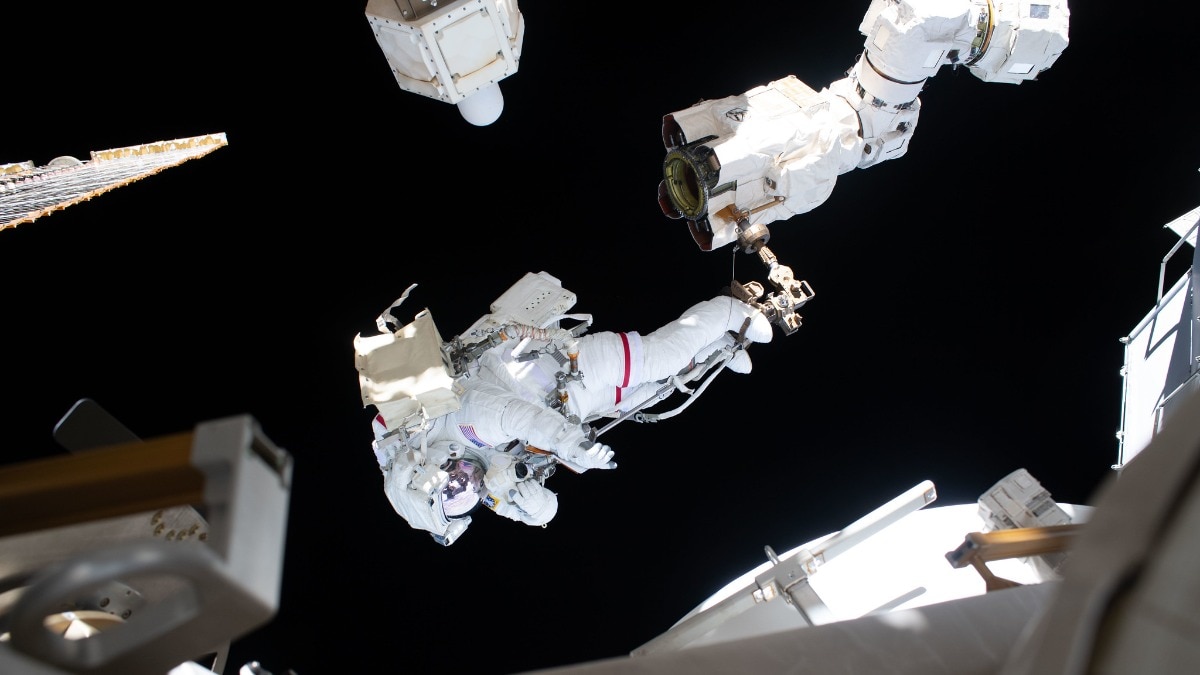
Nasa astronauts aboard the International Space Station are printing blood vessel cells and studying cancer growth. The Expedition 75 crew used microgravity to build three-dimensional tissues for future medical treatments. Meanwhile, astronauts Anil Menon and Joshua Kutryk prepared for two spacewalks scheduled for October 29 and November 5 to install arrays.
Astronauts aboard the International Space Station (ISS) are printing blood vessel cells, studying cancer and preparing for spacewalks as research in orbit continues to explore ways to improve healthcare and support future space missions.
In its recent update from space, Nasa said the Expedition 75 crew carried out experiments on human cells, cancer growth and the body's response to exercise in weightlessness.
HOW CAN SPACE HELP MEDICAL RESEARCH?
Nasa astronauts Luke Delaney and Jessica Watkins worked with a specialised machine that prints tissue from living cells, preparing blood vessel cells and mixing them with a material called bioink before storing the samples in a freezer for preservation.
The research takes advantage of microgravity, the condition in which objects appear weightless in orbit.
Without Earth's usual pull, cells can form three-dimensional structures more easily, helping scientists explore ways to build human tissues and organs for medical treatment.
Such techniques could eventually help develop replacement tissues for patients, although more research is needed before they can be widely used in healthcare.
Delaney also worked on a separate cancer experiment, processing tumour samples inside a specialised laboratory enclosure aboard the station. The samples were preserved for further analysis on Earth.
By studying how cancer cells grow and respond to treatment in space, researchers hope to better understand the changes that drive cancer and potentially develop more targeted therapies.
ASTRONAUTS PREPARE FOR TWO SPACEWALKS
Alongside the experiments, Nasa astronaut Anil Menon inspected tools and safety tethers inside the station's Quest airlock ahead of two planned spacewalks with Canadian Space Agency (CSA) astronaut Joshua Kutryk.
The spacewalks are scheduled for October 29 and November 5, during which the astronauts will install roll-out solar arrays, which unfold like large mats, to increase the station's electricity-generating capacity, increasing the power generation capability by up to 30%.
Kutryk also took part in an exercise study using equipment that mimics the forces experienced when lifting weights on Earth, while a motion-capture system recorded his movements as he exercised.
The research could help scientists improve workout routines for astronauts, who must protect their muscles and physical strength during long stays in space.
It may also offer insights that could benefit sports technology on Earth.