
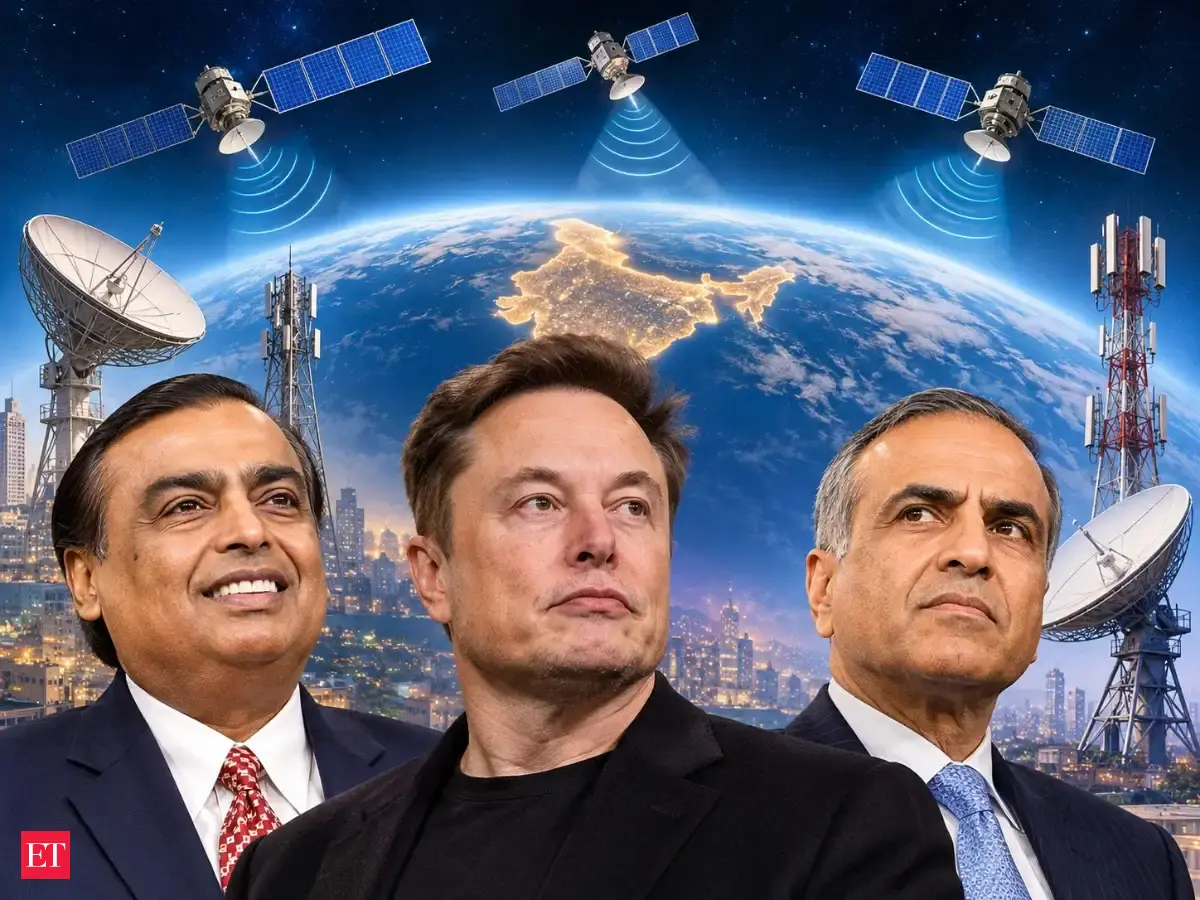
India’s satellite internet market is heating up as Airtel, Jio, and Starlink compete for dominance. A major debate has started over who should control the kill switch for connectivity. Sunil Bharti Mittal said, "this ability must remain with India." The government is now weighing final clearances for these three companies.
Two big battles are raging as India's commercial satcom business gets ready to launch. One is for customers, market share and the lucrative business of connecting places beyond the reach of fibre and mobile towers. The other is for control over the infrastructure carrying India's communications traffic, and the 'kill switch'.
The battle for India's skies is no longer only about who can provide the best internet service to the remotest parts of the country, but also about who has the power to switch it off.
Airtel-backed Eutelsat OneWeb, Reliance Jio's satellite venture and Elon Musk's Starlink have gone all out to capture this big emerging market. With the compeittors' lineup more or less set, a big question has begun doing the rounds: Should a foreign company have the ability to control, restrict or 'kill' connectivity within Indian territory?
Airtel's Sunil Bharti Mittal recently told ET that this ability must remain with India, even as he insisted that Airtel is ahead in the approvals race so far. Meanwhile, the other two contenders -- Musk and Mukesh Ambani -- had a go at each other over the matter a few weeks ago.
So, as the government weighs the final clearances, the India broadband battle is also aquiring a business ambition vs national sovereignty angle to it.
The three contenders are coming in with differing plans and are looking at the matter from different angles. Here is how the battle lines are being drawn.
Bharti Airtel and Eutelsat OneWebMittal's strongest suit has been the head-start he has had on infrastructure and regulatory engagement.
OneWeb has established gateways at Mehsana in Gujarat and Thoothukudi in Tamil Nadu, along with points of presence in Mumbai and Chennai. Its primary focus is the business-to-business market, including enterprises and institutional customers who need more reliable connectivity than conventional networks.
Mittal said his company had applied five years ago and had its ground infrastructure ready for three years. Besides, OneWeb was ready to activate its Indian services once the government granted permission, ET quoted him as saying in an October report.
Reliance Jio and SESJio, on the other hand, has a combination of medium-earth-orbit connectivity through its partnership with Luxembourg-based SES and a longer-term target to build its own low-earth-orbit (LEO) constellation.
The SES partnership gives Jio a way into enterprise and other institutional connectivity markets, while its planned indigenous satellite network could expand its reach and strategic capabilities.
According to an ET report (October 2), Jio is considering a constellation of 1,600-1,650 satellites, with an estimated investment of $10-15 billion.
Jio's formidable terrestrial telecom distribution network and experience in cheap data services might also become key advantages when satellite broadband enters the next stage, i.e. moves beyond specialised customers, the report said.
StarlinkMusk's SpaceX-owned satellite service has a different proposition: a large global LEO constellation and a direct-to-consumer broadband model.
Its strong point is in reaching homes, businesses and people who lack dependable overland connectivity. Starlink has already secured its GMPCS licence and got authorisation for its first-generation constellation of 4,408 satellites. Commercial operations in India, however, remain dependent on spectrum assignment and pending security clearances.
Starlink has also sought approval for a much larger constellation, with nearly 30,000 satellites. The company has said on record that it has spent more than five years working with Indian govt and is ready to provide high-speed internet, Reuters reported.
The commercial rivalry is also becoming a contest over technological sovereignty. In this regard, Jio's proposed 1,600-satellite constellation is particularly significant because it could give India a domestically controlled LEO network.
Jio is targeting a September 2027 test flight, with mass deployment expected from early 2028. It aims to have 400-450 satellites in orbit by 2030 and complete the constellation by 2035.
The network is intended to provide high-speed broadband to underserved areas, alongside capabilities for cellular backhaul and direct-to-device connectivity, ET reported in September.
Who controls the kill switch?This is where a commercial rivalry is spilling into the geopolitical domain.
According to the govt, its worries are not only about foreign ownership but also about the ability of these companies to control satellite networks, route Indian users' data through foreign gateways and potentially interrupt connectivity, without the Indian govt having any control.
Starlink's use of laser-based inter-satellite links has become a bone of contention. This technology allows satellites to communicate directly with one another, creating a mesh network in space. According to an earlier ET report, Indian security agencies are concerned that such links could allow data originating in India to bypass domestic gateways.
The Indian govt is also wary of the ability of an overseas operator to remotely alter coverage or restrict services during a conflict.
It may be noted here that Eutelsat OneWeb and Jio-SES do not use this particular technology.
Modi govt is also looking at a hardware-based security checkpoint through which satellite traffic from foreign providers would have to pass, ET reported in late October.
The proposed device could be installed at subscriber locations or satellite ground stations, giving Indian authorities greater oversight of traffic and the ability to enforce domestic security requirements.
The Indian govt is of the firm view that satellite connectivity is a critical infra, especially during wartime when access to communications can influence outcomes.
India's balancing actAt a recent interview to ET, Mittal put this aspect in perspective. He said that given the growing importance of space-based infrastructure in warfare, countries must retain control over communications networks operating within their territories.
He also advocated for multiple providers rather than dependence on a single foreign company, drawing attention to the fact that a network that can connect remote Indian villages can also become strategically important during a national security crisis.
The government, meanwhile, insists that the rules are same for all.
In September, the Digital Communications Commission okayed a rule proposing a spectrum usage charge of 5% of adjusted gross revenue, with a one-percentage-point concession for services in notified rural and remote areas. However, spectrum assignment and individual security clearances will continue to remain a must before commercial operations can begin, it said.
The battle has spilled into the public domain and divided opinions in India. Musk accused unnamed Indian business interests (apparently Ambani's Jio) of obstructing Starlink's entry to protect their market positions. India rubbished his allegations of discrimination, insisting that not just Musk but all three contenders were being put through the same security tests.
Reliance, who has been at the receiving end of Musk's jibe, too said it welcomed competition and was awaiting the same clearances.
Satellite broadband is not going to replace terrestrial networks. It will only complement them. But its strategic importance will only increase, and therefore, the battle will only intensify.
The winner of this raging battle may not be the company that owns the most satellites or the fastest internet. It may be the one whose control/kill switch spiel turns out to be a better sell.