
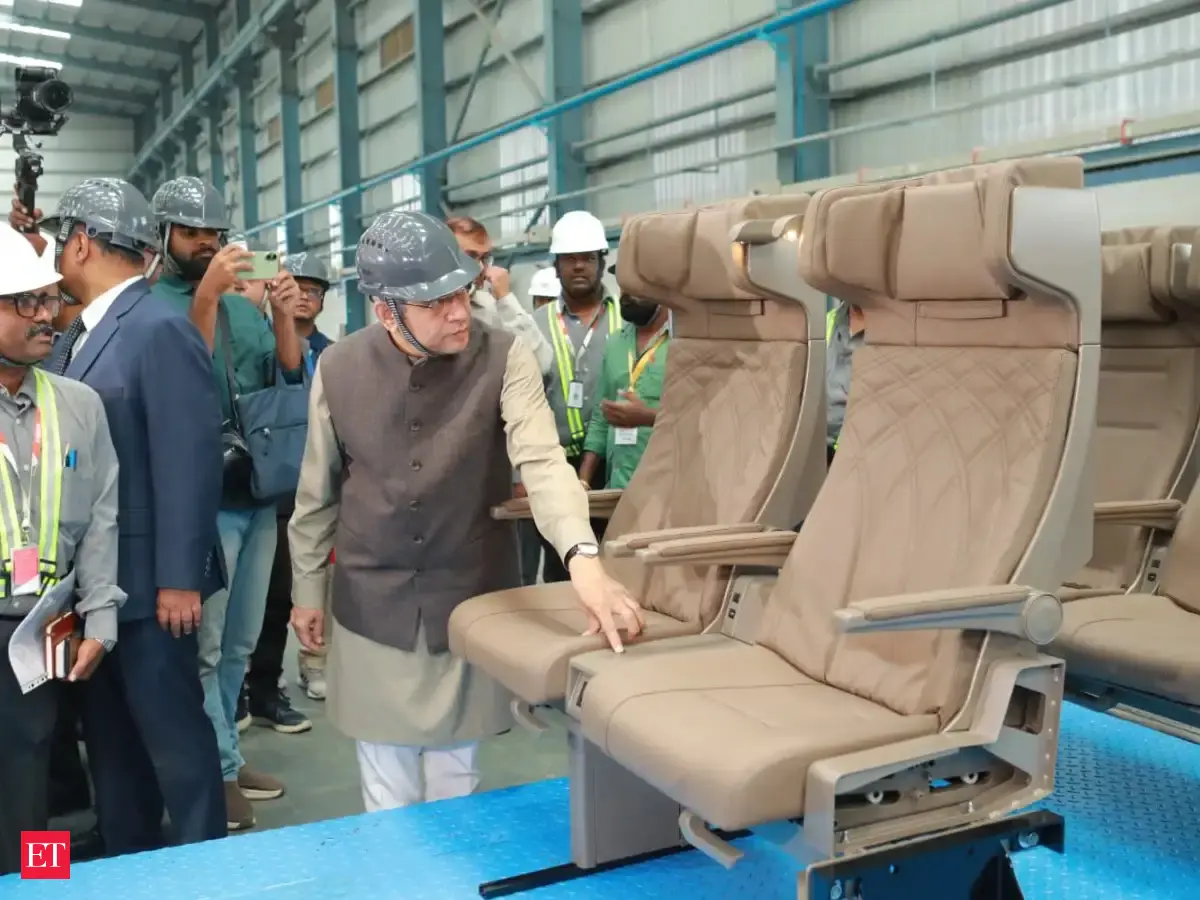
Railway Minister Ashwini Vaishnaw on Sunday reviewed the manufacturing of India's first indigenously built high-speed train, the Bharat Bullet Train, at BEML's Bengaluru facility. Designed for the Mumbai-Ahmedabad corridor, the eight-coach train will carry 557 passengers. It features advanced safety systems and special provisions for persons with disabilities during travel.
Bharat Bullet Train is being developed for the Mumbai-Ahmedabad High Speed Rail corridor, emphasizing indigenous technology. Railway Minister Ashwini Vaishnaw reviewed various production processes at BEML's Aditya manufacturing facility in Bengaluru. The train will offer advanced passenger amenities and adhere to stringent safety standards during its operation. It is designed to accommodate about 557 passengers, including special provisions for persons with disabilities.
Bengaluru:Railway Minister Ashwini Vaishnaw on Sunday reviewed the manufacturing of India's first indigenously built high-speed train, the Bharat Bullet Train (B-28), at BEML's Aditya manufacturing facility in Bengaluru.
The train is being developed for the Mumbai-Ahmedabad High Speed Rail corridor and is being positioned as a major step towards building indigenous high-speed rail technology in India. The project combines advanced engineering, local manufacturing capabilities and passenger-centric design tailored to Indian operating conditions, an official press release said.
During the visit, Vaishnaw reviewed the specialised manufacturing infrastructure, including precision-engineered jigs and fixtures used for carbody fabrication. He witnessed key stages of production, such as underframe, sidewall and roof assembly, final car assembly, surface preparation and treatment processes that are critical to meeting the stringent quality and safety standards required for high-speed rail operations, the release said.
The minister also witnessed a "squeeze test", a critical quality-assurance process in which the train carbody is subjected to controlled compressive and tensile forces to assess structural strength, rigidity and dimensional stability. He reviewed the manufacturing of side and roof modules and observed their integration into the final assembly process.
Vaishnaw inspected passenger seating and reviewed key onboard systems, including the heating, ventilation and air-conditioning (HVAC) system, couplers and other critical train equipment.
According to the release, the eight-coach train will have a maximum test speed of 280 kmph and an operational speed of 249 kmph. The trainset, around 202 metres long, will accommodate about 557 passengers, including dedicated spaces for persons with reduced mobility. It will comprise seven standard-class coaches with 3x2 seating and one executive-class coach with 2x2 seating.
The train will feature an intelligent onboard control system, passenger information displays in English, Hindi and regional languages, automated announcements, emergency communication systems and a Wi-Fi-based infotainment platform.
Designed with passenger comfort in mind, the train will offer ergonomic seating, wide windows, LED lighting, overhead luggage racks, charging points and bio-digester toilets. Accessibility features include level boarding, retractable footsteps, wheelchair-friendly doors, dedicated seating and toilets for Divyangjan passengers, and Braille-enabled signage.
The train will operate on a 25 kV AC traction system and use regenerative braking technology to improve energy efficiency. Its aerodynamic design, developed using computational fluid dynamics simulations, is aimed at reducing air resistance, turbulence, tunnel pressure waves and noise levels, ensuring a quieter and smoother journey, the release added.