
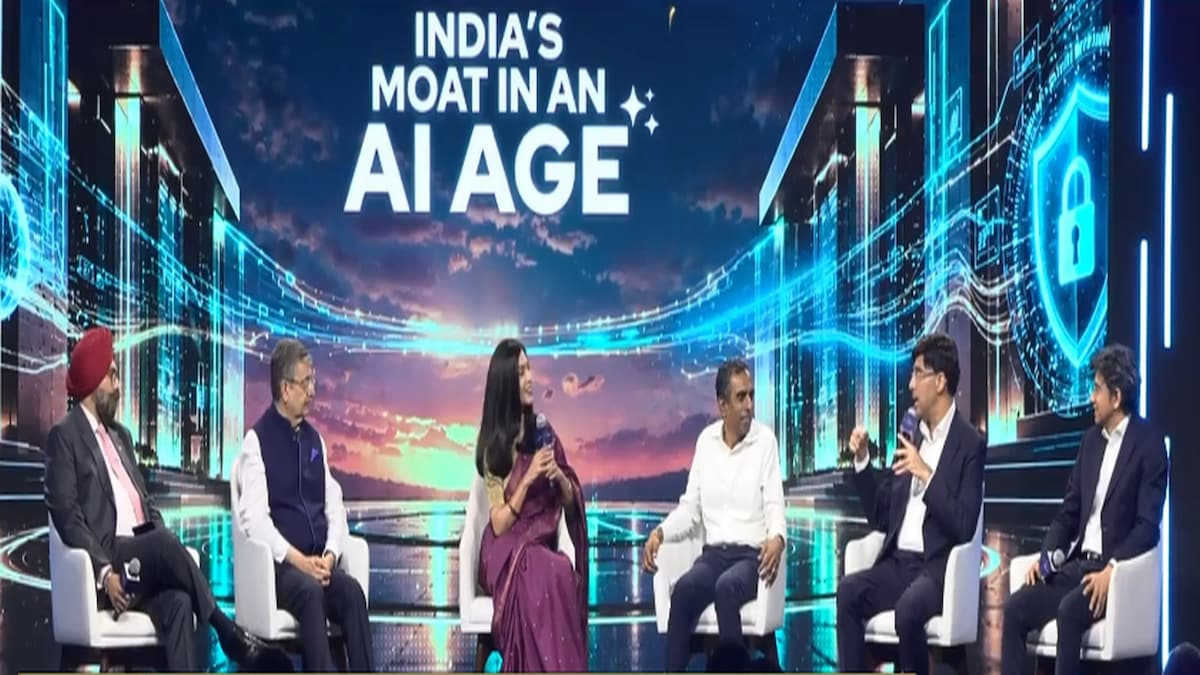
Uday Kotak urged India to boost investments in AI and manufacturing to build resilience amid global uncertainty. Speaking at the IBLA Collective, he noted that US power constraints could give India breathing space. Other leaders added that policy consistency and local innovation are key to attracting significant global capital.
India must use the window created by shifting global dynamics to accelerate its investments in artificial intelligence (AI), research, innovation and manufacturing, while building greater resilience against geopolitical and economic uncertainty, leading business leaders said at the CNBC-TV18 India Business Leader Awards (IBLA) Collective.
Uday Kotak, Founder and Director of Kotak Mahindra Bank, said the changing global landscape, including pressure on the US AI infrastructure expansion, could give India some breathing space to catch up. However, he cautioned against viewing India merely as an anti-AI investment destination, urging businesses to focus on technology, production and manufacturing.
Kotak also called for Indian companies to explore joint ventures with leading Chinese companies and shift manufacturing facilities to India. He stressed the need to identify sectors where India could establish a global competitive advantage and attract investments.
Vellayan Subbiah, Chairman of Cholamandalam Investment, CG Power & Industrial Solutions and Tube Investments, said India must be at the forefront of the AI revolution, with a focus on both affordable AI for the masses and sovereign AI capabilities. He also emphasised the need for Indian companies to develop and retain intellectual property (IP) domestically rather than limiting their role to manufacturing and global capability centres.
PD Singh, CEO of India & South Asia at Standard Chartered Bank, said significant global capital was waiting to enter India, but policy consistency, faster approvals and better infrastructure would be critical to unlocking investments.
Groww CEO Lalit Keshre expressed optimism about India's growth prospects and AI ecosystem, while chess grandmaster Viswanathan Anand highlighted the importance of mass education and human capabilities in an AI-driven world.
The panel discussion also covered foreign investor sentiment, taxation, currency movements, manufacturing opportunities and the economic outlook for 2027.
This is the excerpt of the panel discussion.
Q: Mr Kotak, since your previous forecasts have all been right and you've been prescient, let's start by asking you what you're now forecasting for the economy and the Indian markets.
Uday Kotak: Shereen, you at CNBC-TV18 have impeccable timing. You decided to have this meeting on the day of the US midterm results, and one thing that seems to be clear is the Democratic win versus the Republicans, which should slow down the speed at which new data centre capacity comes up in the US because of the huge pressure on power consumption, which is a major factor for data. It gives India some breathing room to catch up.
I am hopeful that India uses this time to catch up in many areas where it needs to. At the same time, we really need to, as I see it, take this opportunity not just to hope for an anti-AI trade to hold up Indian equity markets, but to take positive steps towards focusing on research, innovation, technology, production and manufacturing, including what my friend Vellayan is doing in semiconductors. We need to go all out and catch up as quickly as we can.
I do believe that the fundamental narrative in the US has come under pressure. Within the last year, there has been no change in the fact that geopolitics continues to dominate the world of finance and the real economy. Therefore, I would say that as we move into the new year, we should do so with some cautious optimism but, even more importantly, with resilience as the mantra for every business and for the Indian economy as a whole.
Q: You talked about moving into the new year, and we're now entering the new Samvat. Diwali is around the corner, and we're looking ahead with cautious optimism, Mr Kotak. But I want to double down on the point that you made, and I will get the rest of the panel to comment on that as well. This idea that India should be seen as the anti-AI play, is that really the way we should be thinking about this? Should we let the world fall out of love with AI before it falls in love with India again? Is that really how we should be approaching this?
Uday Kotak: No, I think we should look at this constructively, and whatever time we get to catch up, we must use it quickly and productively.
We do have the risk that the world gets dominated by two powers, the US and China. India needs to be clear, at some level, about how to use its strengths to leverage opportunities for itself. We should be rethinking our strategy, including with China, from an economic point of view.
I would welcome Indian businesses going out there and entering into joint ventures with top-end Chinese companies in various sectors, and moving manufacturing facilities to India. The Chinese learned from the Americans. Indians need to learn, whether it is from the Chinese or the Americans, but set up things in this country.
Q: And we've had that change with the Press Note 3 relaxations that have come in. So now joint ventures and foreign investment from China are, of course, being allowed without much friction. But before I get Vellayan and PD to comment on what you just said, the big buzz in the market at this point in time, or the clamour, especially as far as the markets are concerned, is that there should be a relaxation in long-term capital gains tax to draw foreign investors back into the Indian equity markets. Do you think that is a fair ask? Secondly, if that were to happen, will it change FPI sentiment? Will it draw FPIs back?
Uday Kotak: I think there are two points we need to keep in mind. One is capital gains tax parity between foreign institutional investors and Indian investors.
Here, if at all a distinction has to be made, my view is that foreign investors' capital gains tax could be dollar-currency-based rather than rupee-currency-based, while Indian investors' capital gains tax can continue to be rupee-currency-based. So that is something that still maintains parity but respects the currency of the respective countries.
As an addendum to that, we may want to rethink or consider a relaxation for sovereign funds and pension funds that don't pay taxation in their home markets. They could be considered in a separate category without taxation on the FPI side.
So, two points on the FPI side: dollar-based taxation and, if exemptions have to be given, a specific window, as we have done for the Abu Dhabi Investment Authority, for sovereign funds and pension funds, since they are not taxable in their home markets. They could be treated as a separate category.
On the second point, I think that in India, while there is a clamour for a reduction in capital gains tax for Indian investors from 12.5%, plus surcharge, which comes to around 14%, the taxation on interest income is at the highest marginal rate of 39%.
I think the gap between around 14% and 39% is very wide. That needs to be narrowed.
I'm not suggesting an increase in long-term capital gains tax on equities, but this gap is too wide.
And I am saying this: there has to be lower taxation on equity risk versus debt risk, but the gap between 39% and 14% is very wide.
Q: Vellayan, one, what do you believe is the imperative at this point in time? Two, what is the sense that you get in terms of business confidence? The expectation is that we're still growing at 7.8% at this point in time. The macros are resilient. We've got strong GST numbers. High-frequency data continues to hold up. What is the sense that you're getting from the ground as we close out 2026 and look ahead to 2027?
Vellayan Subbiah: First, on the earlier question you had about AI versus anti-AI, I honestly think that the only way for us to play is to be on the front foot on AI. We need to get there as a country because it's going to make a huge difference to how the future pans out for India, especially in the long term. We have to be at the forefront of AI.
Second, on your question about Indian businesses, I still think things are going well, and overall, there is a general sense of bullishness in the market, which is good.
But the fact that things are going well in our existing businesses is also not giving us enough of an impetus or a burning platform to start thinking about the transformational things we need to do in sectors like AI.
Q: Let me double down on the point that you made: we need to be at the forefront of AI. Now, what does that mean specifically in the Indian context? And we're talking about India's moat in an AI age. You're foraying into the semiconductor business as well. What will it mean when we talk about taking the front foot on AI?
Vellayan Subbiah: There are two sets of categories that we need to look at here.
First, if we begin to think about what India is going to be, take any technology. Take the Industrial Revolution. The countries that adopted it and adopted it well created a 250-year advantage for themselves.
I honestly believe that the AI revolution is going to be exactly the same. The countries that adopted it and adopted it well are going to create a 250-year advantage for themselves.
Now, as Uday Kotak said, the US and China are definitely winning at this game. The question comes back to what Mark Carney is calling the middle powers and how the middle powers adopt this technology. I really believe that the middle powers have a very important place and standing in the new world order. But we have to get our act together to drive towards that.
Again, if you think about AI, I think there are two broad segments here. India needs affordable AI for the aam aadmi, just as we've been able to provide affordable mobile services. And India needs sovereign AI because that's going to be very much required to protect ourselves in a world where more and more countries will go sovereign by definition.
I think both these aspects are equally important and very relevant to the way we begin to think about AI.
If I were to add the aam aadmi and cost aspects to this, a sovereign AI play that comes at US costs is going to be unaffordable in India. We are generally tending to shy away from China right now. So, even from a national security perspective, I think we need to consider where the costs stack up.
Here's the way I look at it. You've got three layers of costs: chips, servers and racks that are required for compute, and the software to support them.
Most of the providers in that space right now are marking up their products by between six and eight times, which means you're talking about gross margins of over 85%. Then you have models, again dominated by the US and China, with gross margins of 85%.
And then you have providers such as the neo-clouds and hyperscalers. Again, if you look at the actual margins in that business, they're charging quite a bit compared to what we consume in India.
So, if you have all those three layers in the stack marking up prices significantly, you're going to have a solution that is fundamentally unaffordable for India. That's why we need to be thinking about solutions across all those three layers.
I think that's what's critical for India to get to the forefront of where we're going.
Q: But PD, let me address the larger macro picture about India at this point in time and the need to draw in FDI. What is happening with global trade? What's happening with FPI flows? What's happening with the currency? Where do you feel most confident? What do you believe the next steps need to be, to Mr Kotak's point about ensuring that we draw in the dollars?
PD Singh: Firstly, we shouldn't forget that we contribute at least 6.8% to global GDP.
Secondly, just after a roadshow in Singapore, the US and Europe, among other places, our teams and I got the feeling that there is capital waiting on the sidelines. Many of these investments have already been committed.
For example, we were talking about AI and the $38 billion — sorry, around $28 billion — that is already committed. In semiconductors, as Vellayan was saying, there is already a commitment of $20 billion coming in.
So, if you look at the overall picture of $800-850 billion over the next five to six years, with a third of that going into energy infrastructure, I think we really have an opportunity right now, with all the changes in supply chains and the global disruptions happening.
Look at what we've done on the FTAs: the EU FTA and the UK FTA. These are exports of $50-60 billion, which we are projecting to take to over $100 billion, depending on the corridor we're talking about.
Joint ventures with China are very topical. Our China CEO visited just last week, and we saw the optimism when meeting Indian industry. There is a desire to know more and to go out there and actually partner with China to get ahead at a time when I think we have a limited window, as Mr Kotak mentioned, in which we can actually make an impact across various sectors.
That is, I think, a real opportunity at this point in time.
Q: You said there is plenty of capital; it is waiting. What is it waiting for?
PD Singh: Let's cover it through a couple of different paradigms.
One is the speed at which we can demonstrate the confidence and consistency in policy that we would like to see. That's why some of us are out there doing roadshows.
Q: Is it a hard sell?
PD Singh: There is, for example, a lack of awareness about Gift City. So, clarity on various aspects of Gift City — and Mr Kotak is the chair of Gift City — is important to make sure that investors understand exactly what they're getting into.
We also need to find joint venture partners for them when they come into the country. And I think there is also the issue of approvals. If, instead of taking months and probably years, they can get approvals in days, that may also speed up their ability to take a decision quickly.
Q: Lalit, from your vantage point, what we've seen, of course, is a democratisation of the equity markets. It hasn't really done much for investors over the last two years. But they're holding on. They're keeping the faith. As a young founder today, what are you most excited about when we talk about the India story?
Lalit Keshre: I think if you look across the world, you won't find a country of India's size growing so fast. I mean, we are compounding at around 6-8%, give or take. We have been doing that. I'm talking about net GDP, and I think that's going to continue.
I'm also very optimistic about AI. Right now, we are at a point where a lot of research is happening and the ecosystem is building. Ultimately, at the application layer, we are the largest market. When the diffusion starts and token costs keep coming down, I think we'll build a lot of companies that will leverage that ecosystem and build large businesses.
Q: But on the diffusion aspect, I think each one of you has spoken about this as well. Yes, we are seeing faster adoption of AI in India, but innovation isn't necessarily being driven by India at this point in time. Will it be enough for India to be a leader on the application side? That's the question being asked.
Lalit Keshre: Not necessarily. We are already very good at manufacturing.
Again, with Uday sitting here, I don't think it makes sense for me to give any kind of data because, as you know, we are building in semiconductors now. We are investing a lot more in several areas.
By the way, India has one of the highest numbers of semiconductor design engineers. I myself was a chip designer in my previous avatar. So, there is very high-quality talent here, and now we are investing in fabs and manufacturing, and so on.
We are setting up data centers, and models are also evolving. Models are becoming cheaper. Token costs are coming down with open-source and open-weight models, and so on.
So, I don't think it's just the application layer. Across the entire value chain, from top to bottom, including energy, which is the bottom-most layer, we will start seeing progress. And we have already started seeing it.
I also feel that we need to be a bit patient instead of judging ourselves so quickly.
If you look at the internet world, when did Google come in? When did Facebook come in? Then when did Flipkart come in? And when did Groww come in, in 2016? Charles Schwab came in much earlier.
There were decades of difference. Now, that difference is narrowing. Application companies are now coming up within two or three years of each other, and I think that gap will continue to narrow.
Q: But Viswanathan Anand, I think one area across the value chain where India is clearly coming out on top is the chess world. If we can extrapolate what we've been able to learn from the world of chess in terms of the choices we need to make and the capabilities we need to nurture to truly ensure that India continues to play to its advantage in the AI age, what would you like to say?
Viswanathan Anand: I have the perspective of a chess player. Chess-playing humans were surpassed a long time ago, almost 30 years ago, because chess is a very narrow game. It doesn't have all the randomness and everything else. All the information is on the table. I mean, it's complex, but in a narrow way.
What I find interesting is how some of the early predictions turned out. I remember that around 1997-98, when computers had just surpassed us, one of the questions for chess players was: Will we have a profession in 10 or 15 years? If people can watch computers play a better game of chess than humans, why will they need us?
What turned out to be the case is that computers and, of course, later AI drove a lot of popularity for the game and brought more people to watch it. But people are still watching humans play because we misunderstood the audience. The audience isn't coming to see a good chess game; they're coming to watch a good struggle, and humans deliver that better.
My feeling is that one of the lessons for business, and even for work in general, is that this linear way of projecting that AI is very good at something and, therefore, a lot of roles will disappear is not going to be accurate. There will be some losses, but it will be mixed. In chess, it feels like the human element hasn't been displaced that much.
Second, India will not need to be at the frontier of everything. There will be areas of AI and technology where we should invest heavily. But in a lot of areas, because there are many parts of India that need to catch up at a different stage, we can make progress by focusing on the basics.
In chess, we drove a lot of school participation, simply by getting people engaged in the game. That created a critical mass, and one of the things that makes India very strong in chess now is simply the volume — the number of players who participate.
Youngsters drive each other through competition. In fact, India's current golden generation has been together since the age of 12, and they don't get a moment's rest because they may be the sixth-best player in the world, but they are already third-best in their street. That doesn't allow them to relax very easily.
That's really what we have to build on. Not ignoring many other things, but we've got to build on this because that is our clear strength.
Education for the masses — just get everybody a little better educated and able to play a part. I think that's what chess would suggest. And perhaps this is a model for sports as well.