
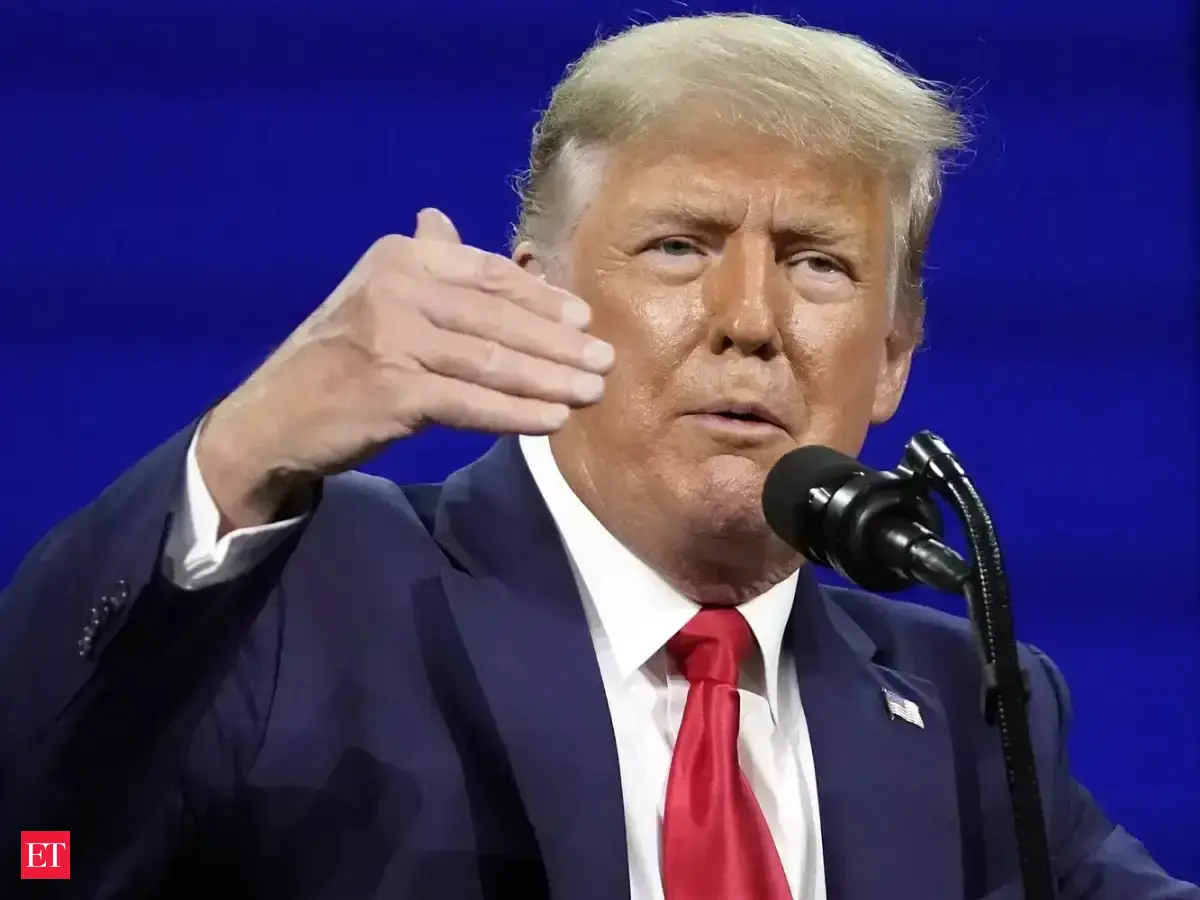
US President Donald Trump threatened a tremendous tax on American companies building data centres overseas. Speaking at the White House on November 20, he said firms would face heavy penalties for such projects. This move could hurt India’s goal of becoming a global AI hub as major investments now face uncertainty.
Synopsis
American companies like Google and Microsoft have committed significant investments to expand data centres in India, highlighting its market potential. Trump's proposal to impose a tax on such overseas investments raises concerns about future American projects in India. This could complicate India's goal of becoming a global AI infrastructure center while attracting substantial foreign investments. Local Indian companies may gain market share if American investments decline due to new restrictions.
US President Donald Trump's threat to impose a “tremendous tax” on American companies building data centres overseas could complicate India's ambitions of becoming a global AI and cloud computing hub. The warning comes at a particularly sensitive time, with Google, Microsoft and Amazon committing tens of billions of dollars to expand their infrastructure in the country.
India has emerged as an attractive destination because of its enormous digital market, relatively competitive costs and growing infrastructure capabilities. But if Washington turns Trump's remarks into policy, some of these investments could face an uncomfortable choice between the Indian market and the financial consequences of expanding outside America. But can Trump actually stop American companies from building abroad?
Why Trump wants American data centres to stay home
Speaking at the White House on November 20, Trump said American companies would face heavy penalties if they built data centres outside the US. He argued that overseas facilities could eventually be taken over by China, allowing Beijing to gain access to computing infrastructure essential for artificial intelligence.
Live Events
The concern is not entirely without substance. Data centres house powerful processors, including advanced Nvidia GPUs, used to train and operate AI models. The US has already restricted exports of its most advanced AI chips to China. But Reuters reported that Chinese companies have continued accessing advanced computing capacity by renting services from data centres in countries allowed to import those chips.
This is the loophole Washington wants to close. By keeping more computing infrastructure inside American territory, the administration believes it can exercise greater control over access to advanced AI capabilities.
There is also an economic argument. Trump wants the enormous investment accompanying the AI boom to generate American jobs, support domestic infrastructure and strengthen the country's technological lead over China.
His comments also come amid growing resistance to data centre construction within the US, where communities have raised concerns about electricity consumption and the impact on utility bills. Trump has encouraged local authorities to negotiate financial benefits with companies rather than reject projects. The policy, therefore, is as much about domestic investment and political messaging as it is about national security.
Why India has so much at stake
India is among the biggest beneficiaries of the global data centre investment rush. The scale of American commitments shows why Trump's announcement is significant. Google announced a $15 billion investment over five years, from 2026 to 2030, to establish an AI hub in Visakhapatnam. The project includes a gigawatt-scale data centre campus and a new international subsea cable gateway. This would be Google's largest AI infrastructure investment outside the US.
Microsoft followed with a $17.5 billion commitment over four years, starting in 2026. The investment will expand its cloud and AI infrastructure, including a major hyperscale facility in Hyderabad and further expansion in Chennai and Pune. This comes on top of an earlier $3 billion commitment.
Amazon Web Services, meanwhile, announced a $12.7 billion investment in Indian cloud infrastructure by 2030. The company estimated that this investment would contribute $23.3 billion to India's GDP and support around 131,700 full-time equivalent jobs annually across local businesses.
These figures should not be treated as money committed exclusively to physical data centres. Microsoft's investment, for instance, also covers skills development and ongoing operations. However, the expansion of cloud and AI infrastructure is central to all three companies' India strategies.
Amazon, Microsoft and Google had pledged a combined $67.5 billion in Indian investments since October last year, largely driven by the race to expand data centre infrastructure. A sudden American restriction could therefore affect a substantial pipeline of investment, although the actual exposure would depend on the final policy and which projects it covers.
Why data centres are coming to India
India's appeal goes beyond its billion-plus internet users. Its growing digital economy generates enormous demand for cloud storage, AI computing and data processing. Companies also need infrastructure close to customers to reduce latency and improve service reliability.
The country offers relatively competitive construction and operating costs, a substantial engineering workforce and access to renewable energy. Its geographical position and expanding subsea cable connectivity also make it attractive for serving markets beyond India. Bloomberg reported in April 2026 that industry investment proposals exceeding $150 billion were in the pipeline, although land availability, electricity infrastructure and regulatory clearances remain significant issues.
The power question is particularly important. A gigawatt-scale data centre requires enormous quantities of uninterrupted electricity. Bloomberg noted that India's problem is not necessarily a shortage of electricity nationally, but the ability of local distribution networks and substations to deliver sufficient power where facilities are being constructed. A Council on Energy, Environment and Water study published in 2026 estimated that Indian data centres consumed approximately 150 billion litres of water in 2024. It warned that consumption could more than double by 2030.
However, to overcome these constraints, developers are exploring locations beyond established hubs such as Mumbai and Chennai. Visakhapatnam, in particular, is attracting attention because of its potential to accommodate large campuses.
India is also actively encouraging these investments. The Union Budget 2026-27 announced a tax holiday until 2047 for eligible foreign companies providing global cloud services through Indian data centres. The measure was intended to provide long-term tax certainty and attract international investment.
Trump's proposed restrictions would therefore run directly against India's attempt to position itself as a global digital infrastructure destination.
What will happen to India plans of American companies?
The immediate risk is not necessarily that Google or Microsoft will abandon projects already announced. Their investments serve substantial commercial interests that have little to do with geopolitical considerations alone. India is a massive market for cloud services. Its expanding banking, manufacturing, telecommunications and government sectors require local computing infrastructure. Data localisation requirements and the need to process information closer to customers also make overseas facilities an imperfect substitute.
However, the economics could change if American parent companies face substantial financial penalties for expanding abroad. A company planning to build additional capacity in India might postpone the project, reduce its scale or redirect some capital towards American facilities. New investment decisions could become more complicated, particularly for projects intended to serve international customers rather than India alone.
The consequences could extend beyond American technology companies. Indian data centre operators, construction contractors, equipment suppliers and renewable energy developers could also lose business if expansion plans are scaled back.
There is, however, a possible silver lining. Indian companies such as Adani and Reliance could gain a larger share of the market if American competitors become more constrained. Foreign investors from Japan, Singapore and the Middle East could also find opportunities.
But replacing American investment would not be straightforward. Hyperscale data centres require enormous capital, sophisticated technology and long-term commercial commitments.
Can Trump actually impose such a tax?
This is arguably the biggest uncertainty surrounding the announcement. Trump did not specify the proposed tax rate or explain how it would work. More significantly, he acknowledged that he had not discussed the idea with his officials before announcing it at the White House.
There is an important constitutional complication. Under the US Constitution, Congress holds the power to impose federal taxes. The president cannot simply create a new tax on American companies because he wants them to invest domestically. The presidential authority over international trade and tariffs depends on powers delegated by Congress through legislation. Any attempt to impose penalties using existing executive powers would need a valid statutory basis and could face legal challenges.
There is absence of clarity yet over the legal authority for Trump's proposal. One possible route would be legislation specifically targeting overseas data centre investments. Another would involve using existing national security or trade-related powers, although applying these to ordinary commercial infrastructure projects would invite scrutiny.
There are practical obstacles, too. American technology companies operate globally and need infrastructure in multiple countries. Building everything in the US would increase costs and make services slower for overseas customers. It would also undermine their ability to compete with companies headquartered in China and elsewhere.
India needs to wait and watch
For India, Trump's announcement is a warning rather than an immediate investment crisis. The proposed tax has no clearly established implementation framework yet, and the commercial logic behind building data centres in India remains strong.
However, the uncertainty could affect future investment decisions, particularly if Washington moves towards legislation rather than leaving the remarks as political rhetoric. India's best response would be to strengthen its appeal independently of American policy. That means faster approvals, reliable electricity, sustainable cooling systems and predictable taxation. It also means encouraging domestic companies to develop the capital and technological capabilities needed to compete with foreign hyperscalers.
There is a larger strategic issue here. India wants to become a global AI infrastructure hub, not merely a market where foreign companies sell cloud services. If American companies are discouraged from expanding overseas, India will need alternative sources of capital and technology.
Trump may be trying to prevent China from gaining an advantage in the AI race. But a policy that forces American companies to retreat from international markets could create opportunities for precisely the competitors Washington wants to keep ahead of. For India, the challenge will be ensuring that an American attempt to protect its technological lead does not come at the expense of India's own digital ambitions.
(You can now subscribe to our Economic Times WhatsApp channel)
What would it take for the world to stop needing the Strait of Hormuz?
Hidden export winners: The unlikely products finding real buyers abroad
India’s USD25 bn copper drive moves from building smelters to securing mines
Why IndiGo could land a sharp rebound in profit despite a sluggish aviation market
Gold still rules, but with a difference: How young India is redefining wedding jewellery
KYC and KYB: Pidilite’s business has more tailwinds than headwinds, but a continuous test called raw material prices – Concluding part