
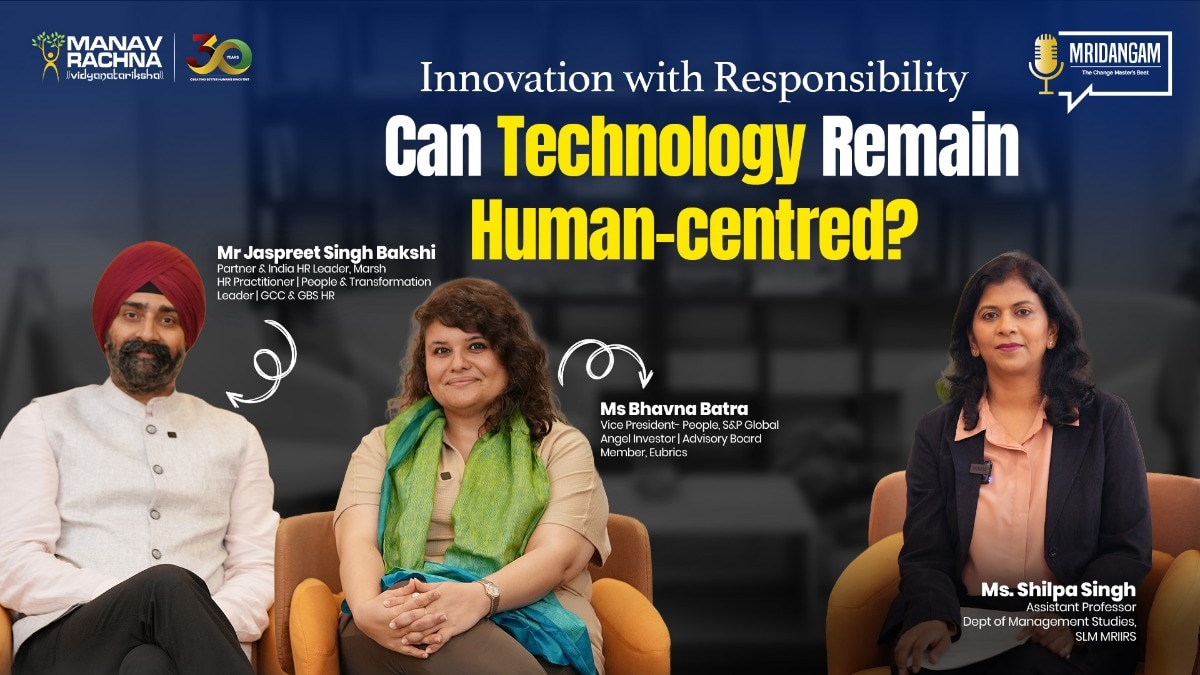
Artificial Intelligence is changing how organizations decide, making judgment more valuable than information. Manav Rachna International Institute of Research & Studies started MRIDANGAM – The Change Masters' Beat to foster leadership dialogue. The platform aims to set a rhythm for discussions, helping many voices find harmony in the AI age.
Artificial Intelligence is rewriting how organizations think and decide. Geopolitical alignments are shifting. Demographics are reshaping workforces, sustainability is now a strategic imperative, and what employees expect from employers is changing faster than institutions can adapt. Leaders are making consequential decisions in conditions where yesterday’s playbook offers limited guidance.
The paradox is that knowledge has never been more abundant, yet understanding has rarely been harder to find. Answers arrive in seconds. Opinions compete for attention on every screen. In such a world, access to information is no longer an advantage. The real test of leadership is the ability to interpret that information, examine competing perspectives, and decide responsibly. The scarce resource is no longer knowledge but judgment, and judgment is sharpened by one thing above all: good conversation. This is where universities find themselves at an inflection point.
Why universities must convene
This raises a question for higher education. If judgment is what the world needs, is teaching alone enough?
Historically, we assessed universities on three measures: the quality of teaching, the strength of research and the employability of graduates. These remain essential. But they describe what a university does inside its walls. In times like these, society also asks what it contributes outside them: whether it helps shape the conversations that influence business, policy, technology and society.
The best universities in the world already answer yes. They convene leaders, bring disciplines together and create spaces where ideas are debated before they become policy and questioned before they become practice. As India aspires to be a global knowledge economy, its institutions need to move the same way, from centers of instruction to centers of intellectual influence. That requires more than the occasional conference. It requires a platform that is sustained, credible and inclusive.
This was the reasoning behind MRIDANGAM – The Change Masters' Beat, the flagship leadership dialogue platform from the Strategic Mentoring Board of the School of Leadership & Management at Manav Rachna International Institute of Research & Studies.
A platform, not an event
The distinction is deliberate. An event ends when the audience leaves. A platform keeps generating value long after.
The name reflects the design. The Mridangam, one of India's oldest percussion instruments, does not merely accompany; it sets rhythm, gives structure and lets many voices find harmony. MRIDANGAM aims to do the same for leadership dialogue. It does not push a single viewpoint or manufacture consensus. It treats disagreement, handled with openness and humility, as a feature rather than a flaw.
Each theme runs as a cycle built on four stages: Listen, Challenge, Reflect and Influence. Initially, a conversation between two leaders with complementary perspectives, then live campus debate across career stages, with emerging talent, organizational leaders and industry veterans examining the same question through different lived experiences. Later, it will distils the learning into literature that feeds an annual MRIDANGAM Compendium.
The aim is simple: conversations should become debates, debates should become insight, and insight should outlast the event.
The first question: Can technology stay human-centred?
For the inaugural theme, we chose the question that sits beneath most of today's uncertainty: "Innovation with Responsibility: Can Technology Remain Human-centred?"
Decisions that once rested on human experience are now supported, and at times driven, by algorithms. Productivity gains are real, and so are the stakes. How do organizations preserve trust while embracing AI? What happens to leadership when machines grow more capable? Can innovation remain anchored in human values? And what will distinguish exceptional leaders in an AI-driven world?
To explore these questions, MRIDANGAM brought together two leaders who work where technology meets people. Bhavna Batra is a people transformation and business growth leader with over two decades of experience across S&P Global, PwC, Genpact and others. At S&P, she is the global head of people for the Enterprise Data organization and the head of people for the India region. Having worked across 40+ countries, she has deep experience in conceptualising and driving technology and culture-led change to build agile, value-focused, future-ready organizations. Jaspreet Singh Bakshi, Partner and India HR Leader at Marsh, brings over 25 years of experience in business and human resources leadership across banking, financial services, telecom and global capability centres. Previously Managing Director – HR at NatWest Group, he has led large-scale organizational transformations and strategic people initiatives. His expertise spans digital transformation, leadership development and building agile, future-ready workforces in complex global organizations.
Both sit on the people side of the enterprise, where the effects of technology show up first in trust, culture and careers. They were well placed to look past the hype and ask what AI means for the humans working alongside it.
The conversation began with the anxiety that surrounds AI today: will machines eventually take over? Jaspreet Singh Bakshi’s answer was reassuring and firm. “AI is an enabler. It is a technology, and it will never work in isolation,” he said. “Humans will always remain in control, and it is human judgment, reasoning and decision-making that will determine how it is used.” Bhavna Batra built on that thought by looking at both sides of the technology’s promise. “AI allows us to explore possibilities at a pace we never imagined,” she noted. “But there is a flip side: in unscrupulous hands, it has the potential to exploit weaknesses like never before.” Taken together, their views pointed to the same conclusion: the question is not what AI can do, but who is accountable for what it does. In an AI-driven workplace, responsibility cannot be handed to the algorithm. It stays with the leader.
Tune into the complete conversation here
MRIDANGAM: Keeping the Change Masters’ Beat Alive
The conversation with Bhavna Batra and Jaspreet Singh Bakshi is only the first step. Over the coming quarters, Manav Rachna will bring together voices from academia, industry, public policy, entrepreneurship and civil society, many of whom rarely share a platform, to examine the questions that will shape the future.
This reflects a deliberate commitment to a wider role. The institutions that matter in the coming decade will do more than educate future leaders. They will be trusted conveners of ideas, bringing people with different views together to listen and be challenged. By opening MRIDANGAM to its students and the wider community, Manav Rachna aims to help shape the questions India asks of itself.
As MRIDANGAM’s founding belief holds, great leadership begins with great conversations. Manav Rachna’s effort is to ensure they keep happening. To know more about Manav Rachna, visit https://manavrachna.edu.in/