
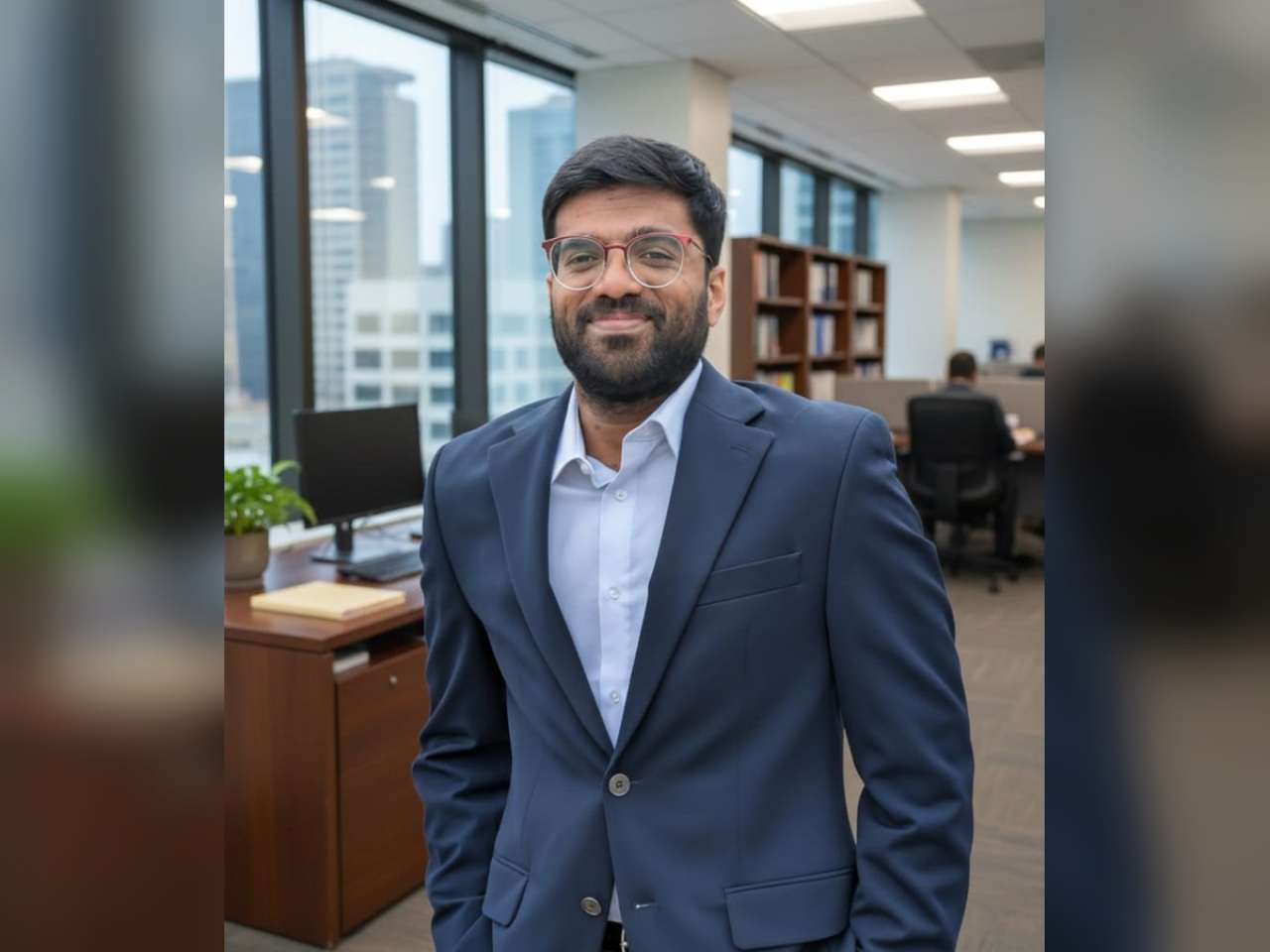
Siddardha Vangala says enterprise AI must move beyond synthetic benchmarks to ensure reliability. In April 2026, he noted, "Reasoning benchmarks mostly measure whether a model can produce logically coherent text, but coding requires producing syntactically valid, executable output." He uses strict safeguards to make generative systems more secure and dependable.
Siddardha Vangala champions reliable, deterministic AI engineering by combining strict execution safeguards, accountable infrastructure, and lessons from spatial computing to make generative AI systems more secure, efficient, and dependable in production.
Across the enterprise technology landscape, the honeymoon phase of generative artificial intelligence is colliding with operational reality. Over the past three years, corporate engineering roadmaps have funneled billions into large language models and high-density compute clusters, often driven more by executive anxiety than clear architectural utility. Yet behind the synthetic benchmark scores, production teams face an unresolved bottleneck: probabilistic models produce unpredictable, uncalibrated failures when plugged into mission-critical systems.
For Siddardha Vangala, a Senior AI Developer at MasTec, this operational friction was predictable.
As Vangala told the technology publication Nexairi in April 2026, "Reasoning benchmarks mostly measure whether a model can produce logically coherent text, but coding requires producing syntactically valid, executable output that interacts correctly with real systems. Small errors that are acceptable in reasoning tasks become fatal in coding workflows."
Vangala's work spans enterprise infrastructure and immersive computing, and it reflects an emerging movement toward deterministic intelligence engineering: tightly bound, auditable software environments where generative engines act under strict constraints rather than as autonomous arbiters.
Grounding Generative Systems in Enterprise Operations
At MasTec, the publicly traded infrastructure company where he works on the company's AI initiatives, introducing generative models means bridging raw intelligence with rigid reliability requirements. Vangala has focused on building accountability into the runtime stack.
Rather than deploying open-ended pipelines, he describes his technical work as focusing on modular tool-server runtimes, performance-testing frameworks, and identity-gated integrations designed to verify every payload before execution.
Speaking to TechNewsWorld in April 2026 about industry data showing widespread idle GPU capacity, Vangala observed that "companies are making board-level bets on AI transformation while their infrastructure teams are operating with no utilization targets, no cost accountability frameworks, and no feedback loops connecting spend to production output."
"You need to integrate AI where it acts deliberately under bounded guardrails," he says. "It cannot be left unchecked across foundational layers."
This engineering philosophy challenges the prevailing tendency to throw excess hardware at architectural inefficiency. Without rigorous utilization targets, overprovisioning yields idle computing rather than business agility. For enterprise software architectures, Vangala
emphasizes structured, human-in-the-loop validation so that automated pipelines avoid the unmonitored bias and erratic routing that can compromise unsupervised systems.
Deterministic Roots: From Spatial Computing to Autonomous Agents
The imperative for deterministic boundaries did not originate with large language models; it was forged in spatial and immersive computing.
Long before agentic frameworks captured headlines, building augmented reality (AR) experiences demanded mathematical precision. In spatial interfaces, a dropped frame, drift in coordinate tracking, or a floating-point inconsistency can break immersion or ruin physical-space alignment.
Vangala worked through these computer vision and spatial constraints as a co-founder of Tiered World Studios, where he served as Chief Technology Officer until December 2019 and continues to serve as a technical advisor. Cool Jellybeans, an immersive extended reality (XR) edutainment platform designed to teach programming concepts to underserved K-6 students, was among the company's earliest projects developed under his technical leadership.
According to the company, the platform reached 597 students in a seven-week pilot program, and 45 of 52 participating students, 66 percent of whom were English language learners, mastered foundational programming concepts, an 86 percent success rate.
That work also produced intellectual property. Vangala is a co-inventor of a U.S. Patent, "Interactive Augmented Reality (AR) Entertainment Hub." Filed in January 2019, during his tenure as CTO, and granted by the United States Patent and Trademark Office in March 2023, the patent describes systems and methods that detect a reference marker on a real-world object through a device camera and pair an AR character with visual programming objects, letting users manipulate digital art assets through augmented reality as part of STEM-based learning.
"Whether you are tracking physical markers in an augmented space or directing an agent across an enterprise API, the underlying software principle remains identical: the system must be deterministic," Vangala says. "The model can suggest an intent, but the execution architecture must guarantee the outcome."
Writing the Production Playbook
Vangala has also taken these lessons publicly. In 2026, he published seven technical essays in Towards AI, a curated artificial intelligence publication on Medium. The essays examine where generative systems fail once they leave the demo environment: failure modes in Model Context Protocol (MCP) deployments, retrieval-augmented generation (RAG) pipelines that retrieve the right documents yet still return wrong answers, and the recurring mistake of treating a model's tool call as if it were an ordinary API call. In one essay, he proposes the Context Reliability Framework (CRF), a production architecture for building trustworthy AI systems.
"Most AI writing celebrates what a model can do in a demo," Vangala says. "I write about what breaks in production, because that is where engineering teams actually lose time and trust."
Architectural Integrity Over Industry Hype
As corporate development teams move from cloud-based conversational assistants toward specialized agentic hardware and embedded intelligence, the need for system-level pragmatism continues to grow. Silicon-level optimizations and persistent device-level memory are reshaping how software layers interact with mobile and edge devices.
Yet Vangala warns that architecture, not hardware volume, will decide which platforms survive industrial implementation.
He has also served as an official judge at venture and AI competitions hosted by the Skandalaris Center for Interdisciplinary Innovation and Entrepreneurship at Washington University in St. Louis, including the Skandalaris Venture Competition, which drew 107 venture submissions in its spring 2026 cycle, and the WashU Mayfield AI Hackathon. In June 2026, he also judged the Entrepreneurship 150 Pitch Competition at Ensign College in Salt Lake City. In each role, he assessed the technical feasibility and innovation potential of early-stage ventures.