
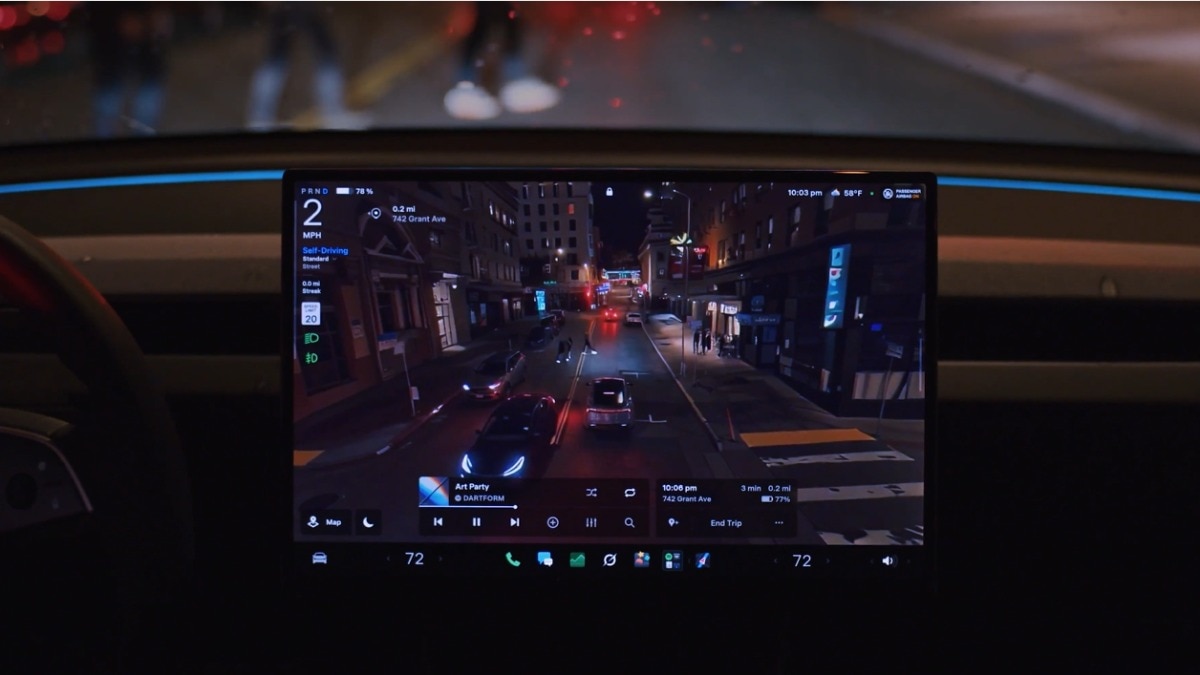
Tesla released FSD v15 to some vehicles on Saturday, November 21, featuring a new Reality View. This update gives drivers a video game-like look at their surroundings. Elon Musk said, "It's like GTA." While the visuals look fun, drivers must still stay alert because the car handles real roads.
Tesla's latest update gives drivers a video game-like view of their surroundings. Elon Musk compare it to GTA. The new Reality View feature aims to make the car's driving decisions easier to understand, but drivers still need to stay alert and ready to take control.
Tesla wants to make driving feel more like a video game. The latest update to its Full Self-Driving (FSD) software attempts to bring that experience to life. Tesla boss Elon Musk compared the update with the viral new video game Grand Theft Auto (GTA). But while the visuals may look like something out of a video game, the technology is dealing with real roads, real vehicles and real people.
Tesla released FSD v15 to some vehicles on Saturday, November 21. Among several claimed improvements, the update introduces a feature called Tesla Reality View. And this is where things get interesting.
Tesla turns the road into a video game
Tesla Reality View gives drivers a photorealistic, third-person view of their car and its surroundings. Think of the camera angle in a racing game, where you can see your vehicle from behind while it moves through the world. The difference is that this is not a virtual track. It is a live representation of the actual road around the Tesla.
According to Tesla's release notes, the feature is designed to let drivers see and understand what FSD is planning to do. Instead of looking at a relatively basic digital representation of the road, users get a more detailed view of their surroundings.
Musk shared his reaction to the feature on X, writing, "It's like GTA". The comparison is easy to understand, particularly at a time when GTA VI is dominating gaming conversations. However, Tesla Reality View is not about turning driving into a game. It is meant to make the car's decisions easier to follow.
Shivon Zilis, director at Neuralink, also responded to the discussion with an interesting observation: "If you zoom out a little further, you can see our simulation playing on the screen of the creators." Her comment adds another layer to the conversation around how machines represent and interpret the world around them.
A video game-like view, but real-world risks
There is a reason Tesla's update is attracting attention beyond its visual appeal. Self-driving technology needs to make sense not only to the car but also to the person sitting behind the wheel. A more familiar visualisation could help drivers understand what the system is detecting and planning.
But there is an important distinction here. Tesla's FSD is still a supervised driving system. The driver must remain attentive and responsible for taking control when needed. A video game-like display does not make the car autonomous, nor does it remove the risks involved in driving.
The update also brings several other claimed improvements, including better handling of potholes, school zones, speed cameras and standing water. However, as Electrek's Fred Lambert points out, FSD updates have not always improved in a straight line. New versions can bring gains in some areas while introducing problems in others.
So, while Tesla's new view may make driving look a little more like GTA, the road outside the windshield is no game. And that is perhaps the most important thing for drivers to remember.