
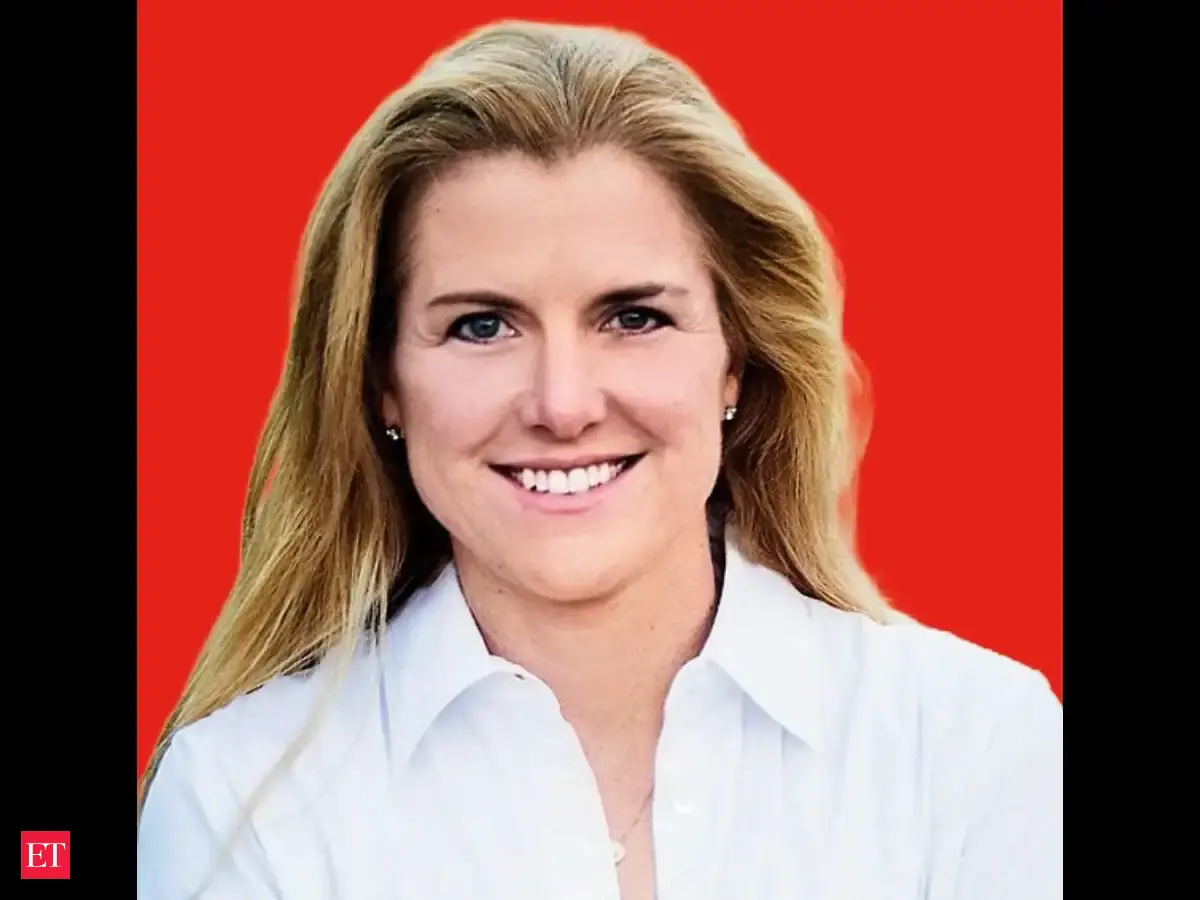
Margaret O'Mara highlights how Silicon Valley’s gender imbalance evolved over time. She explains that women once dominated programming but lost ground due to cultural shifts and biases. Venture capital dynamics also favor male-led teams today. O'Mara says, "In the beginning, software engineering was a profession dominated by women in the US."
Margaret O'Mara highlights how the gender imbalance in Silicon Valley has evolved over time. She explains that women once dominated programming but gradually lost ground due to cultural shifts and biases. O'Mara also notes how venture capital dynamics contribute to this ongoing issue by favoring male-led teams. Furthermore, the consequences of having predominantly male representation in leadership roles are significant for the tech industry.
Margaret O'Mara is the Scott and Dorothy Bullitt Chair of American History at the University of Washington. As the Nvidia imbroglio continues, she spoke with Srijana Mitra Das in ET Evoke about how sharply gender has shaped Silicon Valley -- and why this power difference is becoming so dangerous:
Q. What is the core of your research?
A. I'm interested in how American state building and American business intersect with one another and how the private and public sectors evolved over time. My work has focused particularly on the high-tech industry -- this is a sector often presented as a free market miracle but which actually has its roots in defence spending during the Cold War.
My main research is focused on giving Silicon Valley a history, helping us understand how we got to today's world of big tech and American companies which are not only extremely consequential for the United States economy but are so influential around the globe.
Q. Speaking of history, as you have written, there was a time when women software professionals were the norm in Silicon Valley -- how did the industry then become so shockingly gender-imbalanced?
A. In the beginning, software engineering was a profession dominated by women in the United States. It wasn't a very high-status or high-paid profession then. The 1940s onwards, into the 1960s, programming computers was seen as a clerical job -- the computer, the hardware was what was mattered and male electrical engineers made that. Since then, in many professions and domains, significant gender equity has been achieved the 1960s onwards -- yet, the
tech industry, which you think is so fast-moving and innovative and hence, should have modernised dramatically, did not. Why?
A critical moment was 40 years ago when software itself started becoming a business -- Microsoft and other companies were becoming extraordinarily successful. Suddenly, software engineering was no longer an 'Anyone can do it' profession -- it was becoming central to the economic juggernaut that was tech.
Software engineers were growing better-paid and more high-status and a stereo-type took over, of the software engineer being a geeky guy, reinforced in pop culture as computers become a familiar feature in American homes, schools and workplaces. There were celebrity CEOs, like Bill Gates who was the ultimate geek, and celebrated for it, but these images became very gendered in the way the culture of computer programming was increasingly seen as something men did. In the early 1980s, we had the highest percentage of women in computer science programs in American higher education -- it was much greater than today. It went shockingly downhill, percentage-wise, such programs becoming overwhelmingly male.
Another factor driving the change was the nature of financing of startup companies and how venture capital works. Venture capital is an overwhelmingly male-dominated sector which reflects how finance itself is a very gender-imbalanced profession in the United States. Now, the way venture capitalists identify the next big winner is that they're not only investing in the technology, they're investing in the team running the company. They offer not only money in the early stage but also mentorship, as in, 'I'm going help you build your company and teach you how to do it' -- this becomes a very intimate relationship, one that has a lot to do with personality and temperament as much as actual technology. That's the way venture capitalists thought about it and brought in their own biases -- if you're looking for 'the next Mark Zuckerberg', it's hard to imagine a woman could fit that stereotype.
Another factor is this very firm belief in the way Silicon Valley thinks of itself as a place where all that matters is that you're talented technically -- your race, ethnicity or gender don't matter because 'We don't care about that stuff.' Actually, they do and this belief is only denying the bias. It's interesting because one of the proof points people in tech indicate is, 'We aren't biased -- just look at all the South Asian leaders of tech who got opportunity'. However, that too is very gender-imbalanced -- in India, engineering education is much more gender-balanced than it is in the United States.
Yet, we have a Satya Nadella here but no female version of Satya Nadella. So, multiple factors have caused this imbalance which has been building over a very long time.
Q. What does the NVIDIA event now show us about the tech world and its 'bro culture'?
A. It shows us a great deal. About a month ago, President Trump had several AI leaders meeting at the White House and they got a group picture -- the only women in the room were Susie Wiles, the now-departed Chief of Staff, and Lisa Su of AMD who also happens to be Jensen Huang's cousin. That was it! The image was stunning, particularly as representation matters in leadership. Not only does it model what is possible in science and tech and show the next generation what to aspire to, it also speaks to more than 50% of the world's consumers who are female -- the idea that you're going to be building and selling products in industries without people in the room who have that perspective is not a very smart business decision.
In terms of NVIDIA specifically, there is the dimension of a personal mistake, a man who behaved in a way that not only risked his marriage but perhaps also endangered national security. One wonders if a female CEO would have had similar indiscretions, given how extraordinarily busy women leaders get just running their companies. I think NVIDIA also shows a dimension of 'bro culture' in tech in the rise of a cult-like, extremely powerful single founder-entrepreneur. Jensen Huang is an outsized example of that -- he is the sun around which everything NVIDIA revolves. So, his being forced out of the company was a challenge of much greater dimensions than, say, an ordinary CEO succession -- Apple changed CEOs recently and there was barely a blip. With NVIDIA, it was very different. There are these individuals, like Jensen Huang and his leather jackets and bob-blehead dolls, Elon Musk or Sam Altman, men who have come to symbolise and epitomise companies. They are now proxies for trillion-dollar enterprises.
This is a real concentration of power and wealth in Silicon Valley, something without historical precedent in American history -- even John Rockefeller and Andrew Carnegie did not have the concentrated power and wealth these men have.
Q. You've written about the unmoving faith the world frequently reposes in 'tech whiz-kids'. Are there similarities between Jensen Huang now and Sam Bankman-Fried earlier -- and does such faith in individual men, whom you also describe as being united in not believing in ironing their clothing, impact the way we see science and technology shaping our lives?
A. I think this faith is worrisome. Of course, every new technology, from the light bulb to AI, is greeted with this mix of fascination and fear as well as excitement around the inventor. There's a lot of hope attached to these folks and American culture has really celebrated innovators who seem to be self-made, their smarts being their calling card which got them to success. Americans have historically pinned their hopes on the ability of these technologists and their innovations to bring us to a better world.
Now, that's hanging a lot on one individual -- even if they are the most talented genius of all geniuses. Today, in so many cases, we see how these geniuses themselves are flawed human beings. Their tales highlight how if one achieves wealth and celebrity purely on the basis of being a very good engineer, such people can often be very good engineers to the exclusion of everything else, includ-ing having healthy personal relationships -- or ironing their clothes.
The danger now is that Silicon Valley's technologies have slipped past the boundaries of the desktop and are everywhere, influencing politics, society, culture and key sectors of the economy, giving the people atop these companies a great deal of power. Their expertise -- their ability to excel at one very technical thing -- also perhaps comes from the fact that their brains work in different ways. Evidently, often enough, they simply don't have much empathy or a broader, deeper sense of politics and society.
Silicon Valley had a good several decade run in which the leaders of these companies appeared as if they could do no wrong. It was frequently said,
'We need more Silicon Valley thinking' in, say, other parts of the economy or in improving government. Also, there are amazing technological advances to celebrate from Silicon Valley -- yet, that still doesn't mean that these slightly quirky engineers should hold as much power as they do. No one person should and it is particularly noteworthy that these are people who arrive with an unusual worldview to start with and are putting a lot of faith in technology to fix everything. Technology is not the fix for everything -- having a balance between different sectors of society and letting the public have a voice in where things go is.
In the US, we're now seeing growing discomfort with this imbalance in the pushback and revolt against AI and data centres -- there is a powerful feeling in the mass public that, 'We're being told to join this revolution -- but no one asked us if we wanted to do it and we don't even know if this is a good idea.' We're seeing this playing out in American politics in real time today.