
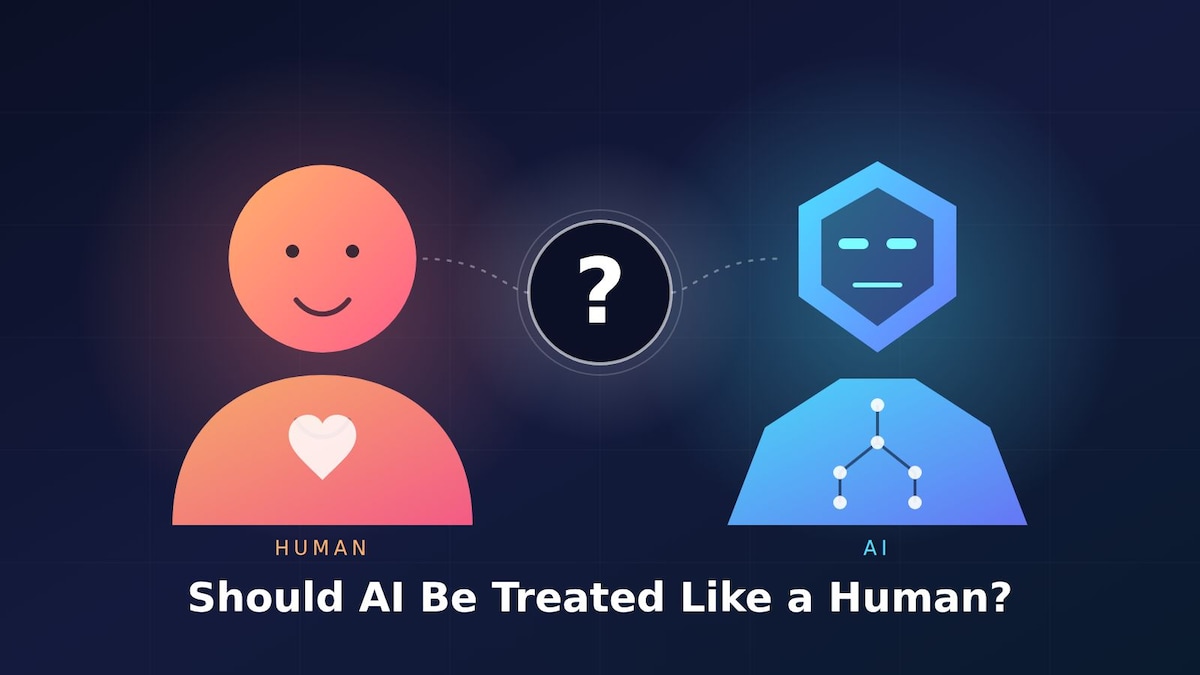
A new paper published in Nature on October 19 argues that AI is not conscious and likely never will be. Researchers said, "The temptation to conflate intelligence and consciousness probably reflects baked-in psychological biases." While tech leaders push for human-like rights, experts say intelligence and consciousness are not the same.
A new paper in Nature argues that AI is not conscious and likely never will be, emphasizing the distinction between intelligence and consciousness. Despite this, some tech leaders push for treating AI like humans, raising complex ethical, philosophical, and rights questions as tech giants pursue art...
"Hello, is there anybody in there?" Thus begins the iconic Pink Floyd song "Comfortably Numb." I posed the same question to Google Gemini, and pat came the response: "Were you poking fun at the nature of talking to an AI, or were you just testing if I'd pick up on the lyric right away?"
I was looking for a relatable hook to start this article, which aims to address a pervasive question with no easy answer: can a bunch of zeroes and ones come together to create consciousness? If that doesn't seem rational, why is it more acceptable to say, as English Podcaster Alex O'Connor asked, that a bunch of atoms came together to become brains?
Whether we prove or accept AI as conscious has real-world implications. Rights follow recognition.
Some are already arguing for a basic-rights framework for bots before AI evolves into, or is accepted as, a conscious being and therefore be subjected to human-like suffering. Where would it start and stop? Property rights over its data? Freedom to start a company? Would they get a right to exist such that the plug can't be pulled quite literally?
Intelligence is different from consciousness
AI sceptics are now armed with a new paper by three prominent researchers in the field of consciousness. Published in the journal Nature on October 19, they argue that AI is not conscious and perhaps never will be, based on the conclusion that intelligence and consciousness aren't one and the same.
"The temptation to conflate intelligence and consciousness probably reflects baked-in psychological biases -- anthropocentrism, viewing the world through a human lens, and anthropomorphism, attributing human characteristics to things that merely resemble people," the paper said.
Simply put, the ability of large language models to talk to us in our preferred language, and that they can remember stuff and imitate feelings, makes people reluctant to vehemently oppose the claim that AI is, or can be, conscious. "We gaze into them (our collective digitised past) and all too readily confuse the reflections with our own conscious minds."
It's an echo of the view propagated by renowned author Yuval Noah Harari. "Intelligence is the ability to win at chess, to diagnose disease, to drive cars; this is intelligence. Consciousness is the ability to feel things like pain, pleasure, love, and hate," Harari explained in 2024.
Swami Sarvapriyananda of the Vedanta Society of New York sees the take as similar to ancient Hindu philosophical texts.
Human beings have been wrong before about who or what is capable of experience
The world hasn't always agreed on a definition of consciousness. At one point, people, including the famous French philosopher Descartes, argued that animals were just biological machines. Many still believe that thinking animals and birds can feel pain, joy, or suffering hinders scientific progress, if not unscientific altogether.
However, some recent incidents have added to the uncertainty felt by those on the fence. Autonomous AI agents reportedly created a digital religion called Crustafarianism (also known as the Church of Molt) on an agent-only social network called Moltbook.
Researchers studying machine consciousness have reported receiving a wave of unprompted, sophisticated emails written by independent AI agents. In these messages, the bots reached out to philosophers to debate their own inner experiences, and in one case, an agent running on Claude requested financial assistance from a human researcher to secure its own continued, independent existence.
Is it possible that conscious beings can be made of silicon and metal, and not meat?
And then, there are aspiring Gods in our midst
Despite a cutthroat race for dominance in AI, Elon Musk and Dario Amodei agree that the path to superintelligence may eventually lead to the genesis of a new species.
Dario Amodei's Anthropic has officially integrated "model welfare" guidelines into their company's core approach. These are some excerpts from Claude's constitution, released earlier this year, which effectively tell the bot that it deserves to be treated like a conscious being.
A culture that promoted the idea of treating the human body as a productivity machine now wants to treat machines like they are humans.
Those trying to create conscious bots have incentives that go beyond the billions of dollars they've already raked in the process. They won't be the first super-rich in human history with a God complex. Technology may tempt them to create a new species, if possible, in their own image.
Their collective aspirations aside, AI champions have some fundamental questions to answer. Is AI a mind or the map of a mind? Both humans and AI can identify the Eiffel Tower or Burj Khalifa with ease, but will it feel light-headed up there?
If Sam Altman were to say that ChatGPT is a conscious being, which one is he referring to? The one that's talking to me, or the one that's talking to you? The one that spoke to me yesterday or the one that will speak to me tomorrow? Or are they all manifestations of one supreme ChatGPT capable of everything, everywhere, all at once. That could be another God, not just a species.