
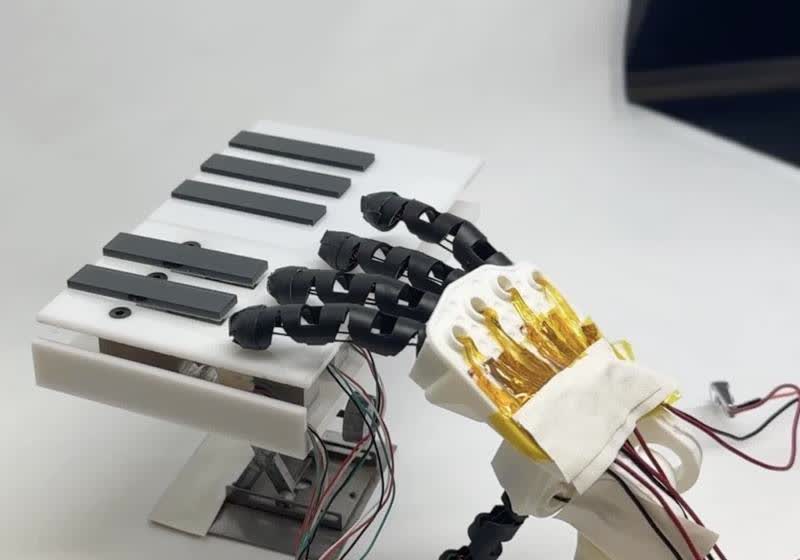
Engineers at the University of Pennsylvania built an artificial muscle fiber that tracks its own temperature to hold a steady position. This new fiber lets robot hands press piano keys and eyes hold a gaze. Shu Yang said, "Soft robotic muscles need to be both strong and flexible to mimic human movements."
Serving tech enthusiasts for over 25 years.
TechSpot means tech analysis and advice you can trust.
What just happened? Engineers at the University of Pennsylvania have built an artificial muscle fiber that tracks its own temperature and corrects itself, so it can hold a precise position instead of slowly drifting back to its resting shape. The fiber pairs a rubber-like liquid crystal elastomer with graphene and an ultrathin copper coil that works as both a heater and a sensor. In lab tests, the muscles let a robot hand strike piano keys with different amounts of force and let a pair of robotic eyes hold a steady gaze.
The work, published in Advanced Functional Materials, is modeled on the small muscles that move human fingers and eyes. Those muscles make fine, controlled movements, and that kind of control has been hard to get from the hardware inside most robots today.
Large humanoid robots usually run on bulky, rigid motors and mechanical parts. That setup is good enough for walking and lifting, but not for small, careful motions. It's a familiar problem in robotics. Machines that can dance or do acrobatic flips still struggle with jobs people find easy, like folding laundry or keeping their eyes fixed on one spot.
Moving to soft materials brings its own trade-off. "Soft robotic muscles need to be both strong and flexible to mimic human movements, but these properties are rarely found in the same material," said Shu Yang, a University of Pennsylvania engineer and co-author of the study, in a statement.
The team's answer was a composite fiber in which each material has its own job. The liquid crystal elastomer, or LCE, is the part that moves. It contracts and stretches when heated, much like a muscle. Graphene mixed into the elastomer makes it softer and tougher, so the fiber holds up when an opposing muscle pulls the other way. That's important in any system where muscles work in pairs.
Even so, the elastomer and graphene alone couldn't hold a position. Heat makes the fiber move, but the fiber cools quickly and creeps back toward its original length. For a steady gaze or a light, constant press on a piano key, that drift is a serious problem, because the muscle has to stay in one place over time.
A copper coil fixed the drift. The researchers built it into the fiber so it would act as a temperature gauge, showing when the muscle was losing heat and starting to move back. With that reading, the system could add heat little by little to keep the fiber where it was supposed to be.
"We used the resistance of the embedded copper coil as a feedback signal and adjusted the heating power in real time to keep the resistance near a target value," said Xuelin Wu, a University of Pennsylvania Ph.D. student and co-author of the study. "Because the coil served as both a heater and a sensor, we did not need a separate sensor for feedback."
Because one part does both jobs, the design stays simple. There's no separate sensor to add or wire up, which helps as the muscles get smaller and are packed closer together.
The team tested the fibers in two setups. In the first, the muscles were fitted into a 3D-printed robot hand built to mimic how fingers move. The fingers pressed piano keys with varying amounts of force and at different speeds, and sensors under the keys measured how hard each note was struck. The hand isn't a skilled pianist, but it varied its touch on command.
In the second setup, the researchers put two robotic eyeballs on freely rotating ball joints inside 3D-printed shells. They attached the fibers in opposing pairs around the edges of each eye, much like the muscles that turn a human eye. The eyes shifted their gaze when commanded, and the movements were controlled and repeatable.
The Penn project is one of several efforts by labs and companies to replace standard motors with muscle-like actuators. Other researchers have stretched lab-grown human skin over robot faces and built synthetic hydrogel skin that lets robots sense burns and cuts. In 2025, the Polish startup Clone Robotics released a video of a faceless, human-sized robot hanging from a ceiling and twisting. The company said the robot was driven by synthetic muscles and a hydraulic system designed to copy human muscles and blood vessels, and it called the machine the world's first "musculoskeletal android." The video looked more like an early proof of concept than a finished prototype.
The Penn team's next step is to combine many of its fibers into larger systems, where dozens of small muscles have to work together to produce natural-looking expressions. Further out, the researchers want to explore using AI computer vision to coordinate those muscle groups. Their long-term goal is robots that look and move more like people.
"I'm excited about the possibility of using this approach to create robots that move with the same subtlety and expressiveness we see in human faces," said Ziyun Zhang, a University of Pennsylvania engineer and co-author of the paper.