
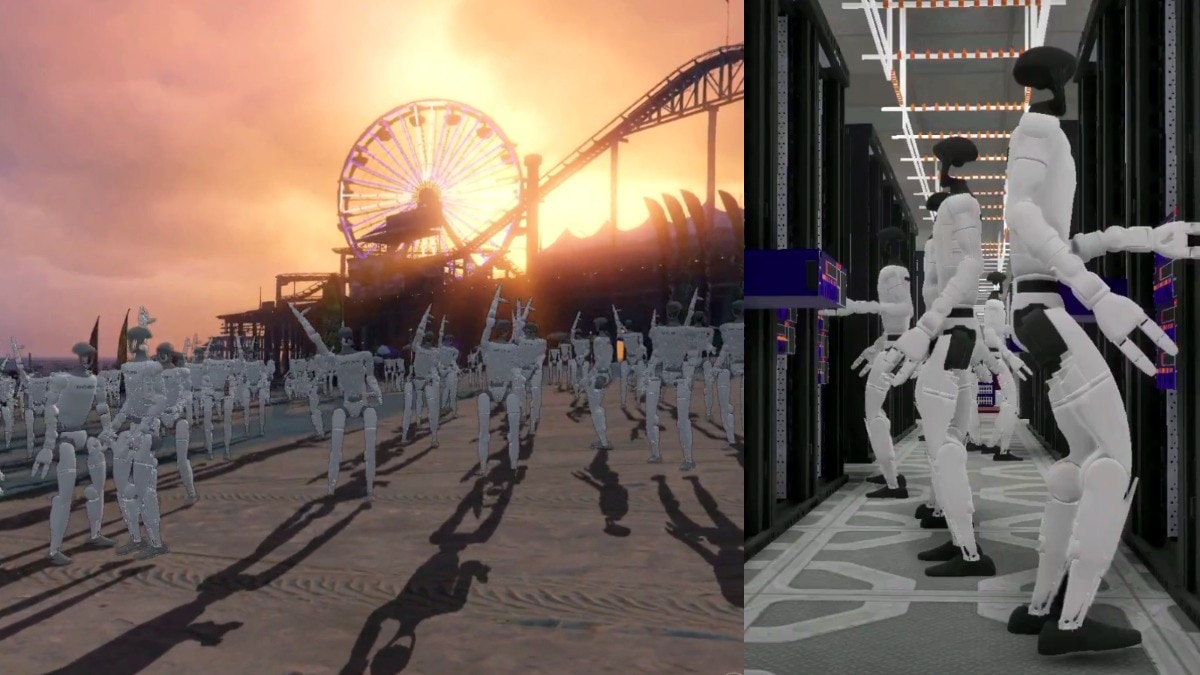
Startup Melty is using video games like GTA V to train robots for real-world tasks. Its Melty Gym platform lets researchers test humanoid models in virtual environments to save time and money. On November 13, the company showed robots driving cars, though it remains unclear if these skills work physically.
A startup called Melty is exploring whether video games can become training grounds for robots. Its Melty Gym research preview lets teams adapt existing games into simulated tasks. A striking GTA V demo has gone viral, but whether these virtual skills transfer to real machines remains unproven yet.
Imagine a robot learning to drive through traffic, open car doors or work inside a data centre. Now imagine it practising all these tasks inside a video game rather than a real-world laboratory.
That is the idea behind Melty Gym, a new platform from startup Melty that wants to turn video games into training grounds for robots.
FROM VIDEO GAMES TO ROBOT TRAINING
Founded by David Miller, Melty is a Y Combinator Fall 2026 startup originally built around modifying and combining video games.
Its latest experiment takes that technology into robotics. Melty Gym allows researchers to put their own robot models into existing games and customise environments, objectives and interactions for training and evaluation.
In its November 13 launch demonstration, humanoid robots appear inside Grand Theft Auto V (GTA V). Given a task, they attempt to open a car, get behind the wheel and drive through the virtual city.
Another sequence shows multiple humanoids working on server racks inside a custom-built data centre environment.
The idea is to use these virtual worlds to run repeated experiments, allowing AI models to learn through trial and error without requiring physical robots for every attempt.
Here's the video posted by David Miller (@davidmilr) on X:
WHY THIS COULD MATTER
Training physical robots can be expensive and time-consuming. Every experiment involving real hardware brings limitations such as equipment costs, physical damage and the time needed to reset tasks.
Virtual environments could allow researchers to run more experiments, test different scenarios and scale training without repeatedly putting machines through physical trials.
Video games also offer complex environments with roads, buildings, objects and multiple moving characters. Repurposing these worlds could save developers from building every training environment from scratch.
THE REAL-WORLD TEST REMAINS
There is, however, a major limitation.
A robot completing a task inside a video game does not mean it can perform the same task in reality. Physical objects, friction, balance, sensors and unpredictable surroundings create challenges that virtual environments cannot automatically reproduce.
Melty Gym is currently in research preview, and the company has not published results demonstrating how reliably skills learnt in its virtual environments transfer to physical robots.
For now, the platform offers an interesting new approach to robot training. Whether virtual gaming skills can translate into useful real-world abilities is the bigger question.