
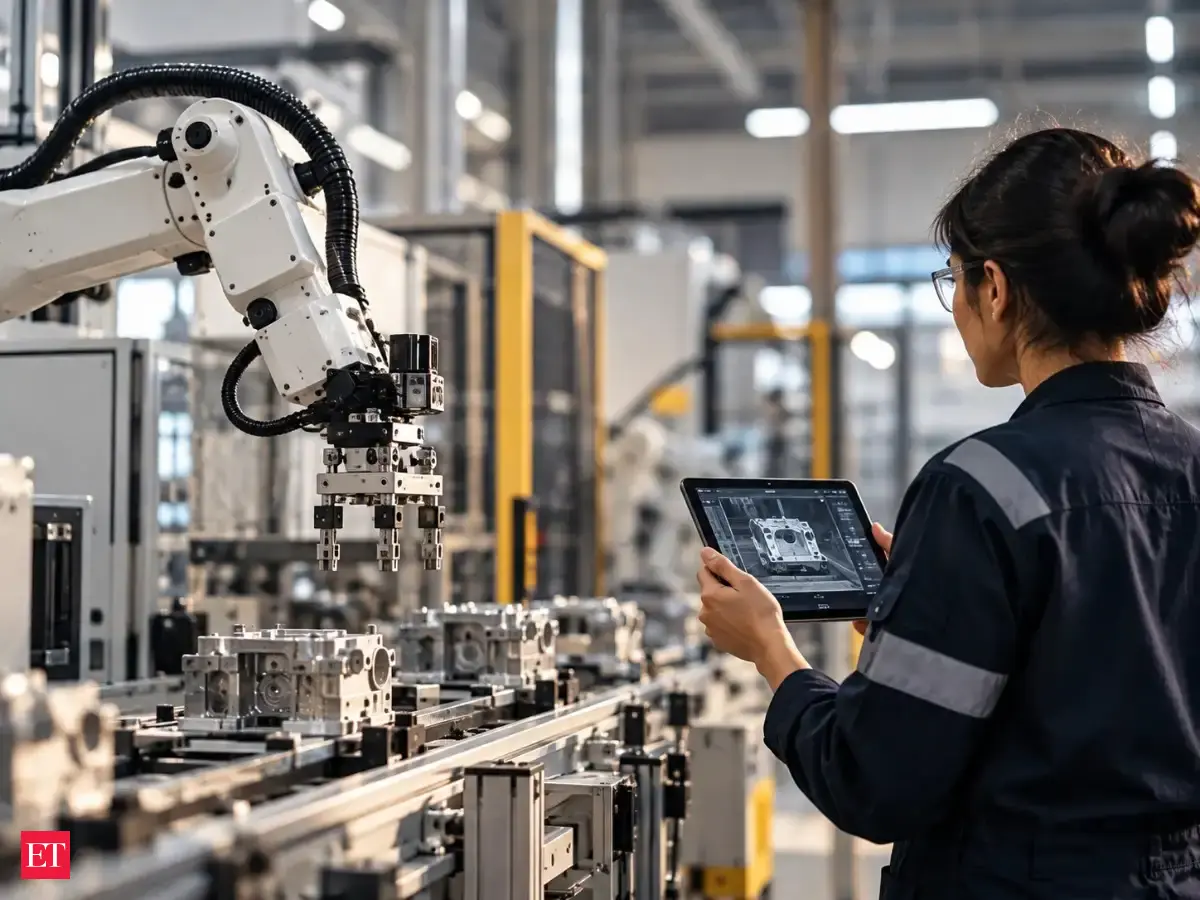
Physical AI is moving into factories and hospitals by using computer vision, robotics, and edge automation. These machines interpret their surroundings to act in real-time. Businesses now face the challenge of scaling these systems reliably. Success depends on strong infrastructure and safety as machines work alongside people in changing environments.
Synopsis
Physical AI is taking artificial intelligence beyond software and into factories, hospitals and other real-world environments. Computer vision, spatial systems, robotics and edge computing are enabling machines to interpret and respond to their surroundings. For enterprises, scaling these capabilities depends on reliable infrastructure, safety, integration and clear operational value.
A software system can pause before making a decision. A robot operating beside a factory worker may have only milliseconds to respond. That difference captures one of the central challenges in Physical AI. When artificial intelligence moves from digital interfaces into machines and industrial environments, it must interpret the physical world and act within it. A model that performs well in a controlled demonstration still has to contend with changing light, moving objects, unpredictable surroundings and the consequences of getting a decision wrong.
For businesses, the implications reach well beyond robotics. Physical AI brings together computer vision, spatial systems, edge computing and automation to help machines interpret their surroundings and respond to them. The commercial question is whether these capabilities can operate reliably enough to justify deployment at scale.
Intelligence has to work where the action happens
Computer vision gives machines the ability to interpret visual information. In industrial settings, that can support quality inspection, defect detection, and the identification of objects moving along production lines. Spatial systems help machines understand position, distance, and their relationship to the environment. Robotics and edge automation then connect that understanding to physical action.
Distinction matters when speed and reliability are critical. Sending every image or sensor reading to a remote system for processing can introduce delays and create dependence on network connectivity. Edge computing allows relevant processing to happen closer to the machine, supporting faster responses in settings where timing matters. Yet moving computation closer to the action does not solve every deployment challenge. Machines must still cope with variations in their surroundings, integrate with existing equipment and operate within safety requirements. The cost of implementation also extends beyond the hardware to infrastructure, testing, maintenance and workforce readiness.
Live Events
The distance between a successful demo and deployment
Physical AI presents a different scaling problem from software-based automation. A digital tool can often be updated centrally. A robotic system deployed across multiple facilities must account for differences in layouts, equipment, operating conditions and the tasks it performs. That makes infrastructure a strategic consideration. Compute capacity, sensor systems, reliable connectivity and the ability to process data locally all influence what an enterprise can deploy. Businesses also need to decide which tasks are suitable for automation and where human supervision remains essential.
India's deployment opportunity spans established industrial operations and newer applications such as surgical robotics and autonomous drones. Each presents distinct requirements. A manufacturing system may need to detect defects consistently across a production line, while a drone must interpret its surroundings as conditions change. The underlying technologies may overlap, but the operating constraints do not.
For enterprise leaders, the priority is to identify applications where intelligent machines can address a defined operational problem, then establish the infrastructure and controls required to expand beyond a pilot.
Building Physical AI for enterprise scale
These questions will be explored at the AI Business Transformation Masterclass & Awards 2026, presented by The Economic Times in association with IIM Bangalore. The Physical AI track will examine both global infrastructure for compute and robotics, and how Indian companies are deploying the technology, from surgical robots to autonomous drones. Scheduled for 19 November 2026, the masterclass will examine the practical decisions involved in moving AI into enterprise operations. The programme will also feature the ET Most Innovative AI Product Awards 2026, recognising AI innovations delivering business value.
Register Now!
(You can now subscribe to our Economic Times WhatsApp channel)
(Catch all the Business News, Breaking News and Latest News Updates on The Economic Times.)
Subscribe to The Economic Times Prime and read the ET ePaper online.
...moreless
(You can now subscribe to our Economic Times WhatsApp channel)
(Catch all the Business News, Breaking News and Latest News Updates on The Economic Times.)
Subscribe to The Economic Times Prime and read the ET ePaper online.