
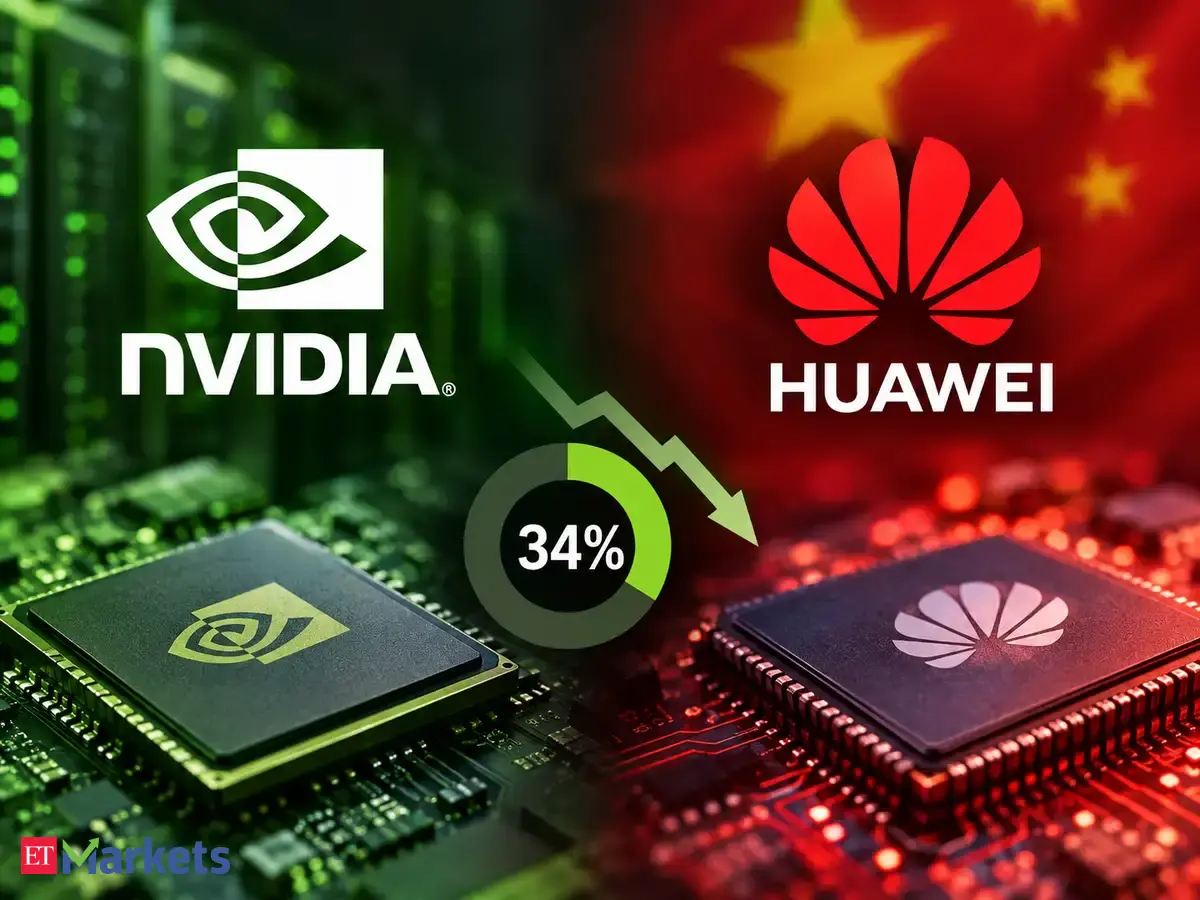
Nvidia’s share of China’s AI chip market fell to 34% in the first half of 2026. US export rules curbed supplies, while Huawei gained ground by shipping 572,000 accelerators. Many Chinese firms now use domestic alternatives instead of Nvidia chips. Total shipments of AI accelerators reached 2.008 million units this year.
Nvidia’s share of China’s data-centre artificial intelligence (AI) chip market fell to 34% in the first half of 2026 as US export restrictions curbed supplies and domestic rivals, led by Huawei, expanded their presence, according to an IDC report seen by Reuters.
Nvidia shipped 678,000 AI accelerators in China between January and June, down 44% from a year earlier, IDC data showed. AI accelerators are specialised processors designed to train and run AI models.
S&P 500 Top Gainers
Fair Isaac740.00(10.85%)
Lamb Weston Hldgs50.18(4.83%)
Medtronic91.93(3.90%)
Molina Healthcare204.36(3.77%)
S&P 500 Top Losers
Coterra Energy32.56(-8.62%)
Corning147.28(-6.00%)
Moderna213.74(-5.00%)
Akamai Technologies101.65(-4.96%)
The decline highlights the growing challenges facing Nvidia in the world’s second-largest economy, where Washington has restricted access to its most powerful AI chips. Beijing has also encouraged the adoption of domestically developed alternatives and required Chinese companies to obtain approval to import Nvidia chips that comply with US export rules, Reuters reported.
Nvidia Chief Executive Officer Jensen Huang has repeatedly criticised Washington’s export restrictions, arguing that the policies have forced the US chipmaker to surrender opportunities in China’s $50 billion AI chip market to Huawei.
Live Events
IDC did not specify which Nvidia products accounted for its 34% market share or whether the figure included advanced chips such as the B200 and B300, which are barred from export to China but have reportedly been smuggled into the country. Nvidia did not respond to a request for comment, Reuters reported.
Huawei expands market share
Huawei shipped 572,000 AI accelerators in the first half of 2026, up from more than 300,000 a year earlier, securing 28% of China’s overall market, according to IDC.
Alibaba’s chip-design unit T-Head accounted for 7% of the market, followed by Cambricon with 5%, Baidu’s Kunlunxin with 4% and Hygon with 3%.
Nine of the 11 Chinese chipmakers tracked by IDC increased shipments from a year earlier, underscoring the momentum behind Beijing’s push to develop a domestic semiconductor industry amid restrictions on access to advanced US technology.
Non-GPU chips overtake GPUs by shipments
Total shipments of AI accelerators in China reached 2.008 million units in the first half of 2026, IDC data showed.
Shipments of graphics processing units (GPUs), the processors most widely used to train AI models, fell 26% to 991,000 units as supplies of products permitted for sale in mainland China remained limited.
By contrast, shipments of other AI accelerators rose nearly 80% to 1.016 million units, surpassing GPUs by volume for the first time in the reported period. These processors include chips designed for specific AI workloads, such as running already-trained models.
Huawei, T-Head, Kunlunxin and Cambricon together accounted for 95% of the non-GPU segment, which IDC said was being adopted by government agencies, internet companies and telecommunications providers.
The shift also reflects changing priorities in China’s AI computing industry. According to IDC, competition is increasingly centred on system-level capabilities, including how effectively chips operate together in large computing clusters, rather than the performance of individual processors alone, Reuters reported.
China AI chip shipments expected to grow
IDC expects total AI accelerator shipments in China to increase 19% in 2026, even as GPU shipments decline 9%.
The contrasting outlook points to a market increasingly shaped by domestic chipmakers and alternative processor architectures as export restrictions constrain Nvidia’s access to China.
While Nvidia remains a major supplier, Huawei’s expanding shipments and the rapid growth of non-GPU accelerators suggest that Chinese technology companies are increasingly turning to local suppliers to meet rising demand for AI computing capacity, Reuters reported.
(You can now subscribe to our ETMarkets WhatsApp channel)
(What's moving Sensex and Nifty Track latest market news, stock tips, Budget 2025, Share Market on Budget 2025 and expert advice, on ETMarkets. Also, ETMarkets.com is now on Telegram. For fastest news alerts on financial markets, investment strategies and stocks alerts, subscribe to our Telegram feeds .)
Subscribe to ET Prime and read the Economic Times ePaper Online.and Sensex Today.
Top Trending Stocks: SBI Share Price, Axis Bank Share Price, HDFC Bank Share Price, Infosys Share Price, Wipro Share Price, NTPC Share Price
...moreless
(You can now subscribe to our ETMarkets WhatsApp channel)
(What's moving Sensex and Nifty Track latest market news, stock tips, Budget 2025, Share Market on Budget 2025 and expert advice, on ETMarkets. Also, ETMarkets.com is now on Telegram. For fastest news alerts on financial markets, investment strategies and stocks alerts, subscribe to our Telegram feeds .)
Subscribe to ET Prime and read the Economic Times ePaper Online.and Sensex Today.
Top Trending Stocks: SBI Share Price, Axis Bank Share Price, HDFC Bank Share Price, Infosys Share Price, Wipro Share Price, NTPC Share Price
...moreless
Curbing rupee bets: What the RBI’s new rules mean for the hedge-now-or-wait question
Brinjal, buffalo, bacteria: Inside India’s pay-for-nature system
Homebuyers wait as NCLT panel picks holes in unfinished Jaypee projects
The NBFC saga - Part 3: How one default in 2018 changed the way RBI reads risk
Four rules made HDFC Bank a compounder. All four have stopped. Can the new CEO rewrite them?