
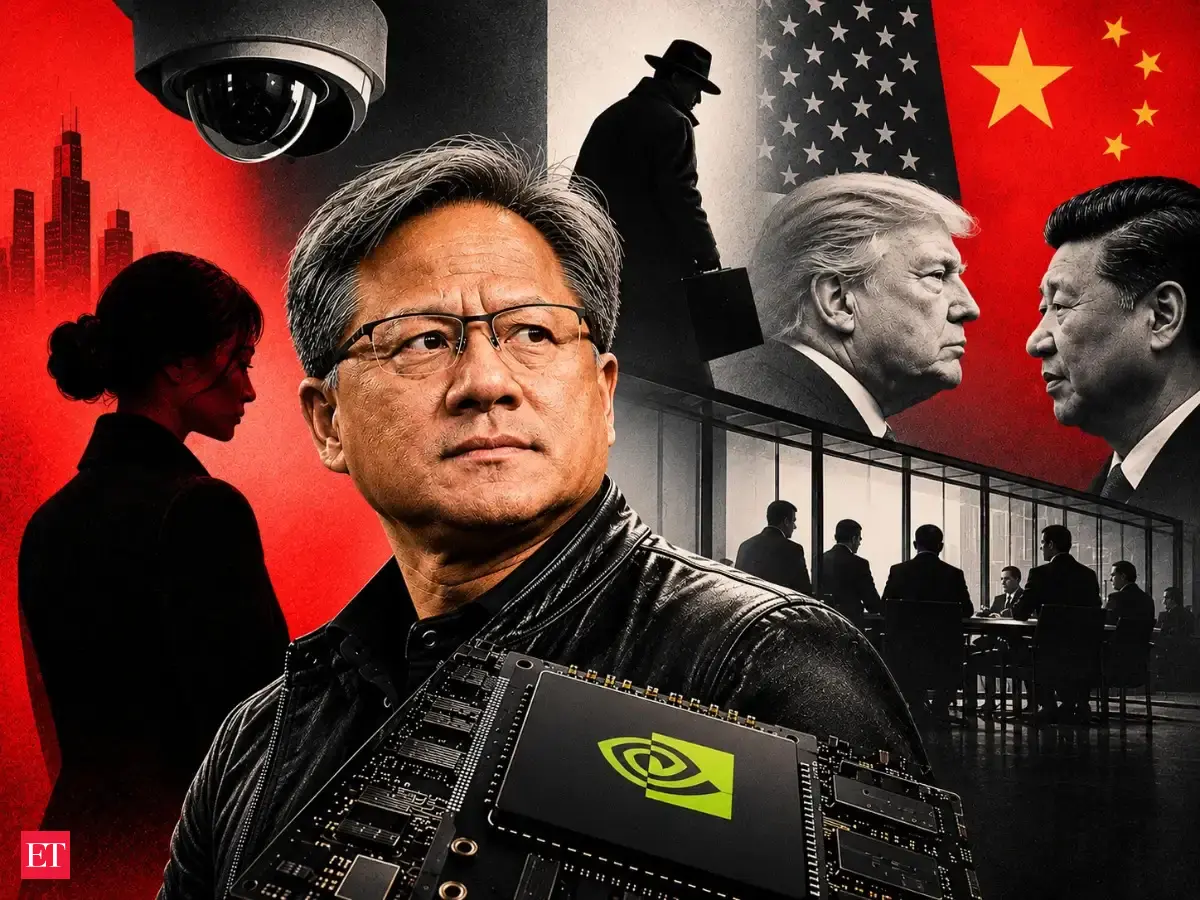
Nvidia started an investigation into CEO Jensen Huang after reports linked him to Alice Huang, a woman suspected of spying for Beijing. This case joins recent security scares at OpenAI and Google. These incidents show that human spies are back in the game, even as AI tools gain popularity.
Synopsis
The Nvidia controversy involving CEO Jensen Huang and a woman suspected by US intelligence of having links to Beijing has renewed concerns over corporate espionage in the AI industry. Recent cases involving OpenAI and Google have also highlighted risks from insiders and traditional spying methods.
Nvidia's decision to launch an independent investigation into CEO Jensen Huang's reported relationship with a woman, Alice Huang, a former executive of Megaspeed, suspected by US intelligence of spying for Beijing has brought an uncomfortable question to the fore. Is the AI industry becoming a new battleground for human espionage? Ironically, when AI tools are supposed to replace the old-style spycraft, human spies are back in the game in the Silicon Valley.
The Nvidia controversy follows the arrest of a former OpenAI engineer accused of planting a concealed listening device in an executive conference room at the company's San Francisco headquarters. It also comes after a former Google engineer was convicted of stealing confidential AI technology.
These incidents suggest that the AI revolution has not made traditional espionage obsolete. If anything, it may have given human intelligence a new lease of life.
The human spy in the age of AI
Live Events
The OpenAI case offers a striking illustration of how human intelligence is irreplaceable even in the AI industry. Abdulrahman Alfozan, a Saudi national who had worked as an engineer at the company since July 2025, was arrested last month and charged with attempting to intercept oral communications. According to the FBI complaint, a concealed recording device was discovered inside a USB port wrapped in toilet paper at the back of a television in an executive conference room. Investigators also found another similar device in his bag.
The room was regularly used for discussions involving confidential research, product plans, commercial opportunities and government engagements. Prosecutors alleged that Alfozan had used an AI chatbot to research recording devices and obtain information about OpenAI's meeting rooms and executive schedules. OpenAI said it had found no evidence that he accessed or extracted model weights, source code or customer data. The allegations have not yet been established in court.
The case is unusual, but the underlying objective is the old-style obtaining of information by gaining access to people and conversations rather than breaking into computer systems.
The Nvidia controversy brings another dimension to this. US intelligence agencies believed Alice Huang, a former executive at Singapore-based data centre company Megaspeed, was working for Beijing. She was reportedly suspected of cultivating a close relationship with Jensen Huang to gather information about Nvidia's strategy and its efforts to persuade Washington to relax restrictions on advanced chip exports to China. Huang has admitted to having a relationship with her.
The report has raised questions about the vulnerability of corporate executives whose relationships extend across geopolitical fault lines. However, the allegations remain unverified publicly. Singapore has also clarified that its government neither investigated Alice Huang nor raised concerns about her alleged intelligence connections, while confirming that investigations into Megaspeed are ongoing.
AI has changed the economics of espionage, not its human element
The case of former Google engineer Linwei Ding offers another insight into the problem. In January 2026, a federal jury found him guilty of stealing thousands of pages of confidential Google documents relating to AI technology. The material included information about Google's custom tensor processing units and computing infrastructure. Prosecutors said he had transferred the material while pursuing business interests in China.
However, a federal judge later ruled that prosecutors had failed to establish the necessary intent to benefit the Chinese government. The economic-espionage convictions were overturned, although the trade-secret theft convictions remained intact.
The case nevertheless highlights the importance of insiders. Unlike an external hacker, an employee with legitimate access can potentially obtain sensitive information without having to defeat the organisation's entire security infrastructure.
This is where AI presents an interesting paradox. AI agents can render human spies obsolete by executing flawless, high-speed cyber espionage that eliminates human vulnerability. Operating at digital scale, these autonomous systems can exploit zero-day vulnerabilities, bypass biometric security via hyper-realistic deepfakes, and silently exfiltrate classified data without the physical risks, emotional liabilities, or threat of defection inherent to human operatives.
This has dramatically reduced the cost of obtaining information. Algorithms can sift through enormous volumes of communications and public records to identify patterns that might otherwise escape humans.
But AI agents cannot independently retrieve a confidential conversation that was never recorded or discover an executive's private intentions simply by analysing stored information.
In fact, as AI technology becomes more strategically valuable, the importance of the people controlling it could increase. A handful of executives and senior engineers possess knowledge about future products, research priorities, government negotiations and commercial partnerships that competitors cannot easily obtain elsewhere. Human intelligence, therefore, is not necessarily being displaced by technological intelligence. The two can reinforce each other.
An AI espionage arms race
The emerging pattern has implications beyond corporate security. The US and China are competing for technological advantages that could shape their economic strength and military capabilities for decades. Advanced semiconductors, computing infrastructure and frontier AI models have consequently become matters of national security.
America's restrictions on Nvidia's advanced chips reflect its concern that access to powerful computing technology could strengthen China's military and intelligence capabilities. China, meanwhile, is investing heavily in domestic alternatives and pursuing greater semiconductor self-reliance.
The contest has echoes of the Cold War nuclear rivalry. Then, the superpowers competed not just to build more powerful weapons but to acquire information about each other's technological capabilities. Scientific secrets, research facilities and the people working inside them became intelligence priorities.
The AI competition could produce a similar dynamic, although the technologies and strategic calculations are different. Unlike nuclear weapons, AI is being developed largely by private companies whose commercial interests do not always align with government security priorities. This makes the intelligence landscape more dispersed and difficult to police.
There is also a new complication. AI itself can assist espionage by analysing stolen material, identifying potential sources and generating convincing digital identities. But the final breakthrough may still depend on persuading a human being to share information or gaining access to a room where important decisions are being discussed.
The Nvidia scandal comes right before Trump-Xi meet
The timing of the Nvidia controversy is particularly sensitive. It has surfaced just before US President Donald Trump is expected to meet Chinese President Xi Jinping at the upcoming APEC summit in China. The two governments are trying to preserve a fragile trade understanding. China has extended its suspension of certain trade measures for another two months, keeping the negotiations alive.
Nvidia sits close to the centre of this diplomatic contest. Its chips are essential to the global AI industry, while Jensen Huang has been lobbying Washington for greater access to the Chinese market. Megaspeed, the company previously associated with Alice Huang, reportedly purchased $4.8 billion worth of Nvidia chips over two years. It has also faced scrutiny over allegations of helping restricted chips reach China.
The intelligence allegations could complicate an already difficult negotiation. The US may face renewed pressure to scrutinise chip exports and the relationships between American technology executives and foreign customers. China, which has dismissed the allegations, could view the controversy as another attempt to undermine its technological ambitions ahead of the summit.
There is no evidence that the reporting was deliberately timed to influence the negotiations. Nor is there any public proof yet that Nvidia's secrets or US national security were compromised. The company's board has said it has no reason to believe either happened, while announcing an independent inquiry.
But the larger issue will outlast this particular controversy. As AI becomes a source of economic and strategic power, the people who develop and control it will attract growing attention from intelligence agencies and commercial rivals.
AI agents may be transforming how computers are hacked to access secret information, but they have not changed the fundamental value of knowing what another human being knows. In the emerging AI arms race, the human spy may remain a potent weapon.
(You can now subscribe to our Economic Times WhatsApp channel)
Explore More Stories
Sass Jordan cause of death: How did ‘Racine’ singer die after cancelling shows over ‘serious medical condition’?
Canadian rock singer Sass Jordan, voice behind ‘Make You a Believer’ and ‘Tell Somebody,’ dies at 63
Helicopter crash on Montreal’s South Shore leaves 4 dead; Transport Minister expresses condolences as probe begins
Nova Scotia teacher charged with sexually assaulting student at school as police identify more victims
Nova Scotia Crime: Teacher faces multiple serious charges, prohibited from public places after alleged assaults at Riverton school
Psychology explains why people who dislike being interrupted may be protecting more than just their train of thought
Powerball jackpot climbs to $313 million for September 21 drawing - Here's what Monday night's winner could take home
Quote of the Day by Malala Yousafzai: ‘One child, one teacher, one book, one pen can…’ - How one person can spark global change with the simplest tools
Quote of the Day by Thomas Mann: ‘Whoever loves the more is at a disadvantage and must suffer’ - Nobel-winning novelist on why the person who care more may have more to lose
Quote of the Day by Anton Chekhov: ‘Every happy man should have someone with a little hammer at his door to knock and remind him that there are unhappy people, and…’
Gary Myers death: NASCAR legend dies at 76; sons mourn ‘hero’ who shaped four generations of racing
Quote of the day by Rita Wilson: ‘Be fearless in trying new things, whether they are physical, mental…’ – Sleepless in Seattle actress on turning fear into growth
Manager keeps booking 4:45 PM Friday meetings despite team logging off at 5, employee calls it a ‘Friday ambush’ and asks if it’s a power move