
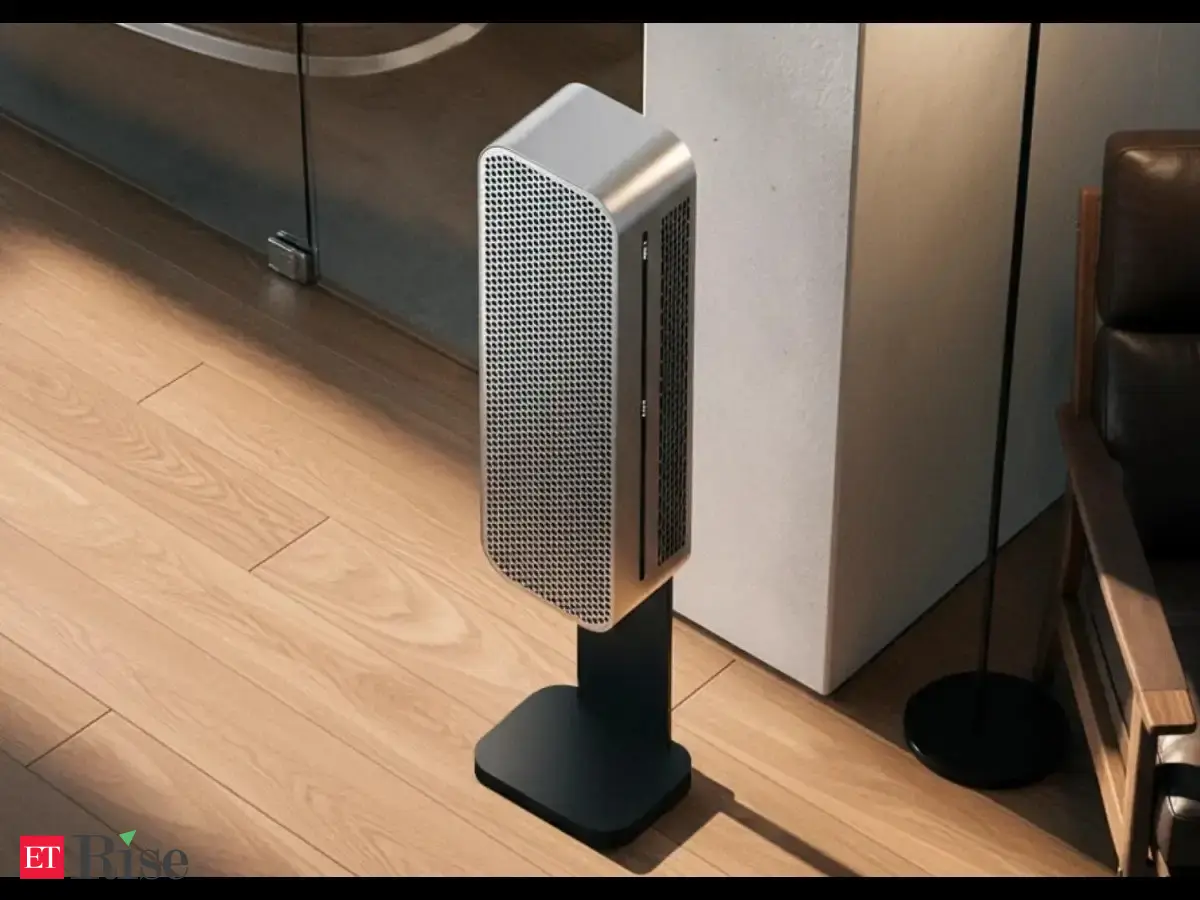
Mumbai-based firm Praan is creating custom air infrastructure for homes and offices. Founder Angad Daryani started the company in 2017 to build advanced purifiers. "That was what we set out to build," he said. Their flagship product, HIVE, is now used in 1,500 locations across India and the US.
Air purification technology firm Praan aims to go beyond providing clean air; it wants to create customised, personalised air infrastructure that makes your home feel like the Swiss Alps.
Stories of residents moving out of metro cities to escape worsening air pollution have been doing the rounds lately. For Mumbai-based Angad Daryani, who grew up with asthma, this was a reality long before pollution became a talking point. During the winter months, his parents would move to Pune so he could breathe more comfortably.
While pursuing his bachelor's degree in electrical engineering at the Georgia Institute of Technology, USA, Daryani realised that there was no equivalent of a 'Tesla for air'. "That was what we set out to build. Initially, we started with a moonshot idea: building air purifiers without filters and placing them outdoors. What began as a project with just me eventually grew into a team of around 180 people, with individuals from companies such as Tesla and SpaceX volunteering their time to help build the company," Daryani said.
Daryani founded Praan, an air purification technology firm, in Atlanta in 2017, with its manufacturing operations based in Mumbai. The company was officially incorporated in 2021. Its flagship product, HIVE, is an advanced air purifier designed for homes and indoor spaces.
HIVE is present in 1,500 locations. The majority of these locations are in India and the US. These include enterprise spaces, as well as cafeterias, hospitality establishments, and other commercial spaces.
"Today, HIVE is used by a large number of affluent households in India. Our customers include members of the Ambani, Piramal, and Jindal families, as well as members of the Indian cricket team and several actors," he said.
Ultrafine air
HIVE's working principle is similar to the standard household air purifiers using a filtration system, but it has added features around filtration efficiency, monitoring, and design. It uses medical-grade H14 HEPA filtration, alongside an activated carbon-based filtration system, while most air purifiers use H13.
The company claims HIVE has been tested for particles as small as 0.015 microns over the commonly referenced 0.3-micron HEPA test particle size. It is designed for 50,000 hours of use with a one-year warranty.
Angad Daryani, Founder and CEO, Praan
Daryani added that HIVE is currently being used in 10 countries, including San Francisco.
"In San Francisco the AQI can be below five, but companies use HIVE in indoor spaces, particularly those involved in robotics and hardware development. These environments generate ultrafine particles that can affect sensors, cameras, and bearings. HIVE is, therefore, used in specialised hardware and development spaces as well," he said.
Growing market
Ashwin Bhadri, Founder and CEO of Equinox Labs, an air, water, and food testing agency, said that some five years ago, the air purifier market used to be very niche and predominantly popular in cities such as Delhi in the winter months. Since the Covid-19 pandemic, people are becoming more conscious about the air quality in indoor environments.
"Significant developments have been made within air purification. HEPA (or HIVE?) filters are effective at capturing small particulates in the air. Activated carbon filters can be used to remove certain gases and smells. Other technologies, such as UV-C, ionisation, and photocatalytic oxidation, are being developed to improve air purification. However, I wouldn't consider any of these to be game changers in this sector yet. How effective they are depends heavily on how they are designed and utilised. I do believe a big opportunity in this sector is combining air purification, ventilation and real-time air quality monitoring," he said.
The air purifier market in India grew from $579.06 million in 2025 to $657.40 million in 2026. It is expected to reach $1,815.20 million by 2034, growing at a CAGR of 13.54%, according to iMarc. Some of the Made-in-India popular air purifier brands include Qubo, Aiither, and uBreathe.
HIVE air purifiers start from Rs 49,000, placing them in the premium segment of the Indian market, as most standard air purifiers for households range from Rs 7,500 to Rs 26,000.
Daryani, however, says pricing is not a major concern for the company, as it caters primarily to HNIs and ultra-HNI households, as well as enterprise customers. "Some individuals have more than 100 devices because of the size of their homes and offices. Blue Tokai, for example, is expected to have around 1,200 HIVE devices deployed by the end of the year," he said.
But he sees manufacturing as one of the main challenges. Unlike many other companies that rely on imports from countries such as China or Malaysia, Praan manufactures its products in India, which means building and managing an entire supply chain locally. This, he said, comes with its own set of challenges.
"As a start-up and a domestic manufacturer, we have to manage sudden spikes in demand, particularly during the pollution season. We often need to ship products almost immediately, depending on demand. However, scaling manufacturing capacity overnight is extremely difficult. It is a multi-quarter process that involves ramping up production cycles and the supply chain. Our factories operate 24/7. There is no Diwali, Christmas, or New Year at Praan because our manufacturing schedules overlap with the pollution season," he said.
Praan clocked a revenue of Rs 4.3 crore in FY25, compared to Rs 1.8 crore in FY24 and Rs 1.3 crore in FY23, according to data from Tracxn. Daryani said that by the end of next year, the company is expecting to clock $12-15 million in revenue.
Engineered air
The company is now evolving and scaling beyond air pollution to focus on air infrastructure. "I believe air pollution is a retrospective problem. Any country going through its developmental cycle will experience pollution-related challenges. However, air infrastructure is a global problem. The HVAC (heating, ventilation, and air conditioning) industry is more than 100 years old, and over the last century, we've largely focused on regulating temperature. However, rooms can still feel stuffy, diseases can spread faster, and temperature, air quality and CO₂ levels are not always balanced," he said.
The company claims HIVE has been tested for particles as small as 0.015 microns over the commonly referenced 0.3-micron HEPA test particle size. It is designed for 50,000 hours of use with a one-year warranty.
Even in the US, he said, one of the biggest concerns is indoor CO₂ levels and how they influence the spread of diseases. To address this, Praan has developed Sanctuary, which is currently invite-only. Sanctuary is an air infrastructure system that allows users to design the air in their rooms according to their preferences and physiology. "For instance, they can choose an environment inspired by the Swiss Alps or the French Riviera or have their room's air environment customised to suit their individual needs," he said.
He mentioned that within 60 days of showcasing the first demo of Sanctuary, the company signed approximately $37 million in conditional purchase agreements with Tier 1 developers in India. This has accelerated the timeline for Sanctuary's launch from November 2027 to December this year.
Praan has taken up the target to bring Sanctuary into 100,000 rooms in the next one year. These could be individual homes or hotel chains, where a single chain could have 10,000-20,000 rooms.