
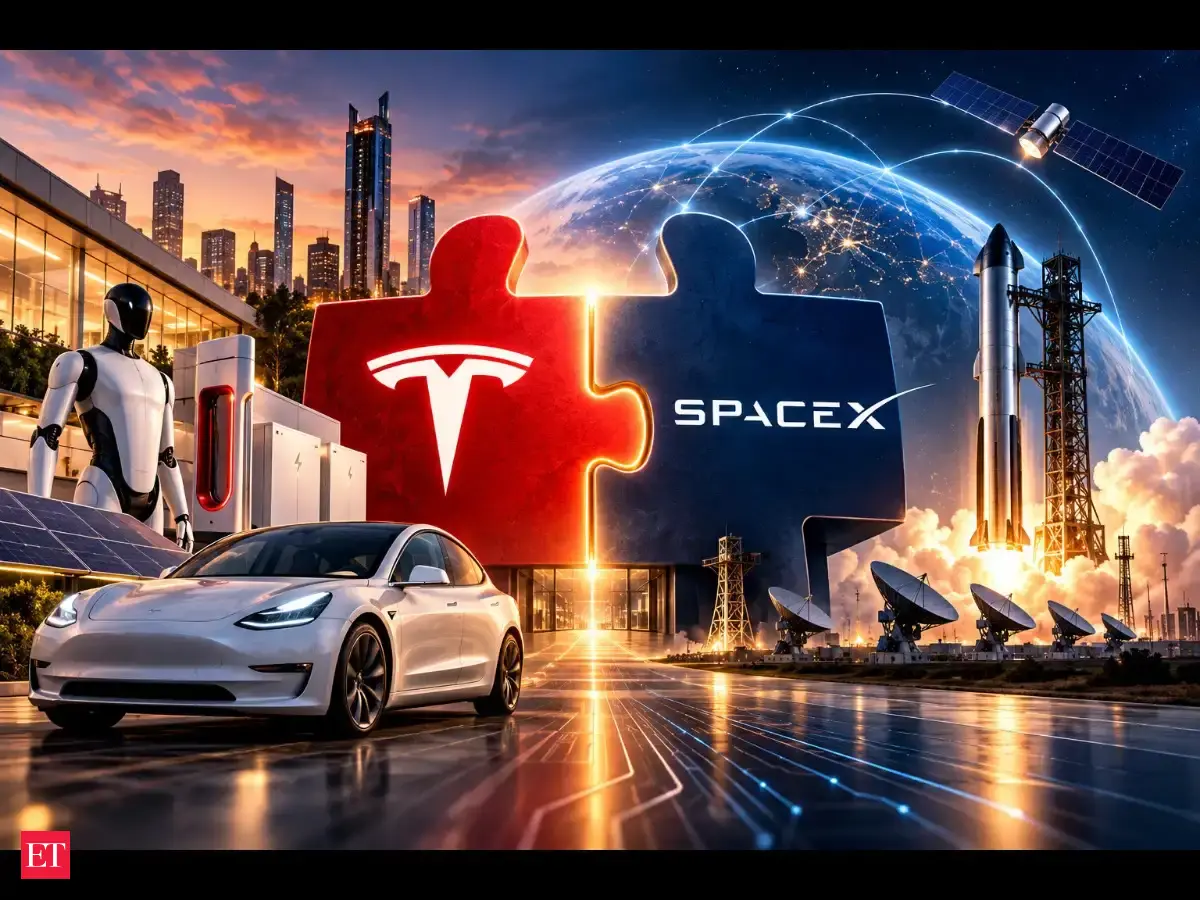
Elon Musk is considering merging Tesla and SpaceX to create a $3.5 trillion tech giant. Both companies formed committees to evaluate the proposal. During the October 20 earnings call, Musk said there was “a lot of merit” in combining the businesses. Investors remain skeptical about the potential financial risks involved.
Synopsis
Elon Musk is considering merging Tesla and SpaceX, with both companies forming committees to evaluate the proposal. This merger could enhance their collaboration in artificial intelligence and robotics, as both companies have overlapping interests. While Tesla may gain from SpaceX’s rocket-launch capabilities, there are concerns about financial risks and governance issues. Investors are skeptical, particularly regarding the potential burden on Tesla's existing operations.
Elon Musk wants to bring Tesla and SpaceX together in a deal that could create a $3.5 trillion technology giant. Both companies have formed independent special committees to examine a merger, but no terms have been agreed and Musk admits the outcome is uncertain. The market reaction has been notably restrained for Tesla, whose shares gained less than 2% in extended trading following his comments. The market response suggests investors might be asking how the deal can create value without overwhelming Tesla’s existing business. The strategic logic is of course compelling, but there could be valid questions too.
Why Musk may want this merger
The strongest argument for combining the companies is their growing overlap in artificial intelligence. Tesla is investing in autonomous driving, robotaxis and its Optimus humanoid robots. SpaceX is expanding into AI computing infrastructure alongside its rocket launches and Starlink satellite network.
During SpaceX’s third-quarter earnings call on October 20, Musk said there was “a lot of merit” in combining the businesses, particularly in developing AI software, robotics and computing infrastructure. The proposal gained momentum after SpaceX delivered a stronger-than-expected quarter.
Live Events
The two companies already collaborate on Terafab, a semiconductor project intended to produce chips for Tesla’s vehicles and robots as well as SpaceX’s computing operations. A merger could bring their engineering teams, capital allocation and infrastructure planning under one corporate roof.
There might also be a question of control. Musk holds roughly 85% of SpaceX’s voting power but around 20% of Tesla’s. Analysts estimate a combination could give him approximately 57% to 58% of the merged company’s voting rights, depending on the transaction structure. That would give Musk greater influence over businesses he sees as interconnected. It would also make the merger a governance issue, not merely a strategic one.
What each company brings to the table
Tesla would gain exposure to SpaceX’s rocket-launch business, Starlink and AI computing operations. This could give its investors access to growth beyond electric vehicles, particularly if autonomous driving and robotics take longer than expected to become major profit generators.
SpaceX, meanwhile, could benefit from Tesla’s manufacturing expertise, battery technology, energy storage and automation capabilities. Starlink’s connectivity infrastructure could also complement ambitions involving autonomous machines and future computing systems.
SpaceX generated $14.6 billion in third-quarter revenue and $4.4 billion in profit. AI had become a major contributor to the business as the company expanded its computing infrastructure. But growth comes at a price. Reuters reported that SpaceX expects capital expenditure of $35 billion to $40 billion in the fourth quarter as it continues investing in AI infrastructure. Its spending could become a major consideration for Tesla investors if the businesses combine.
A merger would not automatically make these investments more productive. It could simply place Tesla shareholders alongside a company committing extraordinary sums to infrastructure whose long-term returns remain uncertain.
Why the stock market is not getting carried away
Tesla shares rose less than 2% in extended trading following Musk’s comments, while SpaceX shares climbed much more sharply. SpaceX had just reported strong quarterly results, giving investors an immediate earnings story to assess. Tesla’s potential benefit from a merger remains hypothetical, with the terms, ownership split and financial consequences still unknown.
Investors may also have pressing questions about Tesla’s standalone performance. The company needs to demonstrate that its automotive operations can generate healthy margins while it pours money into AI, robotics and autonomous driving. A merger announcement does not resolve those concerns. However, JPMorgan analysts continue to see strong strategic logic in a potential combination.
But a good strategic fit can still produce a bad deal if the companies are valued incorrectly or if one shareholder group receives an unfavourable exchange ratio.
The financial risk
The biggest downside is the possibility that Tesla becomes a source of financial support for SpaceX’s enormous investment programme. SpaceX is expanding its AI computing capacity while developing costly space infrastructure. Those commitments could consume substantial cash even as its revenue grows.
Many think SpaceX’s capital spending could significantly dilute the combined company’s earnings and potentially outweigh Tesla’s net profits. That may be a risk scenario and not an established forecast, but it highlights the importance of examining the transaction’s financial structure.
The companies’ profits cannot simply be added together and treated as the earnings power of the new business. Capital expenditure, financing costs and the returns generated by new infrastructure would all matter.
There is a potential upside too. A larger group might have better access to financing and could coordinate investment more efficiently. But investors may want to know whether Tesla’s cash flows or borrowing capacity could be used to support SpaceX’s projects, and on what terms.
Shareholders face a difficult decision
The combined company could be worth around $3.5 trillion to $3.6 trillion, based on the companies’ reported valuations. But the headline figure says little about whether existing shareholders would benefit. The exchange ratio remains undecided yet. Tesla investors would want to know how much of the combined company they would own and whether the terms compensate them fairly for surrendering an interest in an established automotive and energy business.
As per a Reuters report, Tesla’s approval hurdle is particularly high. A majority of all outstanding shares must support the deal, rather than simply a majority of votes cast. That makes shareholder participation as important as shareholder sentiment. The independent committees will need to examine the transaction without Musk directing their deliberations. His substantial interests in both businesses create an obvious conflict, especially if the deal increases his voting control.
Regulatory hurdles and execution risks
The complications extend beyond shareholder approval. Reuters has highlighted the uncertain commercial prospects of orbital data centres and humanoid robots, both of which require heavy investment before their potential returns become clear.
There are also regulatory sensitivities. Tesla has substantial manufacturing operations in China, while SpaceX is a major US government contractor. Combining their operations could attract scrutiny over technology transfers, national security and access to sensitive information.
The merger could also make the combined company harder to evaluate. Rocket launches, satellite broadband, electric vehicles and AI infrastructure have different business cycles and competitive pressures. A sprawling corporate structure may create synergies, but it can also obscure the performance of individual businesses.
Will the strategic fit become a shareholder win?
Musk has made his preference clear, but the committees have yet not agreed on terms. He has warned against treating the merger as certain. Analysts expect a deal could emerge by the end of 2027, although that remains a forecast. Musk had earlier got backing of shareholders on the controversial compensation issue.
The case for combining the companies rests on shared technology and the potential to coordinate investment, and the case against it rests on the price, the governance structure and the risk that Tesla investors could inherit SpaceX’s vast spending commitments.
Shareholders would want to know whether a merger would create more value than continued cooperation as separate businesses and whether the benefits would justify the risks.