
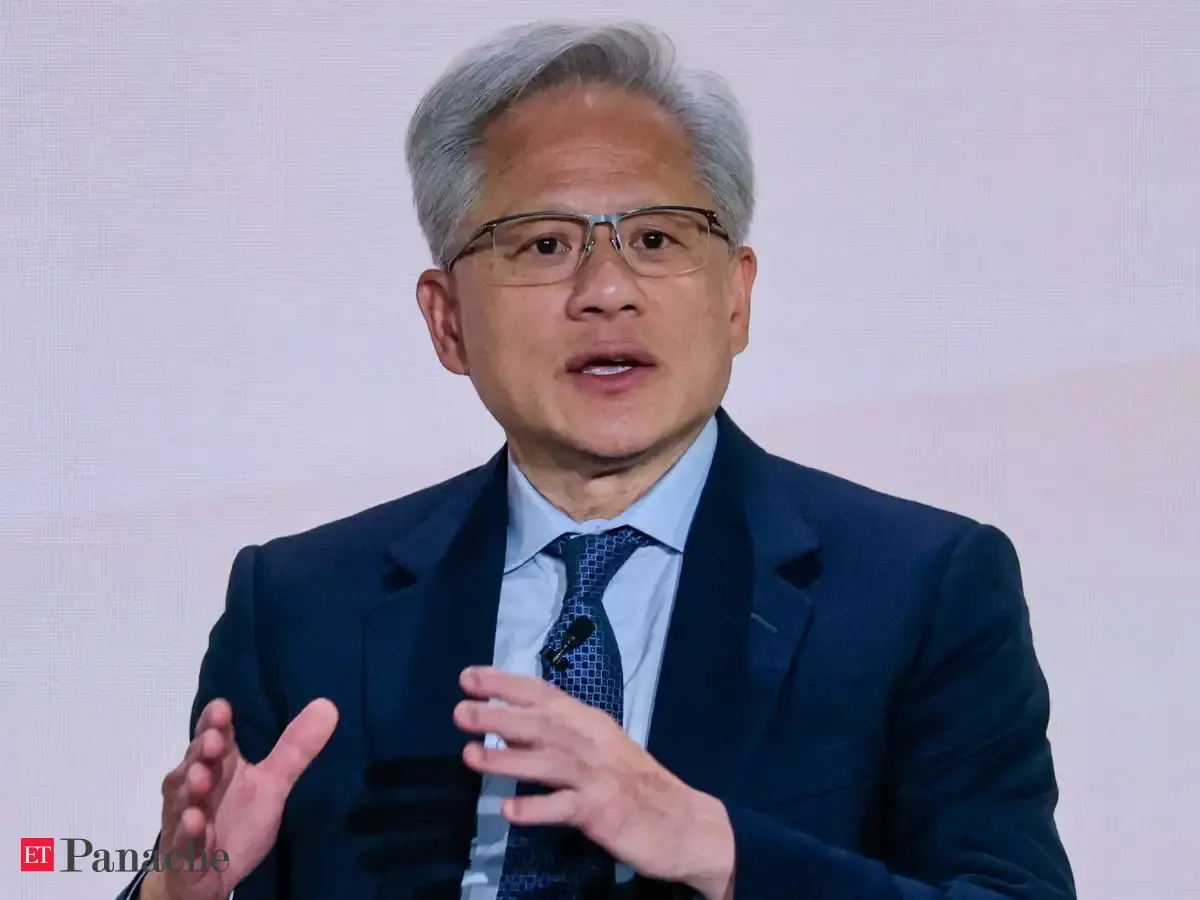
Jensen Huang cofounded Nvidia in 1993 to improve computer graphics. After a risky bet nearly bankrupted the company in 1996, he stayed focused on graphics-processing technology. This choice helped build Nvidia into an AI powerhouse. Today, Huang is the CEO and his net worth stands at $185.6 billion, according to Forbes.
Synopsis
Jensen Huang went from working as a dishwasher at Denny’s to becoming the billionaire CEO of Nvidia. The turning point came in 1993, when he cofounded the company with two engineers to develop chips for better computer graphics. After an early setback nearly bankrupted Nvidia, Huang backed graphics-processing technology that later became essential to artificial intelligence, helping transform the company into a global technology powerhouse.
Jensen Huang’s life journey from washing dishes at a Denny’s restaurant to becoming one of the world’s richest technology leaders started with a decision that could have costed him almost everything. In 1993, he cofounded Nvidia with two engineers which as huge bet on a new way to process computer graphics. Years later, that technology has helped turn the company into one of the biggest player in artificial intelligence (AI).
Huang, who started working as a dishwasher at 15, is now the president and CEO of Nvidia. His reported net worth stands at $185.6 billion, according to Forbes. The biggest risk he took was not simply starting a company, but that he went on to invest in graphics-processing technology that would eventually find applications far beyond video games.
The Denny’s meeting that started Nvidia
Huang’s business journey began long before Nvidia became a major name in the technology industry. Born in Taiwan in 1963, he moved to the US as a child and started working at Denny’s at the age of 15, as per Fortune.
After earning an electrical engineering degree from Oregon State University, he completed a master’s degree at Stanford University in 1992 and later worked at semiconductor company LSI Logic.
In 1993, Huang met his future cofounders, Chris Malachowsky and Curtis Priem, at a Denny’s restaurant in San Jose, California. The three discussed building a company that could develop chips capable of producing realistic 3D graphics on personal computers.
None of them had experience building a company together. But they decided to pursue the idea, eventually founding Nvidia.
In an interview with CBS News’ 60 Minutes, Huang recalled that he and his cofounders had little idea how to start a business. Their initial goal was to improve computer graphics as personal computers became more used by people.
One gamble that nearly destroyed the company
Nvidia’s early journey was far from smooth as According to 60 Minutes, its first attempt at developing the technology failed and nearly bankrupted the company in 1996.
Huang and his colleagues had to change direction. Their work on graphics-processing units (GPUs) eventually produced a technology that upgraded computer graphics and helped Nvidia survive.
A GPU is good at doing many calculations at the same time, for applications that require a lot of computing power. While Nvidia initially focused on gaming, Huang later backed the development of hardware and software that could support much broader applications.
That decision proved crucial. Researchers working on deep learning discovered that Nvidia’s GPU architecture was well suited to the demands of AI.
The company’s technology could now be used for tasks extending beyond gaming, including scientific research, drug discovery, weather forecasting and robotics.
How the AI bet changed Nvidia’s fortunes
Huang’s next major decision was to push Nvidia towards AI computing, even when the opportunity remained very uncertain.
The company developed hardware and software for GPU-powered computing systems that could handle demanding AI workloads. In 2016, Huang delivered Nvidia’s first AI supercomputer to Elon Musk, who at that time was also a board member of OpenAI.
As AI research moved further, Nvidia’s technology became more and ore important to developers building AI systems. The surge in demand for computing power helped propel the company’s stock market value into the trillions of dollars.
According to Forbes, Huang cofounded Nvidia in 1993 and has remained its CEO and president. He owns approximately 4% of the company, making his personal fortune closely tied to Nvidia’s market performance.
The same technology that once helped Nvidia survive a near-bankruptcy crisis has since become the biggest reason for its growth.
(Catch all the Business News, Breaking News, and Latest News Updates on The Economic Times.)
Subscribe to The Economic Times Prime and read the ET ePaper online.
...moreless
(Catch all the Business News, Breaking News, and Latest News Updates on The Economic Times.)
Subscribe to The Economic Times Prime and read the ET ePaper online.
...moreless
War's second-order effects are becoming visible in critical sectors
US mid-term elections – Part 2: What does it mean for Trump to lose control of Congress?