
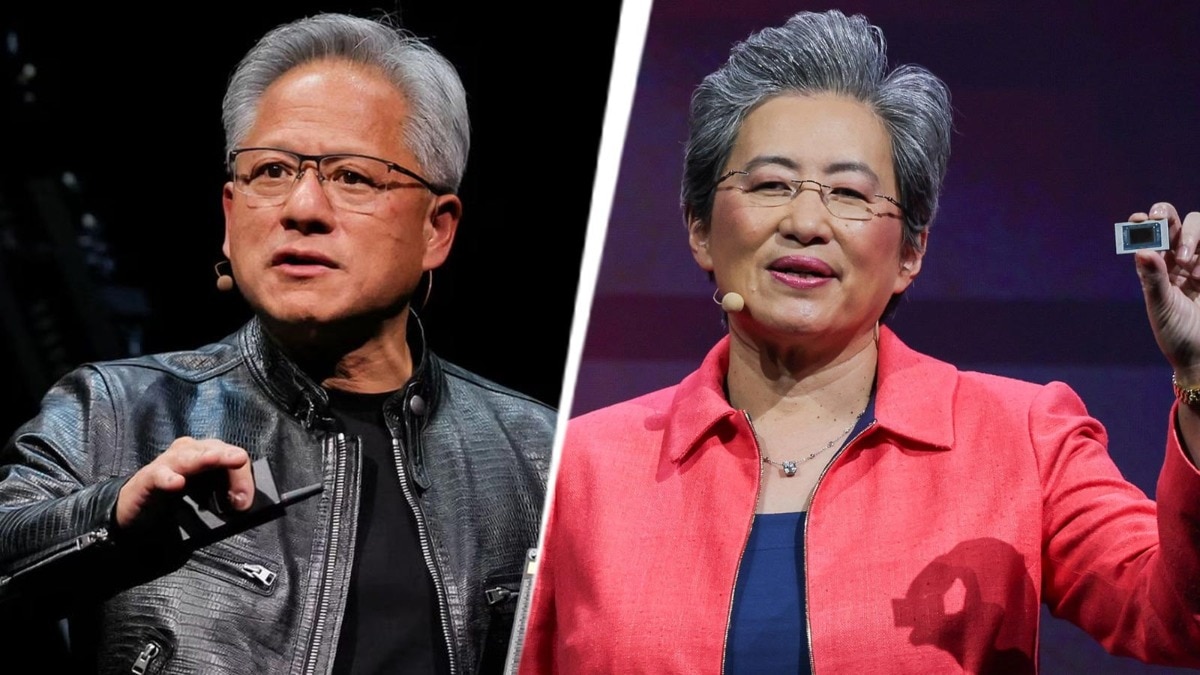
Yahoo Finance named AMD chief Lisa Su its CEO of the Year on Thursday, November 12. The news arrived as Nvidia co-founder Jensen Huang resigned. Su has led AMD through a 158% stock rally this year. These cousins now lead rival companies in a major battle for the technology industry.
A 158% stock rally, a CEO-of-the-Year award, a family connection between two rival chipmaking bosses and a congratulatory post that landed amid Nvidia's leadership crisis. Lisa Su's big moment has come at a rather extraordinary time for AMD.
It has been quite a year for Lisa Su. The AMD chief has overseen a spectacular stock-market run, struck major deals in artificial intelligence and helped position the once-struggling chipmaker as Nvidia's strongest challenger.
AMD, short for Advanced Micro Devices, is a US semiconductor company that designs processors and graphics chips used in computers, gaming consoles and data centres.
On Thursday, November 12, she added another accolade to that list when Yahoo Finance named her its CEO of the Year for 2026. But the timing of the recognition made the moment even more striking.
On the same day, Nvidia announced that its co-founder and longtime chief executive Jensen Huang had resigned with immediate effect. The development sent shockwaves through the semiconductor industry, putting the spotlight on AMD just as its chief was celebrating a year of remarkable gains.
And there is a family connection that makes the coincidence even more intriguing. Su and Huang are first cousins once removed, leading two companies locked in one of the most consequential battles in the global technology industry.
A 158% RALLY AND A CEO-OF-THE-YEAR CROWN
Yahoo Finance's recognition came after a stellar year for Su and AMD. The company's shares had risen 158% year-to-date, significantly outperforming Nvidia, whose stock was down 7% over the same period, according to Yahoo Finance's comparison.
AMD's market capitalisation briefly crossed $1 trillion in September, marking a major milestone for a company that was struggling to compete when Su took charge in 2014.
The business momentum has been backed by strong financial results. AMD reported record third-quarter 2026 revenue of $13.38 billion, up 45% from a year earlier. Its data-centre business generated $8.5 billion, a 97% jump year-on-year, driven by demand for EPYC server processors and its Instinct AI accelerators.
The company also reported adjusted earnings per share of $2.09, up 74% from the year-ago quarter.
For the fourth quarter, AMD expects data-centre revenue to rise 50% sequentially. Su has also outlined an ambitious growth outlook for 2027, projecting revenue growth of more than 80%, with server revenue expected to double and data-centre AI revenue more than double.
The numbers help explain why Su received the award. Her achievement is not merely about a rising share price. She has transformed AMD's business, expanded its product portfolio and pushed it into the centre of the AI infrastructure race.
NVIDIA'S LEADERSHIP CRISIS CREATES AN UNEXPECTED OPENING
While Su was receiving recognition, Nvidia was dealing with a sudden leadership upheaval.
The company announced on November 12 that Huang had resigned as president, CEO and board member, effective immediately. Chief Financial Officer Colette Kress was appointed interim CEO, while the board began looking for a permanent successor.
Huang's departure followed reports about multiple alleged extramarital relationships, including one involving a technology executive whom US intelligence officials reportedly suspect of having links to Chinese intelligence. Huang acknowledged being unfaithful to his wife and apologised to his family and Nvidia employees. The espionage allegations remain unproven.
The developments have raised questions about leadership continuity at a company that has become central to the global AI boom. Huang had been the public face of Nvidia's transformation from a graphics-chip maker into a leading supplier of AI computing hardware.
For AMD, the turmoil at its biggest rival could create an opportunity, even if it does not automatically translate into market-share gains.
A Washington Post report said AMD shares had climbed more than 30% in recent days as investors bet that the company could benefit from Nvidia's troubles. The market reaction reflects expectations of a possible shift in customer sentiment, rather than evidence that Nvidia customers have already moved their business to AMD.
A CONGRATULATORY POST, AND SOME VERY INTERESTING TIMING
The coincidence did not go unnoticed on social media.
AMD's corporate account took to X on November 12 to congratulate Su on the Yahoo Finance recognition, writing: "CEO of the Year has a nice ring to it."
The post appeared at 12.48 pm ET, after news of Huang's resignation had emerged. It drew a flurry of reactions, with users interpreting the timing as a cheeky dig at Nvidia and some describing it as corporate trolling.
AMD did not mention Huang or Nvidia in its post, and there is no evidence that the company deliberately timed the message to mock its rival.
But the timing was difficult to ignore. AMD was celebrating its chief executive's achievements just as Nvidia was confronting an unexpected leadership transition.
COUSINS, BUT FIERCE RIVALS
There is another unusual dimension to the rivalry. Su and Huang are distant cousins, belonging to the same extended family.
Both were born in Taiwan and moved to the United States as children. Huang co-founded Nvidia in 1993, while Su joined AMD in 2012 and became its CEO two years later.
Their professional paths have placed them on opposite sides of a high-stakes semiconductor contest. Huang built Nvidia into a dominant force in graphics processing and AI computing. Su took charge of AMD when it was struggling and steered it back into contention through processor innovation, acquisitions and a renewed focus on high-performance computing.
The family connection has often attracted attention, but their companies' competition is very real. AMD has been trying to challenge Nvidia's dominance in AI accelerators, where Nvidia continues to enjoy a formidable advantage through its hardware, software ecosystem and customer relationships.
CAN AMD TURN THE MOMENT INTO A LASTING ADVANTAGE?
The opportunity for AMD is significant, but the road ahead is not straightforward.
The company's latest results show that demand for its AI products is growing rapidly. Its Instinct MI450 accelerators and Helios rack-scale systems are designed to compete more directly with Nvidia's integrated AI computing platforms.
AMD has also secured major partnerships with technology companies, including OpenAI, Microsoft and Anthropic. These deals could help it establish a larger foothold in a market where customers are increasingly looking for alternatives to Nvidia.
However, Nvidia's competitive advantage is not built around Huang alone. Its CUDA software ecosystem, networking capabilities, manufacturing scale and deep relationships with major cloud companies remain formidable strengths. A change at the top does not erase those advantages.
For investors, the question is whether AMD can convert its current momentum into sustained market-share gains and earnings growth, rather than simply benefiting from a temporary shift in sentiment around Nvidia.
Su's CEO-of-the-Year recognition and Huang's departure have created an extraordinary contrast between the two relatives who lead rival chipmakers. But the more consequential contest will play out in data centres, AI infrastructure spending and the next generation of chips.
For now, AMD has plenty to celebrate. And the timing of its biggest rival's leadership crisis has made the moment all the more remarkable.