
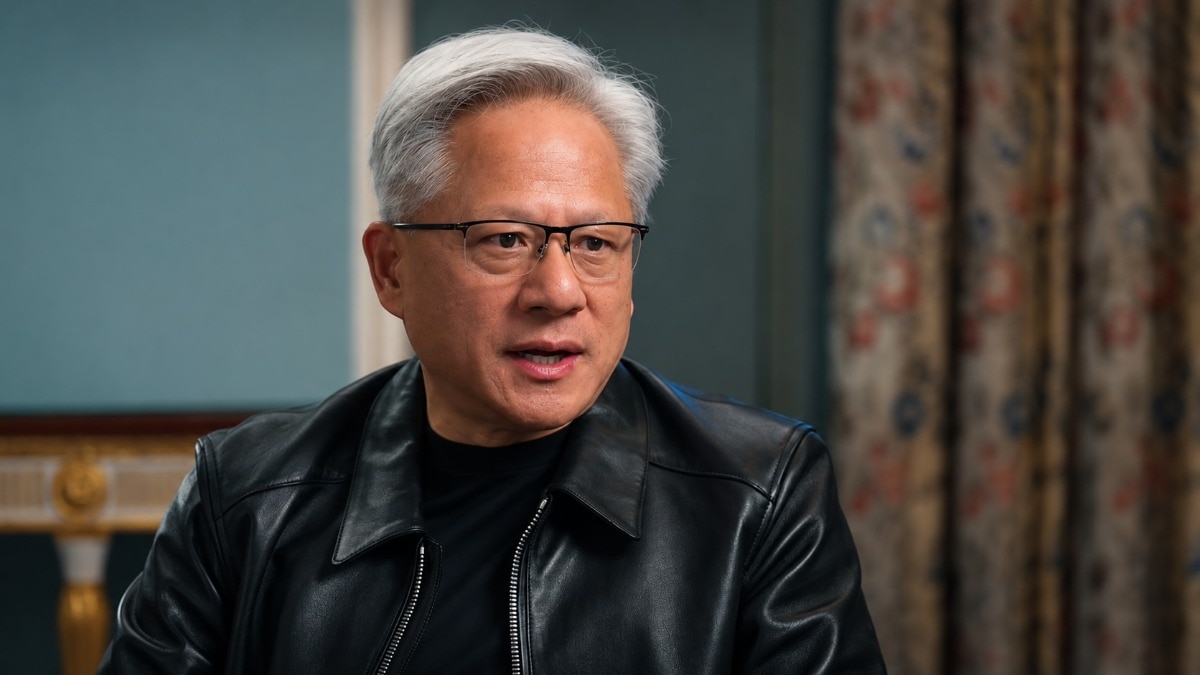
Nvidia founder and CEO Jensen Huang is out at the company this week following public reports of his affairs. His sudden exit threatens to prick the AI bubble, as many believe his leadership fueled the industry's growth. Nvidia supplies the essential chips that make modern AI developments possible for everyone.
Once upon a time Nvidia was a company only relevant to a small group -- avid computer gamers. But currently it sits at the centre of our current AI era. This week, with its founder and CEO Jensen Huang thrown out of the company, the risk to Nvidia also threatens to derail the march of AI.
Things seem to have slowed down somewhat in the world of AI. We are no longer getting frontier models every couple of weeks. The Chinese labs are relatively silent. The likes of OpenAI, Meta and Google are trying to consolidate whatever they currently have. Anthropic is busy with its IPO, which should hit the market in a few days from now.
Instead, the hot story in AI this week has been the sordid saga at Nvidia. After multiple affairs, with multiple personal and public implications, came out, Nvidia founder and CEO Jensen Huang is out at the company. It all happened rather quickly, with Huang leaving the company -- or rather forced to leave the company -- within days of his affairs with Chinese entrepreneur Alice Huang and Nvidia VP Kimberly Powell came out in public.
Much has been written about the affairs. So, I am not going to get into them. Instead, I want to talk about how the Jensen saga threatens to prick the AI bubble. You see Nvidia is not just another tech company and Jensen is not just another tech CEO.
Nvidia and, more notably, Jensen with his close personal relations across industries are at the centre of our current AI world. While OpenAI, Anthropic and others are the companies behind AI chatbots we all talk to, Nvidia supplies the goods that make AI a possibility. It has been there since the very beginning around 13 to 14 years ago. Its silicon chips and CUDA software have been key to almost all the major AI developments that have happened in the last 15 years.
But it is not Nvidia's technology that underpins the AI bubble. The technology underpins only the AI technology. The bubble, as many recognise it after seeing the amount of money companies and punters are spending on AI, has been partly fuelled by the way Nvidia and Jensen have gone about their business.
Jensen, for obvious reasons, has been one of the biggest cheerleaders for AI. After all, more AI means Nvidia can sell more chips. But his cheerleading has not been only about words. He has actually put his money where his mouth is. As Nvidia has earned record profits in the last couple of years, the company has invested back a lot of this money in AI startups. This has led to what many call a perverse loop: Nvidia invests money in AI companies, the same money is then used by the AI companies to buy Nvidia chips, which essentially increases Nvidia profits, so then Nvidia invests a portion of its profits back into AI companies.
And round and round we go.
In addition, Jensen and Nvidia have also done a fair amount of deal making with other AI companies. It has entered into forward-looking partnerships to supply chips and hardware for data centres that are yet to materialise. But such deals, by their nature, have inflated the financial size of the AI world, even if materially there is nothing behind them.
It's a gravy train. Nvidia is its engine.
But Nvidia is now under pressure and is taking a beating. In one month Nvidia share is down by a little over 25 per cent. The company no longer has a CEO. It also no longer likely has a viable plan to do any serious business in the Chinese market, more so because Jensen's alleged affair with Alice also has geopolitical flavour to it. In fact, in a way, Jensen is synonymous with Nvidia. Given that he is no longer in the driving seat, there is a very real chance that Nvidia will find it difficult to sustain its momentum.
If Nvidia loses momentum, the rest of the AI gravy train too hits breaks. What will that do to the bubble? We will see.
Who is behind Jensen Huang's downfall?
Given the central role Jensen Huang and Nvidia have in the AI ecosystem, there are a number of theories going around on his downfall. Who is responsible for it? Is it China? Or is it just Marco Rubio, the US Secretary of State playing his geopolitical games? Or is it Anthropic? Or maybe it is just plain stupidity from the Nvidia CEO who couldn't keep it in his pants?
Many theories. No tinfoil hats. But there are three worth discussing, particularly how quickly Jensen was ousted and how the whole thing has unfolded on the basis of two news reports.
One that seems particularly plausible is that Jensen flew too close to the sun. In the last two odd years he increasingly got entangled within the Washington DC apparatus. The US government is nowadays treating AI, and the Nvidia hardware that powers it, as a highly strategic resource. According to the US government, top AI models and Nvidia chips cannot be allowed to move throughout the world freely. Jensen, while following the US diktat, has been fairly vocal about the approach. He has advocated that Nvidia chips should be sold to anyone who wants to buy them -- though we are not sure if this is an outcome of his closeness with Alice Huang. Jensen has also taken an interest in open-source AI models.
Reports indicate that the US government was aware of Jensen and Alice's relationship. It was probably the reason why he was not, most likely due to objections from Rubio, originally invited to join Donald Trump's entourage for the meeting with Chinese president Xi Jinping. But then Trump allegedly overruled Rubio and Jensen boarded the Air Force One in Alaska. According to conspiracy theorists, this month some people in the US government decided that Jensen needed to go. They leaked the details of his affair to the media.
Another popular conspiracy theory too blames the government -- but on this occasion the Chinese government. This theory argues that the Chinese were aware of Jensen's affairs. The Chinese are also trying to deflate the American AI boom aka bubble because that will help Chinese labs and crash the US financial markets. This week they decided that the best way to go about it is to make Jensen and Nvidia hobble, and they leaked details of Jensen's affairs to the media.
The third theory argues that Jensen's affairs with Alice and Kimberly were open secrets. Lot of people knew about it. This week someone in another major AI lab -- Anthropic's name has gloated in unsubstantiated rumours -- decided to put a target on Jensen's back. The details were leaked to the media. Rest we know.
Of course, none of this negates the possibility that the Jensen saga is nothing more than what we see. A powerful tech tycoon had a couple of affairs, the media sniffed it and then reported on them, the moral outrage followed, combined with the geopolitical implications brought about by the involvement of Alice, and the Nvidia board decided to part ways with Jensen. In fact, this is the most likely story. But then the speed at which Jensen has been ousted, even before the Nvidia board could investigate the affairs, does raise some eyebrows.
Did AI lead to Outlook outage?
Microsoft suffered one of the biggest outages in its history this week after Outlook, and a couple of other services, went down for hours. Outlook is a service that is used by almost every sizeable company in the world and the fact that the mails were inaccessible for hours raises some significant questions.
One of them is: Did AI somehow lead to the Outlook outage? Was it because some people armed with AI tools attacked Microsoft servers? Or was it because some AI-generated code was deployed and then it broke something fundamental in the Outlook servers?
Microsoft has answered the question categorically. The company said, "This was a technical issue not related to cyber or AI (or) agents. The incident was introduced by an issue during an earlier network capacity upgrade that surfaced following a recent network change. We have addressed the underlying issue and continue to restore service to remaining customers and regions."
Reading between the lines, I believe Microsoft is saying that the Outlook outage was not due to any cyber attack or by any rogue AI. But the statement does not rule out the possibility that the outage was the result of vibe coding.
And even if it was, I am certain that Microsoft, or for that matter any tech company, will acknowledge it. In the last one year or so tech companies have fired thousands of employees, arguing that AI can take over a lot of tasks. They are not going to acknowledge when AI-generated code breaks something. Blaming vibe coding for something will mean: one, they are wrong in firing human engineers, and two, the AI is not yet ready for primetime. No one, and definitely not Big Tech, wants to be wrong.
Muse to arrive in India in 2027
In the last few months, one of the most exciting AI products has been Muse. Created by Meta, Muse is an AI agent that is simplest to use and is tuned for use by individuals who might not be very tech savvy. But currently Muse is only available in the US.
Now, we are getting some buzz around Muse launch in India. According to Meta India chief Arun Srinivas, Muse is likely to arrive in India in 2027. Once it is here, millions of Instagram, Facebook and WhatsApp users will be able to use Muse as their AI companion.
Around the same time, there is also chatter about its possible price. Though currently the price of Muse seems to be a placeholder, buzz indicates that it could be Rs 1,799 per month for the basic tier in India. The subscription that would give the maximum access to muse could cost as much as Rs 8,999 in India.