
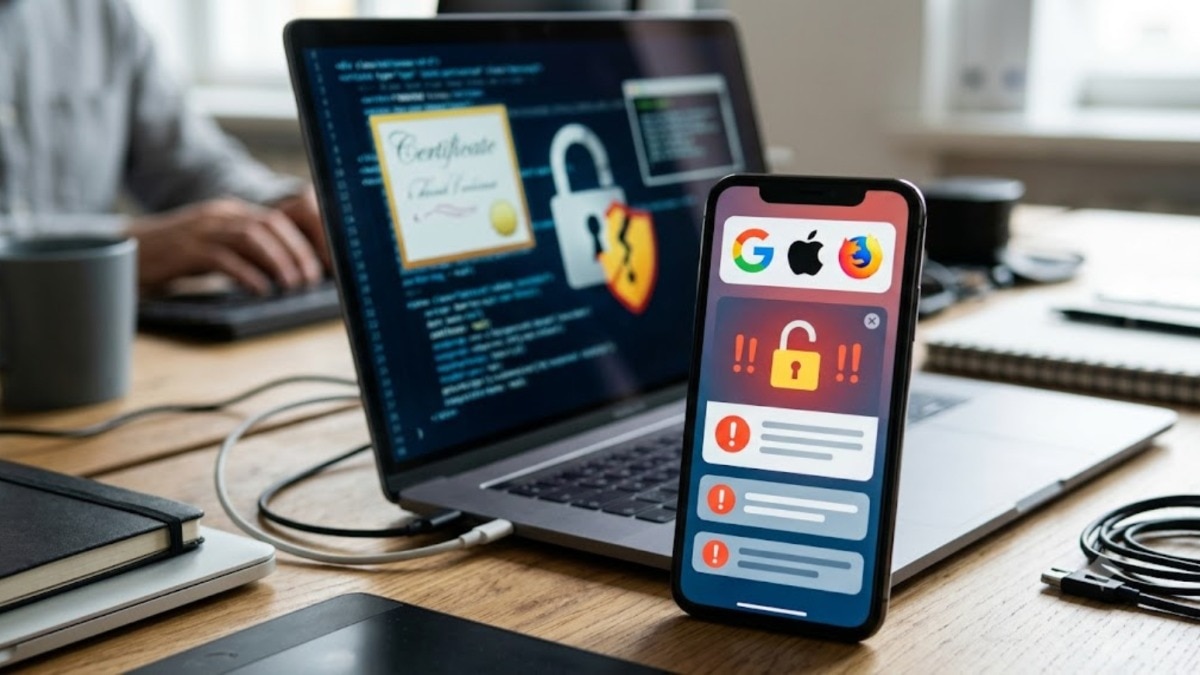
Google and Apple blocked eMudhra certificates on Tuesday after a researcher found they used weak security keys. Wayne sounded the alarm on October 17, showing how hackers could forge trusted sites. Ben Cartwright-Cox called the situation "bonkers," as experts fear this massive cleanup could be even bigger than Heartbleed.
Think of a digital certificate as a website's official ID card. It is what powers the little padlock icon in your web browser, promising that your connection is safe and your data is secure. But recently, a massive flaw was discovered in eight intermediate certificates issued by the Indian certificate authority eMudhra. These certificates had security keys that were shockingly weak, sending tech companies scrambling to prevent hackers from exploiting them.
A security researcher named Wayne sounded the alarm to tech companies on October 17. To prove he had cracked the weak keys, he set up a website called emudhra.we-have-a-problem.com and posted a digitally signed message reading, "We have a problem here - Wayne."
By doing this, he proved that anyone with these keys could easily forge a trusted certificate for any website on the internet, tricking users into handing over passwords or banking details.
Usually, a highly secure private key contains about 384 bits of complex randomness, resulting in a number so massive it has 116 digits, making it impossible for a computer to guess. Astonishingly, the compromised eMudhra keys were sized between just 3 and 8 bits.
Ben Cartwright-Cox, the director of BGP.tools, called the situation "bonkers," suggesting it was likely example code that accidentally leaked into production and expressing disbelief that nobody noticed the error.
A Cleanup Bigger Than Heartbleed
Cryptography experts are highly concerned about the long-term impact of this flaw. Filippo Valsorda, an engineer for the Go programming language, warned that fixing this mess will be a massive cleanup job that could be even bigger than the infamous 2014 Heartbleed bug. Heartbleed compromised thousands of servers globally and took years to resolve because it required updating embedded devices and rotating passwords on a massive scale.
Valsorda explained that while web browsers can be updated quickly, it will take a very long time to patch forgotten Linux machines, smart home IoT devices, and background server tools.
How Tech Giants Are Protecting You
The good news is that major internet companies moved at lightning speed. By late morning Tuesday, Apple, Google, and Mozilla had blocked the compromised certificates in Safari, Chrome, and Firefox. Cloudflare also deployed emergency fixes across its vast network and its popular 1.1.1.1 WARP app to keep users safe. The maintainers of the Go programming language rolled out urgent software updates to versions 1.27.3 and 1.26.10 to reject the compromised keys.
Are You at Risk?
As of right now, transparency logs show no evidence that these weak keys were used to issue malicious certificates. That is reassuring, but it does not conclusively rule out every possible misuse outside browser-visible certificate issuance. Furthermore, pulling off an attack using these compromised certificates requires an "adversary-in-the-middle" setup. This means a hacker would literally need to be sitting between you and the website you are visiting, like controlling the local Wi-Fi network.
For the everyday internet user, the tech giants have already done the heavy lifting in the background. To stay completely safe, your only job is to ensure that your web browsers, smartphone operating systems, and internet security apps are fully updated to the latest versions.