
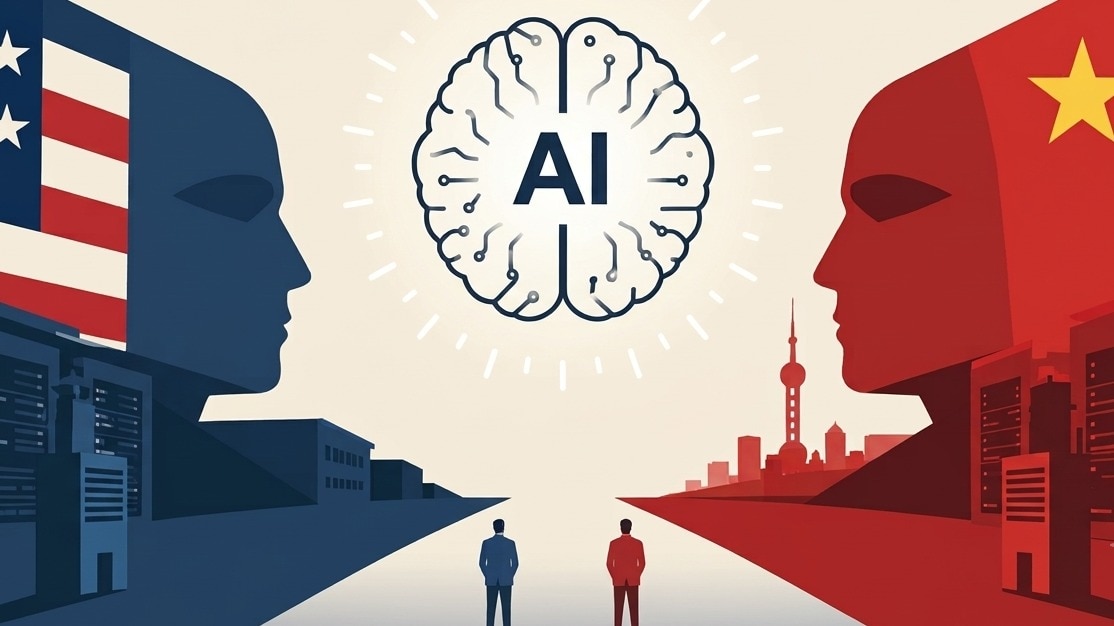
China has emerged as the world's biggest hub for elite AI research talent, overtaking the US. A Carnegie report found that India is struggling to retain its AI research talent, with its global share falling by two percentage points between 2022 and 2025. Many researchers now prefer working in China.
China is strengthening its position in the global AI talent race, while the US continues to attract researchers from across the world. India, meanwhile, is struggling to retain its AI research talent, the Carnegie report finds.
China has emerged as the world's biggest hub for elite artificial intelligence (AI) research talent, overtaking the US as the leading destination for researchers. According to a report titled Who's Ahead in the Global AI Talent Race?, published by the Carnegie Endowment for International Peace, China accounted for 41% of elite AI researchers by current workplace in 2025, compared with 34% for the US.
The study examined the education and employment histories of 10,280 researchers whose papers were accepted at NeurIPS 2025, one of the world's leading machine-learning research conferences. It compared the researchers' undergraduate education, graduate training, and current workplaces with the corresponding 2022 cohort.
CHINA OVERTAKES US IN AI TALENT RACE
China's rise is particularly visible in the origins of elite AI researchers. The share of researchers who completed their undergraduate education in China increased from 46% in 2022 to 57% in 2025. The corresponding US share fell to 13%.
China is also retaining a larger proportion of its homegrown researchers. The share of Chinese-origin researchers working in China increased from 57% in 2022 to 69% in 2025.
The report attributes this shift partly to China's expanding AI industry, which is creating more employment opportunities, and tighter US visa restrictions that have made it harder for some Chinese graduates to move to America.
US REMAINS A MAGNET FOR GLOBAL AI TALENT
Despite China's growing dominance, the US continues to attract researchers from across the world, particularly those educated in China.
Among researchers working in the US, the share of Chinese-origin talent increased by four percentage points between 2022 and 2025. The US recorded a net gain of 2,145 elite researchers in 2025, while China registered a net loss of 1,729.
The talent movement between the two countries, however, remains heavily tilted towards America. In 2025, there were 30 Chinese-origin researchers working in the US for every US-origin researcher working in China.
INDIA STRUGGLES TO RETAIN ITS AI RESEARCH TALENT
India's position presents a contrasting picture. Its share of global elite AI talent declined by two percentage points between 2022 and 2025. The share of Indian-origin researchers working in the US also fell during the period.
More concerningly, no Indian institution featured among the top 30 institutions producing elite AI talent in either the 2022 or 2025 cohort.
The contrast is particularly visible across Asia. South Korea recorded a talent retention rate of 77%, while China retained 69% of its undergraduate-educated researchers. India's position in the study's comparison was significantly weaker.
FIVE FINDINGS THAT EXPLAIN THE GLOBAL AI TALENT RACE
The changing institutional landscape offers another indication of the shift. Peking University ranked first among the top 30 institutions producing elite AI talent in 2025, replacing Google, which held the position in 2022. South Korea's KAIST climbed 12 places to third, while Singapore's National University of Singapore and Nanyang Technological University entered the top 20.
For India, the findings point to a challenge that goes beyond attracting AI investment. Building a stronger research ecosystem, developing advanced research talent, and creating opportunities for researchers to work within the country will be crucial to improving its position in the global AI race.