
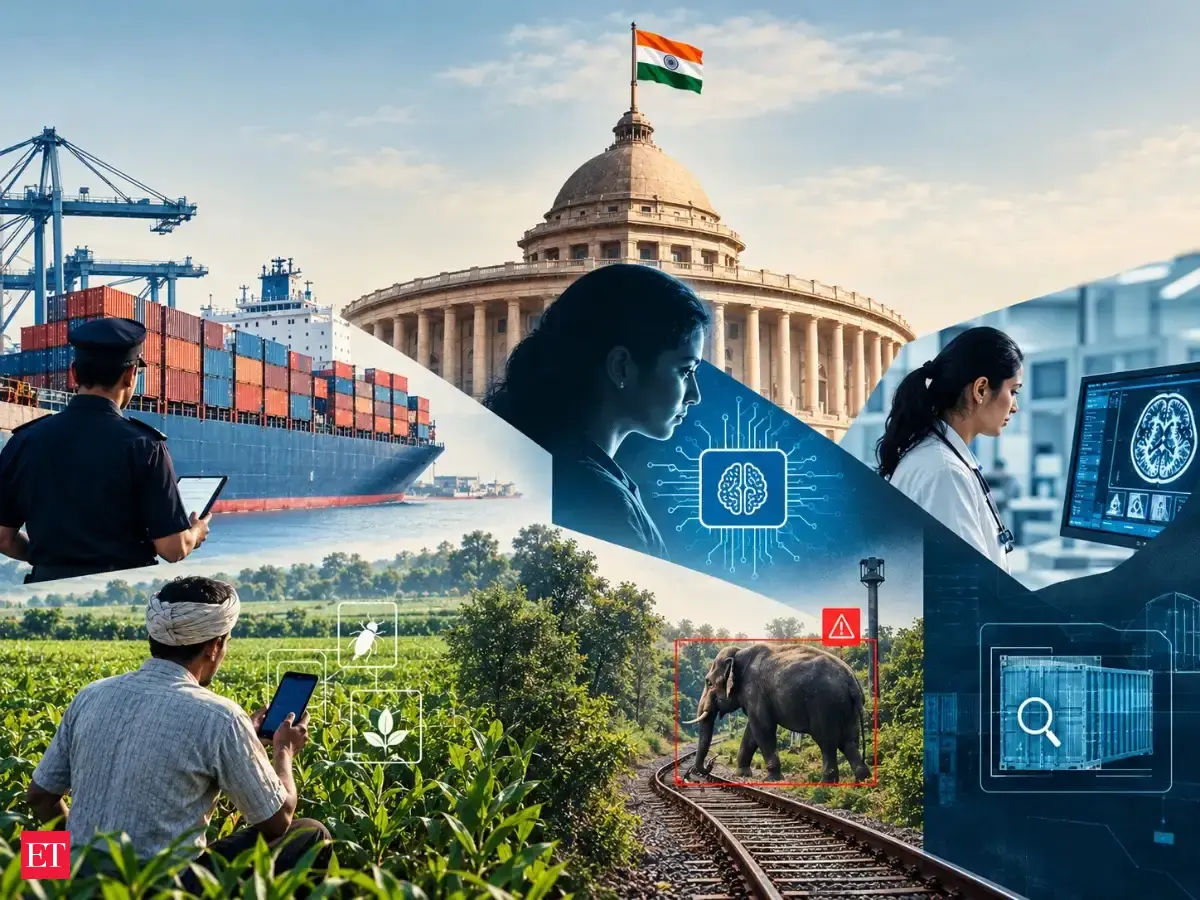
The Indian government identified 762 potential AI applications across 62 ministries to improve public services. Officials started using these tools for farming, railway safety, and tax compliance. As NSN Murty said, "Public-sector requirements can be defined more clearly." Many projects are already in use, while others remain in pilot stages.
Synopsis
The Indian government has identified 762 potential applications of artificial intelligence across 62 ministries and departments, spanning farming, railway safety, tax compliance, public grievances, customs and healthcare. While some tools are already in use, others remain in pilot or development stages.
What do an ambiguous cargo consignment, an elephant nearing the railway tracks and a farmer facing a pest infestation have in common? On the face of it, nothing.
However, each is a problem the government hopes to tackle with artificial intelligence (AI).
Across 62 central ministries and departments, officials have identified 762 areas where AI could possibly be implemented.
Some initiatives are in use; others remain at the pilot or planning stage.
According to Santosh Misra, partner at PwC India, India's digital public infrastructure — notably Aadhaar, UPI and GSTN — laid the foundation of this shift.
Live Events
He highlighted the IndiaAI Mission, approved in March 2024 with an allocation of ₹10,372 crore, and subsequent policy measures as significant steps towards integrating AI into government operations.
More than 170 deployed and scalable solutions feature in six IndiaAI sector casebooks.
Mitali Nikore, founder and chief economist at Nikore Associates, says tax, customs and grievance redress are among the better-documented areas of government AI use.
But deployment is only one measure of process. Allowing algorithms to contribute to administrative processes creates a difficult question: how should authorities handle an erroneous recommendation, especially when it negatively affects a citizen or business?
According to NSN Murty, partner at Deloitte India, "Public-sector requirements can be defined more clearly: which applications need to undergo independent evaluations, what must be revealed, who is accountable for the risk, and how can citizens seek redress?"
This question is especially relevant as AI moves into specific government functions.
In India's fields, AI is helping farmers detect crop threats
Delayed detection of pest attacks can lead to significant crop losses.
The Agriculture Ministry is using AI to help farmers identify pest attacks before they cause significant crop damage. Through its National Pest Surveillance System (NPSS), the ministry uses machine-learning models to analyse crop images for signs of pest activity and provide treatment recommendations to agricultural extension workers.
As of July 2026, more than 10,000 agricultural extension workers were using the platform, according to the ministry.
NPSS covered 73 crops and over 436 types of pests, according to government figures.
Farmers can also access Kisan e-Mitra — an AI-powered conversational platform providing information about government-sponsored agricultural programmes and assistance.
By December 2025, it had answered more than 93 lakh queries, handling over 8,000 a day in 11 regional languages, according to government data.
AI-based monsoon forecasting offers a more direct indication of how technology may affect decisions on the ground.
During the 2025 kharif season, a pilot sent local monsoon-onset forecasts by SMS to 3.88 crore farmers across 13 states.
Surveys in Madhya Pradesh and Bihar found that 31–52% surveyed farmers changed decisions about sowing or land preparation based on the forecasts.
Separately, as per a World Bank survey in 2025 involving about 250 villages in Telangana found that AI-enabled monsoon forecasts influenced farmers' crop and input choices.
The findings suggest that forecasts can influence agricultural decisions, although the programme’s reach and the quality of the resulting decisions are different measures of success.
Grievances are receiving an AI intermediary
It is often difficult for citizens to determine which government department should receive their complaint, particularly when an issue involves multiple authorities. The Centre has introduced an AI-based service to simplify this process.
Samadhan Didi, an AI-enabled voice chatbot launched by Minister of State for Personnel, Public Grievances and Pensions Jitendra Singh on May 30, 2026, allows citizens to lodge grievances by speaking in their own language.
The chatbot understands their concerns, asks clarifying questions and automatically identifies the appropriate ministry, department and complaint category before filing the grievance.
Samadhan Didi integrates with CPGRAMS — the Centralised Public Grievance Redress and Monitoring System — to interpret complaints, seek additional information from citizens if needed, and route them to the appropriate government authority.
Developed in collaboration with BHASHINI, it supports 22 languages recognised under the Eighth Schedule of the Constitution, in addition to English.
The wider grievance-redress system has seen a substantial increase in usage. According to government figures cited by Nikore, annual grievances rose from around two lakh in 2014 to more than 25 lakh, while the reported disposal rate exceeded 95%. CPGRAMS' average disposal time also dropped from 157 days in 2014 to 15 days in 2025.
These figures, however, describe CPGRAMS as a whole and cannot be attributed to Samadhan Didi, which was launched in 2026.
On railway tracks, AI is tracking elephants
AI is also helping detect elephants near railway tracks in Northeast India.
AI-enabled intrusion detection systems alert locomotive pilots, station masters and control rooms when elephants approach railway tracks, giving railway personnel time to prevent collisions.
In December 2025, the Railways Ministry notified Parliament that AI-enabled intrusion detection systems had been deployed across 141 route kilometres along the Northeast Frontier Railway.
Elsewhere, the Railways is piloting AI to predict signalling failures and detect loose or missing components on moving trains. AI-based Video Analytics are also being used at railway stations to detect unauthorised access, loitering and identification through facial recognition technology.
Tax departments are using AI to flag suspicious transactions
Tax departments use data analytics and AI-based tools to identify transactions requiring further investigation, including potentially invalid input tax credit claims, circular trading activities and other irregularities.
Nikore, citing Central Board of Indirect Taxes and Customs (CBIC) report, says the GST Network's Business Intelligence and Fraud Analytics (BIFA) engine scores taxpayer networks using data that includes customs records, income-tax information, e-way bills and UIDAI data. Such tools can help authorities identify patterns that warrant scrutiny, but a risk score is not proof of fraud.
Developed by the National Informatics Centre, GST Prime analyses GST records and e-way bills to help authorities identify irregularities.
According to NIC documentation updated in May 2026, GST Prime generates more than 80 analytical and statistical reports, as well as forecasts of tax collections using AI-based models.
The Income Tax Department's NUDGE campaigns provide another example of analytics-led compliance. According to a Finance Ministry data cited by Nikore, the campaigns led to around 1.25 crore revised returns and ₹9,493 crore in additional tax.
The Income Tax Department’s NUDGE campaigns provide another example of analytics-led compliance. According to Finance Ministry data cited by Nikore, the campaigns led to around 1.25 crore revised returns and ₹9,493 crore in additional tax.
The use of AI and analytics in direct-tax administration extends beyond these campaigns. In a March 2023 reply to Parliament, the Finance Ministry said the Central Board of Direct Taxes (CBDT) uses data analytics, big data and AI/machine learning to identify high-risk cases for scrutiny, flag apparent mismatches between income-tax returns and reported transactions, map taxpayer relationships to identify potentially risky transactions, and target compliance campaigns at taxpayers considered more vulnerable to tax evasion.
However, these results do not isolate AI's contribution from other forms of data analytics or establish how much additional revenue would otherwise have gone uncollected.
AI enters cargo screening
Each year, Indian customs officials screen import and export declarations for inaccurate information, questionable valuations and other anomalies.
A World Trade Organization (WTO) case study published in July 2026 describes an AI-based cargo assessment system under development at the National Customs Targeting Centre for Cargo.
Beyond predefined screening criteria, the proposed system would identify anomalies in customs records, including multiple identities per declaration, implausible addresses and inconsistencies between declared goods and tariff categories. It is also designed to interpret cargo X-ray images.
However, none of the project's components had been deployed nationally as of July 2026. Before any risk indicators generated by the models are put into operation, customs officers will, however, review and approve them.
Putting AI in healthcare to the test
In healthcare, where an inaccurate assessment may affect treatment decisions, the government is establishing frameworks for evaluating AI models before broader deployment.
Union Health Minister JP Nadda announced two programmes in February 2026: SAHI (Strategy for Artificial Intelligence in Healthcare for India) and BODH (Benchmarking Open Data Platform for Health AI).
BODH, developed by IIT Kanpur and the National Health Authority, is designed to evaluate AI models for accuracy, bias and performance across different population groups.
The Centre is also offering grants of up to ₹50 lakh for AI-based cancer care pilots and up to ₹1 crore for broader deployment.
From experimentation to accountability
While ministries experiment with AI, the government is developing safeguards through Ministry of Electronics and Information Technology’s (MeitY) India AI Governance Guidelines, released in November 2025; the inter-ministerial AI Governance and Economic Group, established in April 2026; and 13 IndiaAI Mission projects addressing algorithm auditing, bias and privacy.
In a written reply to the Rajya Sabha on December 19, 2025, Minister of State for Electronics and Information Technology Jitin Prasada said the India AI Governance Guidelines adopt a "risk-based, evidence-led and proportional governance approach”, with sectoral regulators responsible for oversight within their legal mandate.
He said the guidelines “do not introduce new statutory mechanisms such as independent audits, appeals, or new oversight bodies”. Instead, they “rely on existing laws”. These include the Information Technology Act, the Digital Personal Data Protection Act, and sector-specific regulations.
The government is also building the data infrastructure needed to support AI. MeitY has established AI curation units across 50 key ministries to identify valuable government datasets and integrate them with AIKosh, the IndiaAI Datasets Platform.
By December 2025, AIKosh had more than 9,500 datasets and 273 sectoral models.
The Centre has also empanelled six companies to help government departments build and operate AI applications.
Nikore argues that India's AI Governance Guidelines rely largely on voluntary measures.
She points to the UK's requirement for central departments to publish algorithmic transparency records and recommends a public register of India's government AI systems, alongside independent audits and impact assessments before high-stakes decisions are automated.
She recommends that departments record AI-generated recommendations and instances in which officials override them. Citizens should also be able to obtain a reasoned decision and have it reviewed by a human official.
As government AI usage expands, effective oversight, transparent evaluation, and clear accountability will help ensure that these systems deliver better public services.
(You can now subscribe to our Economic Times WhatsApp channel)
The tough business behind the walls
KYC and KYB: Inside Damani’s DMart, the retail chain for the middle class. And stock for the long term? – Part 2 of 3
Will it be a regulatory nightmare if an exchange lists on its own platform?
KYC and KYB: Inside Damani’s Avenue Supermarts that refuses to charge more – Part 1 of 3
Will oil turn into a lingering problem? Is the world economy, India, or the market prepared?
KYB and KYC: Business behind the wealth creator called ‘Divi’s Lab’ – Part 2, concluding