
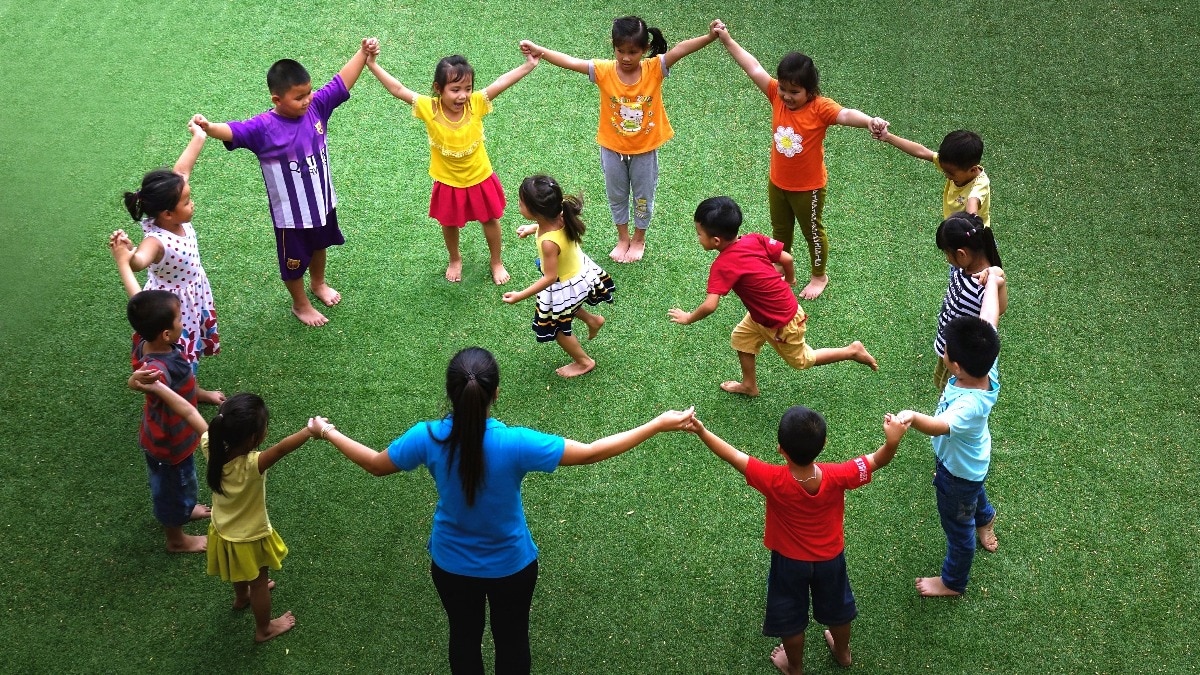
The 2022 India Report Card on Physical Activity for Children and Adolescents showed Indian children got a C grade for physical activity. Experts say sport teaches grit better than digital classrooms. Simran Mulchandani said, "Sport shapes character, grit, resilience, discipline, commitment, drive and depth more than any education can."
As screens and artificial intelligence become a bigger part of children's learning, the playground is losing ground. Experts say sport could teach children some of the most important lessons that textbooks and digital classrooms cannot.
Imagine two children facing a setback. One gets a question wrong in a test. The other misses a crucial goal during a football match. Both have failed, but what happens next may teach them very different lessons.
The first child can look at the correct answer. The second must decide whether to try again, how to deal with disappointment and how to face teammates who were counting on them. There is no answer key for that moment.
Yet, in many schools, such experiences are squeezed between classes, homework and exam preparation. Play is often treated as a reward for finishing work, rather than an essential part of learning.
India's research on children's physical activity offers reason to pause. The 2022 India Report Card on Physical Activity for Children and Adolescents, published in the Journal of Exercise Science & Fitness in January 2023, gave Indian children and adolescents a C grade for overall physical activity and a D grade for sedentary behaviour. It also found that sedentary behaviour had worsened across successive report cards.
As schools prepare children for an AI-driven future, this raises a question: in the rush to teach children how to use technology, are they getting enough opportunities to learn how to deal with people?
"Sport shapes character, grit, resilience, discipline, commitment, drive and depth more than any education can," says Simran Mulchandani, co-founder and chief executive officer of Rangeet.
For him, the playground is not simply a place to burn off energy. It is where children begin learning to handle situations that cannot always be solved by following instructions.
WHEN THERE IS NO ANSWER KEY
A child loses a race. A teammate refuses to pass the ball. A group disagrees over who should lead. These may seem like small moments, but each demands something from a child: patience, communication, emotional control or the willingness to start again.
Mulchandani has seen this through his experience of hiring graduates and raising a son who is a professional sportsperson. He says he would actively seek out sportspeople among job applicants, all else being equal.
"The ability to wake up every day and get back to it, rain or shine," he says, builds character and grit.
Nidhi Shukla, co-chief executive officer of Girl Rising, makes a similar distinction between understanding a concept and putting it into practice.
"A classroom can teach us the theory, a sports field gives us the opportunity to put that learning into practice," she says.
A child can learn about teamwork in a lesson. On a field, however, they must decide when to lead, when to listen and how to respond when a plan falls apart. They learn to make decisions under pressure, work with different personalities and handle setbacks.
These skills matter in group projects, job interviews, workplaces and everyday relationships.
THE COST OF A CHILDHOOD SPENT ON SCREENS
Now consider what happens when those opportunities become less frequent.
Children can spend hours connected to friends, classmates and online communities, yet have fewer chances to navigate disagreements face to face. A message can be ignored, a game closed and an awkward interaction avoided. In person, children have to read expressions, negotiate boundaries and work out how to move forward.
Mulchandani worries that these everyday opportunities are disappearing.
"They are hyper-connected and lonelier than ever, living in a world of social comparison, fake news and cyberbullying," he says.
The evidence on screen use among young children adds to the concern. A 2025 systematic review and meta-analysis titled Screen Time Among Under-Five Children in India, published in Cureus, analysed 10 studies involving 2,857 children. It estimated average daily screen time at 2.22 hours.
The researchers also discussed the declining prevalence of outdoor games, although the studies varied considerably and the estimate should not be treated as representative of every Indian child.
The problem is not that every screen is harmful or that digital learning has no place in education. It is that time spent online cannot provide every experience a growing child needs.
Shukla puts it simply: "What children risk losing is not simply physical activity, but real-world experience."
CAN SPORT AND AI SHARE THE SAME CLASSROOM?
This need not become a battle between technology and traditional play. Schools do not have to choose between teaching children to use AI and giving them time on a playground.
Shukla argues that digital literacy, artificial intelligence and sports should be treated as complementary parts of education. Technology can help children access information and explore ideas; play gives them opportunities to put their learning into practice with other people.
At Girl Rising, the Rise Premier League brought this approach to a cricket field. Skills such as leadership, resilience, teamwork and negotiation, introduced through the RISE classroom curriculum, were practised through sport.
Girls who had never played sport became captains, while boys learnt to collaborate and support one another as equals. The field became a space where lessons discussed in class had to translate into actual decisions and behaviour.
The distinction matters in an AI-shaped world. Children will need digital skills, but they will also need judgement, empathy and the ability to work with people whose opinions differ from their own.
THE MOST IMPORTANT LESSON MAY NOT BE ON THE REPORT CARD
Making room for play does not necessarily require expensive facilities or professional coaching. Schools can begin by protecting time for daily physical activity, encouraging inclusive games and ensuring that sport is not reserved for children who already excel at it.
The aim is not to produce a school full of athletes. It is to give every child the chance to experience cooperation, disappointment, responsibility and the satisfaction of improving through practice.
Mulchandani believes character deserves to be valued as seriously as academic performance. Shukla, too, argues for an approach to education that is holistic, inclusive and experiential.
That challenge becomes especially important as AI takes on more tasks involving information, content and problem-solving. Preparing children for the future will mean more than teaching them to find answers quickly. They must also learn what to do when there is no obvious answer, when a teammate needs support or when failure demands another attempt.
As Mulchandani recalls a school principal in Madurai telling him: "Academics comes second -- what comes first is character and play."
Perhaps the real question is not whether schools can afford to make time for play. It is what children might miss if they do not.