
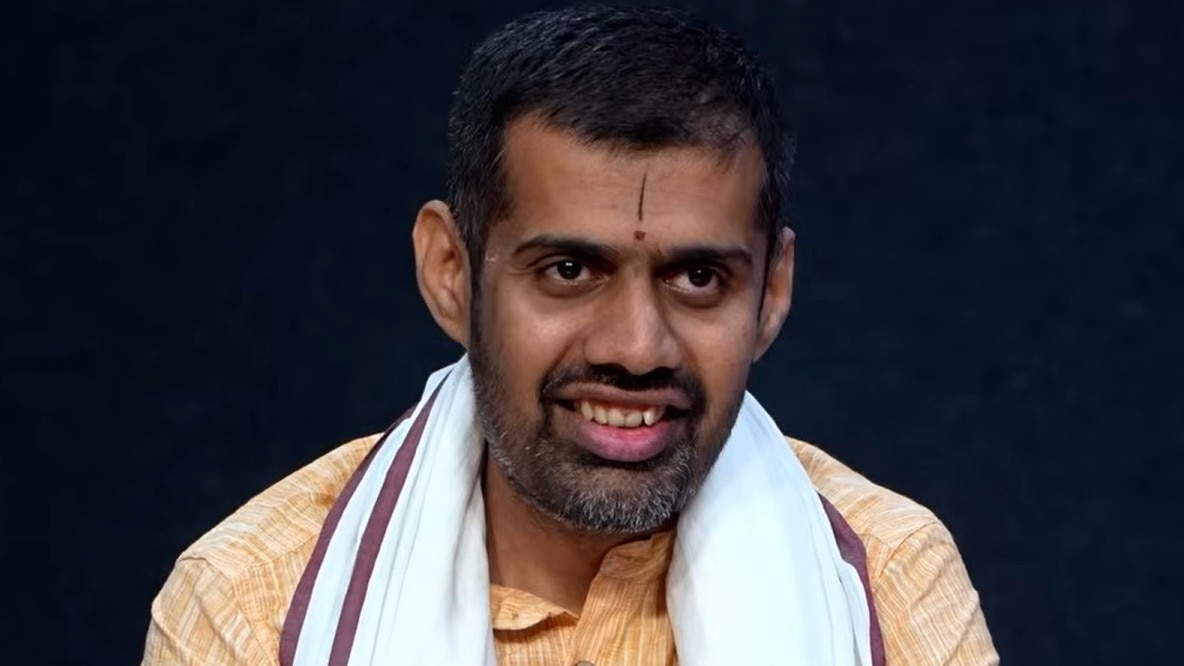
IISc Bengaluru professor Pratosh AP said IIT students are studying shastras under his guidance. He noted that many students want to explore traditional knowledge alongside modern AI studies. "I'll tell you what, some of my IIT students are studying shastra with me today," he said, encouraging deep logical inquiry.
As artificial intelligence and computer science occupy an increasingly prominent place in contemporary education, IISc Bengaluru professor Pratosh AP has raised questions about the relevance of traditional Indian knowledge, citing the example of IIT students who are studying shastras under his guidance.
Speaking on the relevance of Vedic education, the professor said that some of his students from the Indian Institutes of Technology (IITs), including students who had performed well in the Joint Entrance Examination (JEE), had approached him to understand why Sanskrit and shastras should form part of their intellectual pursuits.
"I'll tell you what, some of my IIT students are studying shastra with me today," he said.
He recounted the case of one student who had continued learning Nyaya Shastra under him for five years. The student, according to the professor, had initially approached him with the intention of challenging his arguments and establishing that his views were incorrect.
"One of my students tells me that I come to you to learn and I stay here with you for 10 years just to prove that what you are saying is wrong," he said.
The professor said he welcomed such an approach, adding that he did not mind if students eventually arrived at materialist conclusions, provided they did so through intellectual inquiry and logical reasoning.
"I don't worry if they end up becoming Charvakas. At least they will become great Charvakas with great intellectual and logical conclusions," he said.
AI AND THE QUESTION OF TECHNOLOGICAL RESPONSIBILITY
A major part of his address concerned artificial intelligence and the questions its development raises for society. Referring to AI as a powerful force that humans are still learning to deal with, he argued that the study of shastras could offer a framework for considering how such technologies ought to be used.
Drawing a connection with the Mahabharata, he said that algorithms should be constructed in a manner that leads to the betterment of human life.
He questioned what might happen when powerful technological tools are placed in the hands of people without an understanding of dharma.
The professor also referred to transformer architecture, which underlies contemporary AI systems, while explaining the relationship between language and the representation of words through mathematical embeddings.
However, he cautioned against reducing the study of ancient texts to an exercise in identifying scientific discoveries within them.
Using the analogy of agriculture, he said, "You don't cultivate the crop for the sake of weed; you cultivate the crop for the sake of crop." He argued that the principal purpose of studying shastras was not to establish that they had anticipated modern science.
INTELLECTUAL TRAINING THROUGH TRADITIONAL TEXTS
Explaining the relevance of shastras, the professor outlined three dimensions of their study: intellectual, social and metaphysical.
At the intellectual level, he argued that sustained study of these texts could develop reasoning abilities. Citing Nyaya Shastra, he said that a person who had studied it for 12 years could be trained in quantum physics and mathematics within a year. He said he had conducted experiments to support this claim.
At the social level, he connected the study of dharma with questions of technological responsibility, while at the metaphysical level, he referred to the Upanishads and their discussions on wealth, happiness and liberation.
He cited the conversation between Yajnavalkya and Maitreyi in the Brihadaranyaka Upanishad, in which the question of whether material wealth could lead to immortality is discussed.
Returning to the question of education, the professor said that the engagement of students from technical institutions with traditional texts was rooted in the willingness to examine ideas through reason and debate.
"Shastras make you learn how to learn," he said, adding that the question was not merely why shastras were relevant, but why they were not being studied.