
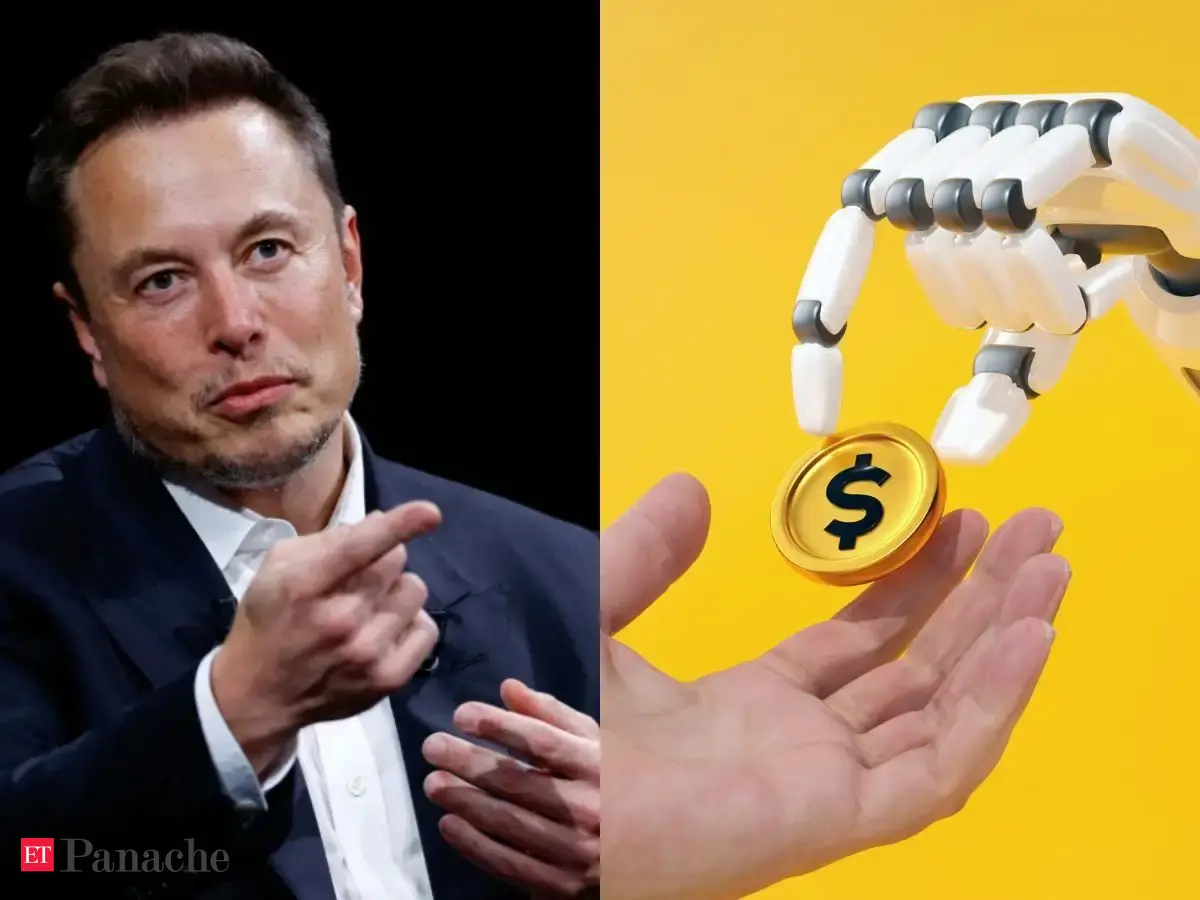
Elon Musk said advances in artificial intelligence and space travel could eventually make money less important. Speaking on The Builders podcast, he predicted digital superintelligence might boost global economic output significantly. Regarding how humans stay happy without work, Musk said, “I think people will find ways to be happy.”
Synopsis
Elon Musk believes advances in artificial intelligence, robotics and space travel could eventually make conventional money less important by transforming the global economy. Speaking to Walter Isaacson on The Builders podcast, the Tesla and SpaceX CEO said people would find ways to be happy even if they no longer needed to work, comparing the possibility to retirement. Musk also predicted that digital superintelligence could significantly increase global economic output.
What would life for humans be like if people didn not have to work to pay their bills, buy food or secure a comfortable future for themselves? It is a question that becomes more and more relevant as artificial intelligence and robots take on tasks traditionally performed by humans. Elon Musk believes technological advances could eventually bring the world closer to such kind of future, but he admits that what people would do with their lives in that situation is not an easy question to answer.
The Tesla and SpaceX CEO discussed the possibility during a conversation with American journalist and biographer Walter Isaacson on The Builders podcast. When Isaacson asked what would happen when money became irrelevant and how people would organise themselves, Musk suggested that humans would find their own reasons to be happy.
“I mean, I do struggle with this question... I think people will find ways to be happy. In the same way people who retire seem to be really happy, even though they’re not working,” Musk said.
How AI and robots could make money less important
Musk's prediction seems to come from his belief that artificial intelligence and robotics could dramatically increase the world's ability to produce goods and services. If machines can do more things faster, then the global economy can expand beyond its current limits, potentially making traditional work and income less important.
In the conversation, Musk said digital superintelligence could add 20% to 30% to the global economic output, or about $30 trillion a year to the world economy.
He also argued that space exploration could open up opportunities on a much larger scale. If robots help establish the infrastructure needed to access resources beyond Earth, economic activity could grow far beyond what is possible on the planet today.
“If you have robots and you get to space and can do a mass driver on the moon, then you can get to, I think, potentially a million times the size of the Earth economy,” he said.
Will money disappear completely?
Despite predicting that conventional money could lose its importance, Musk did not suggest that every form of currency would necessarily disappear. Instead, he believes the way value is measured could change as technology transforms production and access to resources.
“There will still be currency, but I think currency will be measured in fundamental physics metrics like wattage and tonnage, mass and energy,” he said.
In this scenario, the traditional role of money could become less important in an economy where robots handle much of the work and technological advances make more resources available.
Meanwhile, during the podcast, the discussion also touched on the possibility of artificial intelligence becoming more powerful than humans. Sharing his thoughts on a future in which people might no longer stay in control, Musk joked, “I hope AI is nice to us.”
(Catch all the Business News, Breaking News, and Latest News Updates on The Economic Times.)
Subscribe to The Economic Times Prime and read the ET ePaper online.
...moreless
(Catch all the Business News, Breaking News, and Latest News Updates on The Economic Times.)
Subscribe to The Economic Times Prime and read the ET ePaper online.
...moreless
The global business of promising more
One company, 2 words. Bond yield and CDS: Will they decide the fate of global markets?
Business of Odd Things: Inside an industry that farms fish that nobody is meant to eat
War's second-order effects are becoming visible in critical sectors
US mid-term elections – Part 2: What does it mean for Trump to lose control of Congress?