
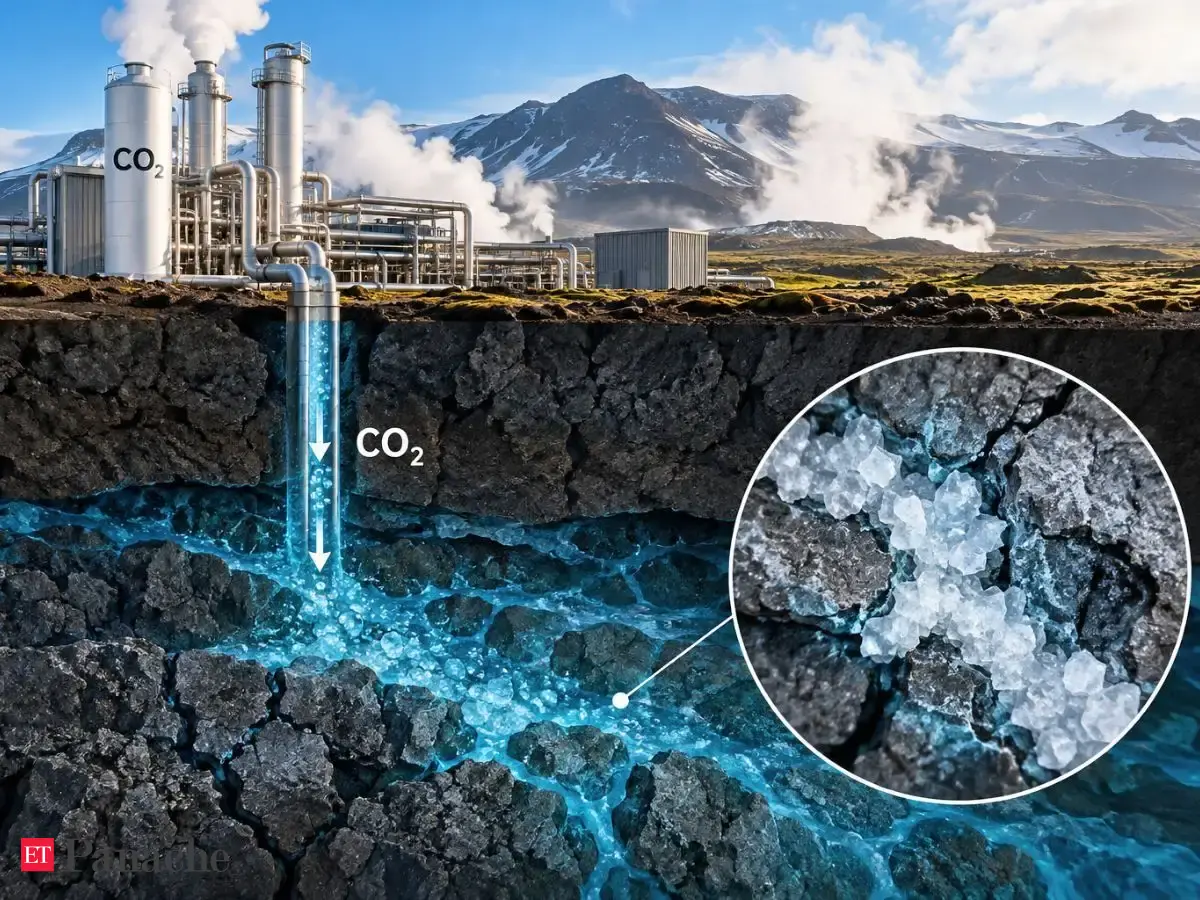
Scientists in Iceland are turning 120,000 tonnes of carbon dioxide into stone to fight global warming. The Carbfix project uses volcanic rocks to lock the gas underground. This method turns CO2 into solid minerals in two years. It started as a research effort in 2012 and now operates at power plants.
Scientists in Iceland are using volcanic rocks to turn captured carbon dioxide into solid minerals, locking the greenhouse gas underground instead of storing it as gas. The Carbfix project has stored more than 120,000 tonnes of CO2 in rock, with recent results showing that its Steingerður plant processed 99.6% of the CO2 entering the facility.
Scientists in Iceland have found a method that can turn trapped carbon dioxide (CO2) into stone, and this offers a way to keep the greenhouse gas locked under the ground instead of allowing it to escape out into the atmosphere. The technology, which has been developed under the Carbfix project, uses water and volcanic rock to convert CO2 into solid minerals in as little as just two years.
The project has jumped from laboratory research to current operations at the Hellisheidi geothermal power plant near Reykjavik. Latest findings indicate that the process is able to capture and store emissions from energy production, a source of greenhouse gasses that persists even when electricity is produced from renewable sources.
How does carbon storage work in Iceland?The Carbfix process starts with capturing the CO2 that is emitted when geothermal energy is produced. Then the gas is dissolved in large volumes of water to make a solution of carbonated water like sparkling water. The liquid is then pumped underground into porous basalt, a volcanic rock that results from cooled lava.
Once in the rock the dissolved CO2 reacts with minerals containing calcium, magnesium and iron. These chemical reactions instead convert the carbon into solid carbonate minerals, storing it as a solid in the rock rather than as a gas.
The technique is different from traditional carbon storage methods which means injecting compressed CO2 into underground formations and keeping it there. Carbfix hopes to decrease the risk of the gas leaking back into the atmosphere by converting it into minerals.
From an experiment to an operating power plantCarbfix began as a research effort in Iceland, with an underground test site established in 2012 in the country's southwest area. Researchers injected CO2 into basalt and found that almost all of it had mineralised within just two years. The findings, reported in the journal Science in 2016, helped in carving the way for a wider deployment.
The project is a collaboration involving Reykjavik Energy, the University of Iceland, France's National Centre for Scientific Research and Columbia University in the United States.
The technology is now used at the Hellisheidi geothermal power plant, which harnesses heat from beneath the Hengill volcanic area to generate electricity and supply heating. Although geothermal energy produces fewer emissions than fossil-fuel-based power generation, the process still releases CO2 and hydrogen sulphide.
New results show the technology's potentialAccording to ThinkGeoEnergy, Carbfix reported that its Steingerður air purification plant captured and sent almost all the CO2 entering the facility for underground storage between July 1, 2025, and June 30, 2026. During that period, 99.6% of the CO2 and all the hydrogen sulphide entering the plant were dissolved in water and sent for storage in the bedrock.
More than 19,000 tonnes of CO2 were injected through existing geothermal wells repurposed for reinjection during the period. Since the method was first introduced at Hellisheidi, more than 120,000 tonnes of CO2 and over 50,000 tonnes of hydrogen sulphide have been bound in rock, according to ThinkGeoEnergy.
The Steingerður facility had opened in June 2025 and it was part of the Silfurberg project, which received nearly €3.9 million in funding from the European Union's Innovation Fund.