
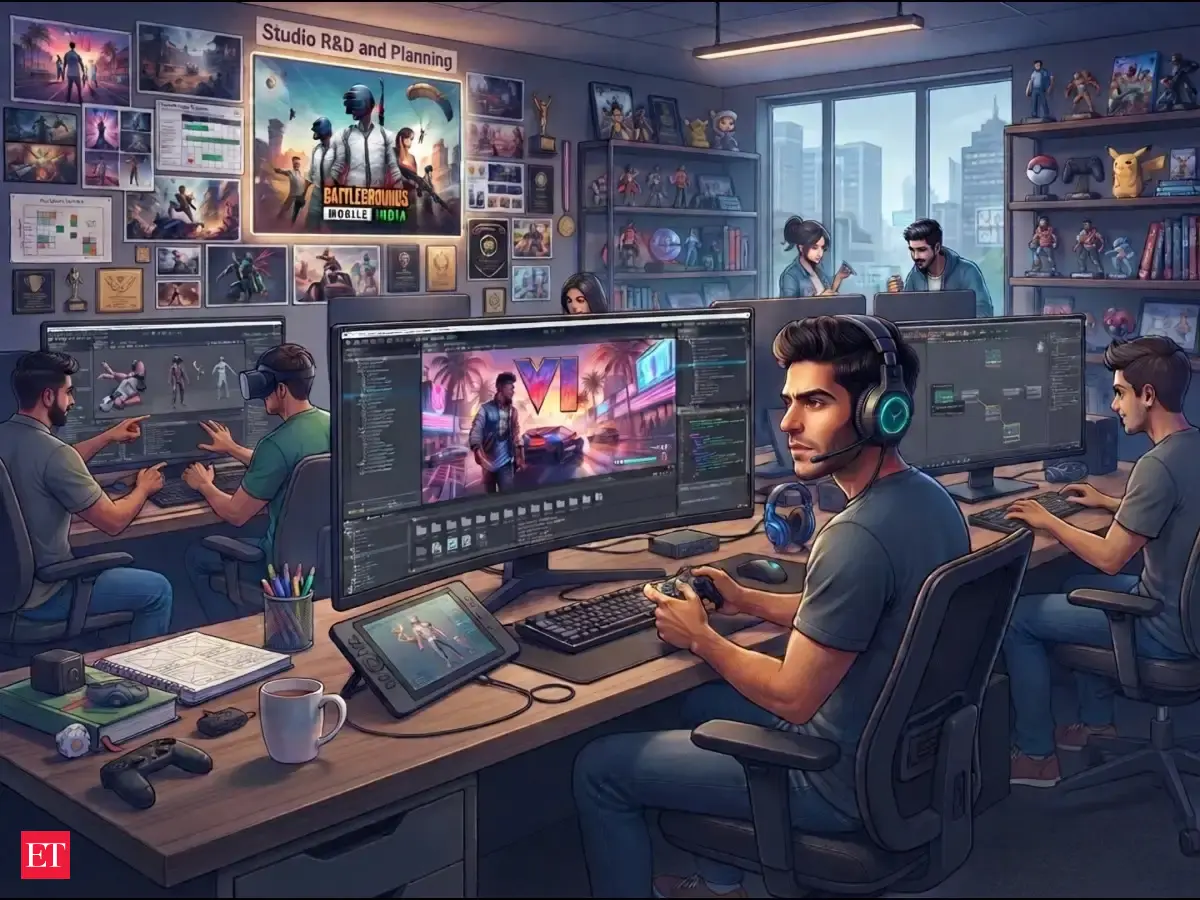
India had 511 million gamers in 2025, but revenue remains low. While mobile downloads hit 8.45 billion in FY25, monetization struggles to keep pace. Industry experts said the gap between the size of the audience and the strength of the companies serving it is at the heart of India's gaming challenge.
India's gaming market is witnessing significant growth in audience size, reaching over 511 million gamers by 2025. Despite this, the revenue generated remains limited, primarily due to low monetization rates. There are ongoing challenges related to the ownership of intellectual property, inadequate early-stage funding, and gaps in specialist talent. As studios attempt to build sustainable businesses, they face difficulties in user acquisition and retention.
India has one of the world's largest gaming audiences, but its presence among the companies that create, own and publish globally successful games remains limited. The country had an estimated 511 million gamers in 2025, generating about $1.04 billion in video-game revenue, according to the Game Developer Association of India's (GDAI) GameDev Outlook 2026. Yet annual revenue per player was just $2.04.
The contrast is visible in mobile gaming. India recorded 8.45 billion mobile-game downloads in FY25, the highest globally, according to Sensor Tower, a mobile app analytics firm. But in-app purchase revenue was only a little over $400 million. Downloads measure reach; they do not necessarily translate into paying customers or sustainable businesses.
The gap between the size of the audience and the strength of the companies serving it is at the heart of India's gaming challenge. Industry executives point to a combination of low monetisation, limited ownership of original intellectual property (IP), inadequate early-stage capital, gaps in specialist talent and an underdeveloped global publishing ecosystem.
India's appetite for global gaming franchises is hardly new. Pokémon GO generated at least 70,000 social media conversations in the country in the fortnight before its official launch in July 2016, according to Blueocean Market Intelligence. Mumbai accounted for 32% of the conversations, followed by Delhi at 21% and Chennai at 10%.
PUBG Mobile took that enthusiasm to another level. The game had attracted an estimated 33-50 million players in India in 2019, while Sensor Tower data showed 55 million Indian installs in the first half of that year. Its India-specific successor, Battlegrounds Mobile India (BGMI), crossed 100 million registered users within a year of its launch in July 2021. Krafton now puts
BGMI's accumulated downloads at 260 million.
The latest demonstration came with the November 19 launch of Grand Theft Auto VI (GTA VI). Gaming cafes in Delhi, Bengaluru and Srinagar saw players turn up for the console-only release, with one Delhi cafe receiving 40-50 enquiries on launch day and bookings filled through Sunday. Popular Indian gaming creators CarryMinati and Mythpat each attracted more than 13 million views through their
GTA VI coverage.
Monetisation: Millions of players, but limited spendingIndia's mobile-first growth has created scale, but not the same spending economics as mature gaming markets. A large part of the audience has been built around free-to-play titles, advertising and low-cost access. That makes it difficult for studios to finance expensive development and compete for players in markets where spending per user is significantly higher.
"Most of its 500M+ players came online only in the last decade, through cheap smartphones and free mobile games. That taught early studios to optimise for downloads rather than revenue, and per-user revenue is still a fraction of what it is in the US, China or Korea," said Anuj Tandon, Global Partner, Emerging Markets, BITKRAFT Ventures, a global gaming investment firm.
For studios, the challenge is to build games that retain players and persuade a meaningful share of them to spend. Kashyap Reddy, co-founder and CEO of Metasports Interactive, said, "Building a sustainable gaming business requires more than acquiring users. Retaining players and giving them reasons to monetize within the game are equally important."
At Hitwicket, a cricket strategy game developed by Metasports Interactive, the business model combines in-app purchases and advertising, without real-money gaming. The aim is to get players to spend on upgrades, customisation and gameplay value.
S8UL, an Indian esports and gaming-content organisation, has built its business around esports, content creation and talent management. "At the moment, content creation offers more consistent commercial opportunities in India," said Animesh Agarwal, co-founder and CEO of S8UL Esports and 8Bit Creatives, a creator and talent management agency. S8UL said more than half its revenue comes from brand partnerships and sponsorships, with the balance coming from creator monetisation, esports prize money, merchandise and other activities.
IP ownership: India makes games, but does it own them?India has developed a sizeable base of studios working on art, animation, testing, quality assurance and co-development for international publishers. These services create jobs and production experience, but they do not necessarily give Indian companies ownership of the game, its audience or the long-term revenue stream.
"Today India is mostly a large consumer market and a strong services hub. Indian studios do a lot of the art, testing and co-development for global games, and they do it well. Original IP is the emerging part, and it is real, but still small," said Nitish Mittersain, founder of Nazara Technologies.
Moving up the value chain requires studios to own the IP and manage the game beyond launch, including distribution, marketing, updates and live operations. Reddy estimated that Indian developers account for less than 10% of gaming revenue in the domestic market and less than 1% globally.
There are signs of a shift. GDAI's survey found that 82.7% of industry respondents prioritised launching new IP, while 49% were focused on entering international markets.
"Critical components such as CPUs, GPUs, memory and motherboards are still largely sourced from global manufacturers," said Vishal Parekh, Chief Operating Officer of CyberPowerPC India, a gaming PC brand and system integrator. The company assembles systems in India, but the key components are sourced from global manufacturers. Parekh said the economics of manufacturing at scale and the need for consistent demand remain constraints on developing a domestic gaming hardware ecosystem.
The GDAI GameDev Outlook 2026 draws on 104 industry submissions and 13 submissions from academia, alongside stakeholder consultations and market research. The survey findings cited here relate to industry respondents.
Capital: The prototype funding problemGames are risky, hit-driven products. Studios can spend years building a title before knowing whether it will find an audience. That makes patient capital particularly important, but early-stage developers often struggle to secure funding even for a playable prototype.
"Access to patient capital and publishing investment remains the most critical bottleneck for original IP," said Shruti Verma, CEO of GDAI. "Game development involves long production cycles and significant upfront investment, making it difficult for studios to move from prototypes to commercial launches."
She pointed to a recurring dilemma: investors want to see a playable demo, but building one requires money in the first place. GDAI's survey found that 75% of respondents identified capital or publishing investment as a barrier to growth.
Funding figures for the broader gaming sector also need careful interpretation because they include businesses such as real-money gaming and transactions that do not necessarily finance game development. Venture Intelligence data reported by The Economic Times showed gaming-startup funding falling from $661 million in 2022 to $130 million in 2023, before rising to $195 million in 2024. The 2024 figure was largely driven by Tencent's divestment from Dream11 parent Sporta Technologies, illustrating why headline funding totals do not automatically reflect money flowing into studios creating original games.
Talent and production: Beyond coding and artIndia has a deep engineering and creative workforce, but building a globally competitive game requires more than developers who can execute a brief. Studios also need experienced game directors, product leaders, monetisation specialists and live-operations teams who understand how to keep a title relevant across markets for years.
"The biggest bottleneck is that India's gaming ecosystem is still early," Tandon said. "Engineering and art talent is abundant, but there hasn't been enough time to build a deep bench of game directors, product leads and live-ops specialists who have scaled a game to millions of paying players."
GDAI's survey found that 56.7% of industry respondents considered fresh talent poorly prepared or not prepared for production requirements. The challenge is especially pronounced in PC and console development, where teams need experience managing larger budgets, longer production cycles and more complex pipelines.
Newzoo, a games market data firm, estimated that PC and console games generated a combined $88.3 billion globally in 2025. Mittersain said a large game can take three to five years and require very large budgets before generating revenue. He believes the more practical route for Indian studios is to build mid-sized original games for international audiences rather than immediately compete with the largest AAA productions.
Distribution: Building a hit is only half the jobEven a well-made game can struggle without the ability to reach players, acquire users at a sustainable cost and market itself internationally. Indian studios have often relied on overseas publishers for these capabilities, but such arrangements can limit how much of the commercial upside remains with the developer.
"AI is making development faster, but building the game is only a small part of the journey. The harder part is acquiring players and scaling it," said Abhishek Malpani, founder and CEO of Funcell Games.
Funcell says its games have crossed 400 million downloads globally. Its self-published title Pawn to Don crossed two million downloads and generated $1.5 million in revenue in its first three months, Malpani said. He cautioned that revenue is not the same as profit, but said the example underlines the importance of building in-house publishing capabilities.
The opportunity is not limited to selling games in India. A FICCI-EY report, drawing on estimates supplied by GDAI, put game-development export revenues at more than $1.5 billion in FY26. However, the estimate includes services such as development and live operations for international companies with India-based teams; it is not a measure of revenue from Indian-owned original IP alone. EY said the figures had not been independently verified.
For Mittersain, monetisation remains the central constraint: "If I had to pick one, it is monetisation, because capital follows it." Nazara's own international studio acquisitions, he said, have helped it access markets and experience that Indian developers have historically lacked.
India's next phase will therefore depend not just on how many people play games, but on how many companies can turn that audience into paying communities -- and build, own and publish games that find customers beyond the domestic market.