
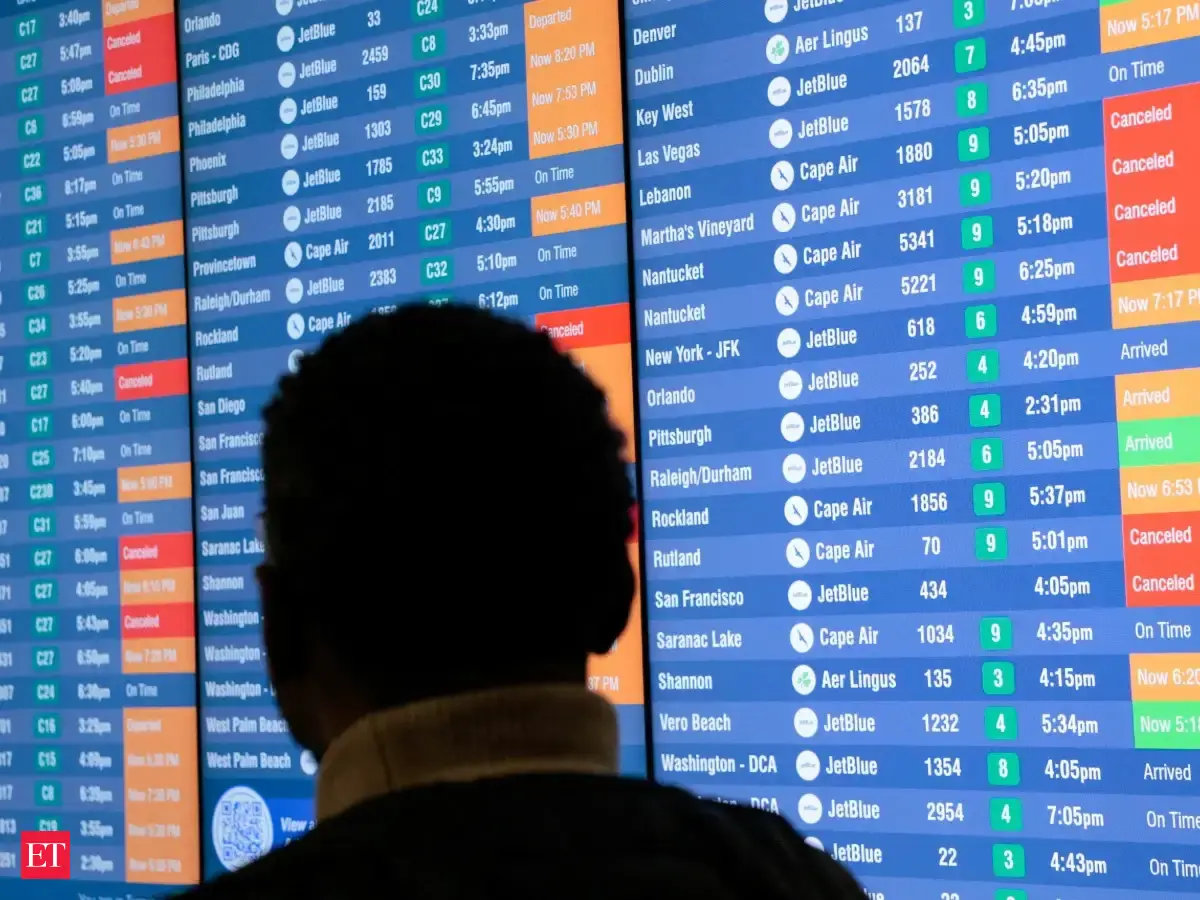
A communications failure at US air traffic control centres on November 13 forced the Federal Aviation Administration to halt departing flights nationwide. The outage disrupted thousands of journeys, showing how much the system relies on ageing technology. More than 15,000 flights got delayed or cancelled before operations finally returned normal.
The US aviation network manages tens of thousands of flights daily through a chain of airport towers, radar facilities and regional control centres. The November 13 FAA outage exposed how dependent this network is on reliable communications and ageing technology. Here is a look at the scale of US air traffic, how controllers manage aircraft movements and the modernisation funding sought by the Trump administration.
A communications failure at US air traffic control centres on November 13 forced the Federal Aviation Administration (FAA) to halt departing flights nationwide, disrupting thousands of journeys and exposing the vulnerabilities of the country's ageing aviation infrastructure. The ground stop was lifted later that evening, but more than 15,000 flights were delayed or cancelled, and airlines warned that it could take days for operations to return to normal, Reuters reported.
The scale of the disruption reflects the enormous volume of traffic managed by the US aviation system. The FAA handles an average of around 44,000 flights every day, including commercial, cargo, military and private aircraft. As many as 5,500 aircraft can be airborne simultaneously during peak periods, while millions of passengers travel through US airports daily.
Managing this volume requires a vast network of airports, air traffic control towers, radar facilities, communications systems and en-route control centres. The November 13 outage highlighted how a failure in the infrastructure connecting these facilities can affect flight operations across the country.
How big is the US aviation system?The US
National Airspace System (NAS) is one of the world's largest and most complex aviation networks. It covers approximately 29.4 million square miles, including domestic airspace over the 50 states, US territories and coastal waters, as well as extensive oceanic airspace over the Atlantic, Pacific and Gulf of Mexico.
According to FAA figures, the system handles approximately 44,360 flights daily, or more than 16 million flights annually. This includes scheduled commercial services as well as cargo, military, private and other aviation operations.
The passenger traffic is equally significant. US airlines carry close to one billion passengers annually, while airports across the country handle millions of travellers on a typical day. The network also includes nearly 19,500 landing facilities, comprising public-use airports and private airfields.
At peak times, up to 5,500 aircraft can be in the air simultaneously. Keeping them separated and guiding them safely through different stages of their journeys requires continuous coordination between pilots and air traffic controllers.
How does the US air traffic control system work?The FAA manages aircraft movements through a network of facilities responsible for different stages of a flight. The main components are airport control towers, Terminal Radar Approach Control facilities and Air Route Traffic Control Centers.
1. Airport control towers
Control towers manage aircraft movements on and around airport runways. Controllers coordinate take-offs and landings, oversee aircraft taxiing on the ground and provide pilots with instructions to ensure safe movement within the airport's controlled area.
2. Terminal Radar Approach Control facilities
After an aircraft takes off, responsibility is generally transferred from the airport tower to a Terminal Radar Approach Control (TRACON) facility. These controllers manage aircraft as they climb away from an airport or descend towards one, coordinating their movements and maintaining safe distances from other aircraft.
3. Air Route Traffic Control Centers
Once aircraft reach cruising altitude and travel between airports, they are managed by Air Route Traffic Control Centers, also known as en-route centres. These facilities monitor aircraft travelling across large sections of airspace, coordinate their routes and maintain separation between flights.
The FAA operates 21 such centres, which manage high-altitude traffic across the country. These centres are particularly important because they connect different regions and coordinate flights travelling over long distances.
As a flight progresses, responsibility is handed from one facility to another. This coordination depends on controllers having access to reliable communications, surveillance information, flight data and automation systems.
Why can a communications failure disrupt flights across the US?The November 13 ground stop followed a communications failure affecting air traffic control centres across the country. The FAA halted departures as a safety precaution after problems with the systems used to coordinate aircraft movements.
Transportation Secretary Sean Duffy said the disruption began when switches and routers carrying critical data became overloaded, resulting in inconsistent information from the systems. The FAA did not completely lose radar or communications and was able to guide aircraft already in the air to safe landings, Reuters reported.
A nationwide ground stop does not necessarily mean that every aircraft in the sky is ordered to land immediately. It primarily prevents additional departures from entering the affected airspace while controllers assess the situation. International arrivals can also be handled separately, depending on the circumstances.
The decision to halt departures reflects the importance of reliable communication between control facilities. If controllers cannot consistently exchange flight information or coordinate aircraft movements, allowing more planes to take off could increase operational risks.
The November 13 shutdown was the longest nationwide ground stop since the September 11, 2001, attacks. More than 6,600 flights were cancelled and 8,600 delayed, according to FlightRadar24 data cited by Reuters. The FAA lifted the restrictions at 8:15 pm Eastern Time, but airlines faced the task of repositioning aircraft and crews to restore schedules.
How outdated is US air traffic control technology?The latest disruption has renewed concerns about the ageing technology used to manage US air traffic. The system relies on a combination of communications networks, radar and surveillance equipment, flight-data processing systems and automation tools. Some of this infrastructure has been in service for decades, making maintenance and replacement increasingly difficult.
The FAA has been working to replace older equipment and communications infrastructure. It has also announced plans to phase out floppy disks used to transmit weather and other critical information at more than 400 air traffic control facilities by the end of 2028.
Previous technical failures have demonstrated how problems at individual facilities can affect a much wider area. In September, a circuit failure at an air traffic facility in Philadelphia and a construction crew's accidental severing of a fibre-optic cable in New Jersey contributed to thousands of delayed and cancelled flights across the Northeast.
The shortage of air traffic controllers adds another challenge. The FAA has been recruiting and training additional controllers, but staffing gaps at some facilities have put pressure on operations. The combination of ageing equipment, communication vulnerabilities and workforce constraints has made modernisation a priority for the agency.
How much is the Trump administration seeking for aviation modernisation?The Trump administration has asked Congress to approve additional funding to upgrade US airports and air traffic control infrastructure.
Before the November 13 outage, Transportation Secretary Sean Duffy and White House Office of Management and Budget Director Russell Vought urged lawmakers to approve an additional $30.1 billion. The proposed allocation included $10.1 billion for air traffic control modernisation, with $7.2 billion for a common automation platform and controller workstations and $2 billion for cloud computing. The wider proposal also included funding for airport infrastructure.
Following the nationwide ground stop, Duffy called for $50 billion to modernise the air traffic control system, arguing that the existing infrastructure needed a broader overhaul to prevent similar disruptions. The administration has also pointed to the need to replace outdated equipment and improve the technology used by controllers.
Congress had previously approved $12.5 billion in 2025 for air traffic control modernisation. However, the latest outage has intensified the debate over whether the funding and pace of upgrades are sufficient.
The challenge is not limited to replacing individual pieces of equipment. The FAA must modernise interconnected systems while continuing to manage tens of thousands of flights every day. Its ability to upgrade communications, automation and surveillance infrastructure will be central to maintaining the reliability of the US aviation network.