
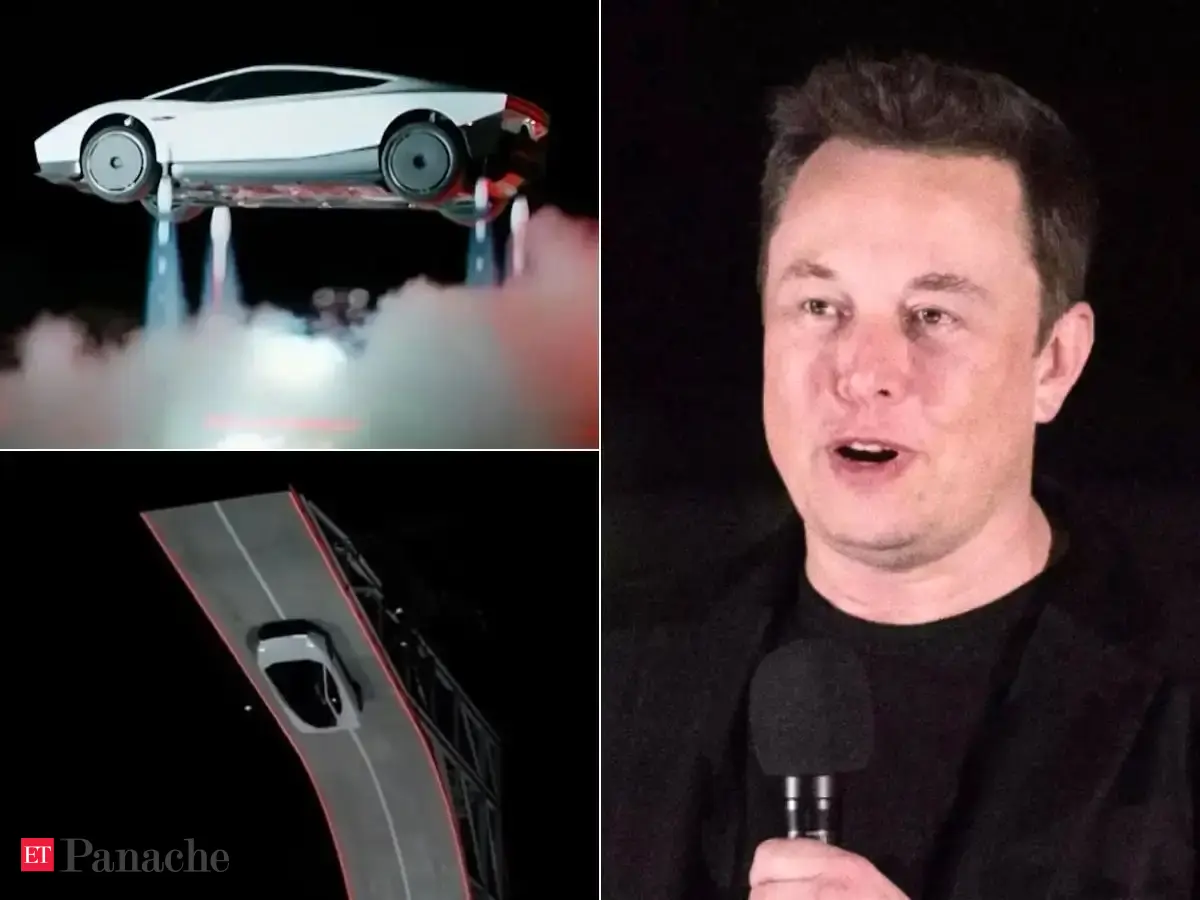
Elon Musk’s new Tesla Roadster uses cold-gas thrusters and a suction system to perform stunts like lifting off the ground. Tesla vice-president Lars Moravy said the car has "10 thrusters supplied by 600 litres of compressed air." Production of this futuristic electric sports car is expected to begin in 2028.
Elon Musk's Tesla Roadster has showcased stunts that seem to defy the laws of physics, from lifting off the ground to driving upside down. But the technology behind these moves is very different from what powers an ordinary electric car. Here's how its rocket thrusters and suction system work, what makes its performance claims unusual, and whether buyers will be able to get their hands on this futuristic vehicle.
Elon Musk's new Tesla Roadster has been built to do something only a few cars have ever attempted, that is to lift off the ground, flip in mid-air and drive upside down. The electric sports car was revealed and displayed at a product demonstration in Texas, where the vehicle appeared to challenge the limits of conventional car engineering.
But all of the stunts that it performed were obviously not magic, nor does the vehicle fly like an aircraft. The technology that it is based on combines compressed-gas rocket thrusters with a powerful suction system that helps the car grip surfaces. Developed with SpaceX engineers, the setup of this car is intended to deliver both extreme acceleration and brief airborne jumps. Production of the new Tesla Roadster is expected to begin in 2028.
How does the Tesla Roadster fly?The secret of this bizarre ability lies in cold-gas thrusters, a propulsion system that releases highly pressurised gas through small nozzles in order to generate thrust. Instead of burning fuel, the system pushes gas out at very high speed, propelling the vehicle in the opposite direction of the thrust.
The science behind this is similar to releasing an inflated balloon without tying its opening. As the air rushes out, the balloon moves in the opposite direction. The Roadster uses a more controlled version of the same principle, with pressurised gas stored in specialised tanks and released through electronically operated valves.
According to Motor Trend, the car shown at the event uses a composite-overwrapped pressure vessel to store the gas. Pipes carry it to the thruster nozzles, while carefully controlled valves regulate its release.
Tesla vice-president of vehicle engineering Lars Moravy said the car has 10 thrusters supplied by 600 litres of compressed air, according to a report by TechCrunch. The additional capacity allows the vehicle to perform short jumps and manoeuvres.
However, the system is not designed to keep a car flying for extended periods. The gas supply that has been places inside is limited, and lifting a heavy vehicle requires a substantial amount of thrust.
Elon Musk's Tesla Roadster can fly and drive upside down
What makes it stick to ceilings?The Roadster's other unusual feature is a fan system that has been placed beneath the vehicle that creates suction.
Tesla describes this setup as a multi-mode fan and ground-sealing system that pulls air from underneath the car. This creates a force that presses the vehicle against a surface, increasing the load on its tyres.
Ordinary racing cars rely on aerodynamic downforce that is generated by wings and other bodywork. That force generally increases with speed. A powered fan, by contrast, can generate suction even when the vehicle is stationary.
During the demonstration, the Roadster used this system to travel up a curved ramp and remain attached while staying completely upside down. The suction also helps increase tyre grip during acceleration, braking and cornering.
The distinction is important because the thrusters provide propulsion, while the fan creates suction and improves grip. Together, the systems allow the car to perform manoeuvres that conventional road vehicles cannot.
Tesla also showcased a claimed acceleration time of less than one second to reach 60 mph, or around 97 kmph. The Drive reported a figure of approximately 0.81 seconds from the demonstration.
Elon Musk's New Tesla Roadster
Will the flying Roadster be available on public roads?According to its website, Tesla says there will be four versions of the new Roadster: Performance, Thrust and Rocket.
The Performance version is intended for regular road use, while Thrust adds rear-mounted thrusters for extreme acceleration. The Rocket package includes the additional hardware needed for airborne manoeuvres and is designed as a single-seater.
The thruster-equipped flying version is not expected to be approved for public-road use. Its cost, safety requirements and regulatory challenges also make it unlikely to become an ordinary consumer vehicle.
New Tesla Roadster Interior
How to book the Tesla Roadster and when will deliveries begin?Tesla has opened reservations for the Roadster, but the company has not announced the final purchase price yet.
The new Tesla Roadster's reservation page list payment plans of $50,000 for the Performance version and $250,000 for the Thrust variant. The Rocket package can only be booked by invitation only, although it will not be available for ordinary road use as of now.
Production of this car is scheduled to begin in 2028. However, the Roadster has already experienced years of delays earlier as it was first unveiled in 2017, and initially expected to enter production in 2020.