
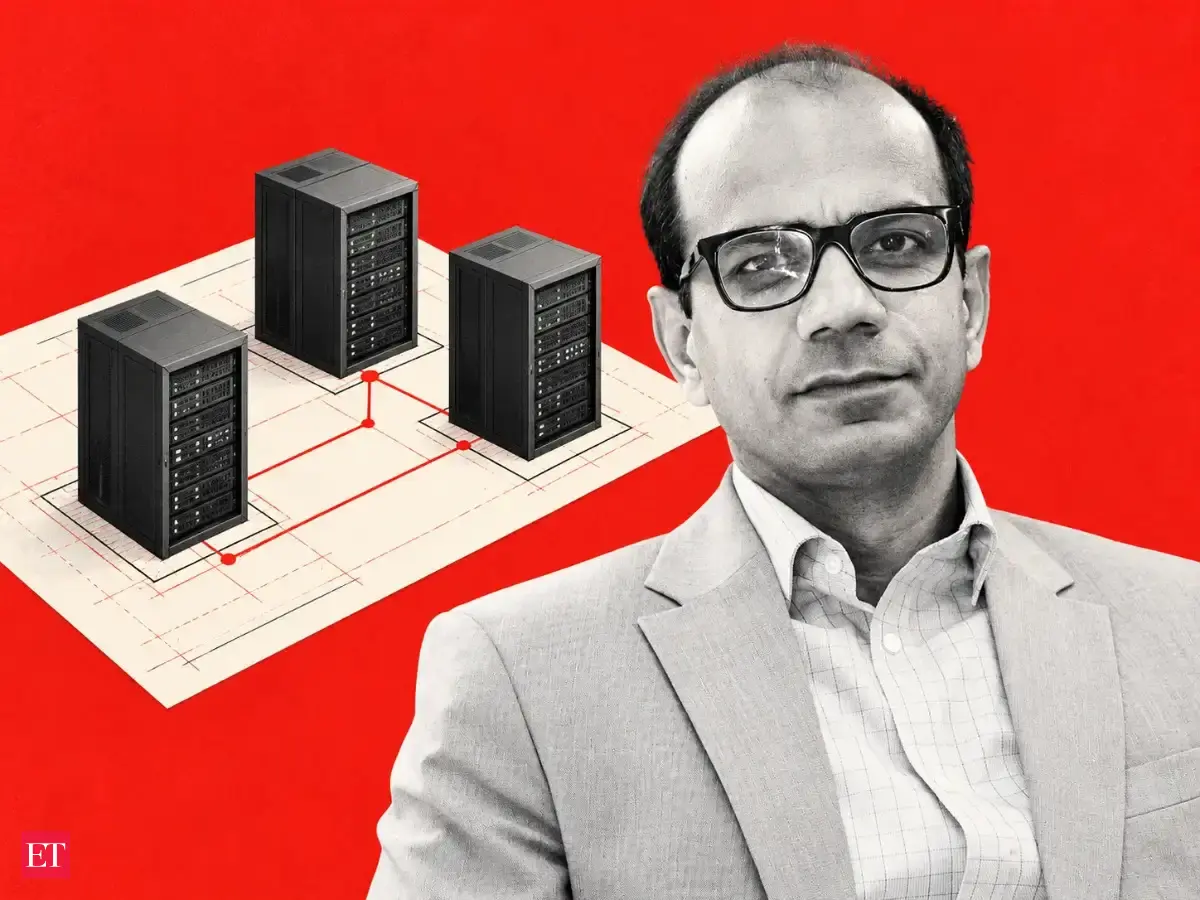
Oracle’s Sanjeev Chauhan said engineers must stop building careers around tools that might not survive as AI takes over routine infrastructure work. He noted, "Some of those traditional skills which relied on individual tuning of individual components will transition more towards architecture." Professionals should now focus on designing entire systems.
Oracle's cloud engineering head says AI is taking over routine infrastructure work, and engineers will need to move from tuning individual systems to designing how entire systems work together.
As artificial intelligence (AI) takes over the routine work of setting up and tuning databases, servers and applications, infrastructure engineers will need to focus more on designing how entire systems work together, according to Sanjeev Chauhan, vice-president of cloud engineering at Oracle.
"Some of those traditional skills which relied on individual tuning of individual components will transition more towards architecture, more towards resiliency and thinking process rather than actually the build process of the entire component," Chauhan told The Economic Times Digital.
Chauhan, who works closely with the technical teams of some of India's largest enterprises, said this shift has been under way for years. Oracle, best known for its database software, also runs Oracle Cloud Infrastructure (OCI), which rents computing power and storage to companies and has cloud regions in Mumbai and Hyderabad.
He cited software testing, the process of checking whether a program works as intended, as an example of how technical work has evolved from manual tasks to automation and, more recently, AI.
"There was a time when we used to write manual test cases and execute those manual test cases in a sequence once the software was built. From there, the entire code inspection to test cases writing to the entire automation was done by software a few years ago. Now, all of that automation is now moved to AI," he said.
Security is another area where Chauhan believes companies need more automation, particularly when it comes to installing software fixes, known as patches, to address vulnerabilities.
"We see it on a regular basis that all these vulnerabilities are addressed in the patches that were provided by certain OEMs [original equipment manufacturers], but they were never patched, we are running a few versions behind... Now, some of that could be automated using AI," he said.
A familiar role with a new name As AI companies turn to forward deployed engineers (FDEs) to help customers use their technology, Chauhan sees a familiar role under a different name. These engineers work with a client's teams to adapt a company's technology to specific business needs, a function he said
enterprise technology companies have performed for decades.
"These teams would understand a customer requirement, convert it into the expectation from the underlying software or technology and then build a configuration or architecture, help it deploy and make it run for the next couple of years. This was to ensure the original objective around availability, performance, feature set was exactly met with what was promised," he said.
Chauhan said such teams had long been part of Oracle, although the industry had used other titles for the work.
"It was probably called pre-sales or the system engineer or system architect in many of the organizations. But when many of the new age AI companies got into the larger enterprise market, they realised the need for a technical field force which can make their technology palatable," he said.
Learn the problem, not the tool For infrastructure professionals, Chauhan said, the scope of the job has already expanded, with individuals now responsible for far more applications and databases.
"Somebody was just managing administrator of one application and now his scope has increased to manage tens of applications, hundreds of databases probably. So, what we've done for the transition is we have built all of these AI tools as part of the data platform itself to make the entire administration job fairly easy," he said.
However, he cautioned against building a career around specific tools, including software that automates the setting up and management of infrastructure.
"Earlier there was a huge amount of focus on these teams being skilled on certain tools, and those tools transitioned over a period of time. You could clearly see this has happened many times over. If the skills are around tooling and those tools get outdated, then the teams are just focused on learning new technology rather than building an outcome," he said.
The same focus on outcomes should guide technology purchases, he said. Teams that have modernised their data systems successfully avoid what he called reference buying, or choosing a solution simply because other companies have used it.
"There are 10 people who have already done exactly the same, and that's the easiest possible option for me to do rather than the first-principle approach, that 'why should we do it in the first place'," he explained.
For the next generation of infrastructure leaders, Chauhan said, the ability to build and test ideas themselves will be particularly useful as AI coding tools make it easier to develop prototypes.
"You could use some of these coding tools to build some of these assets yourself, and the entire prototyping work could be done very, very quickly," he said.
"I don't think there are going to be skills where folks will have skills in certain areas and their skill would continue exactly in the same manner, hoping that the tool survives for the next few decades," he added.