
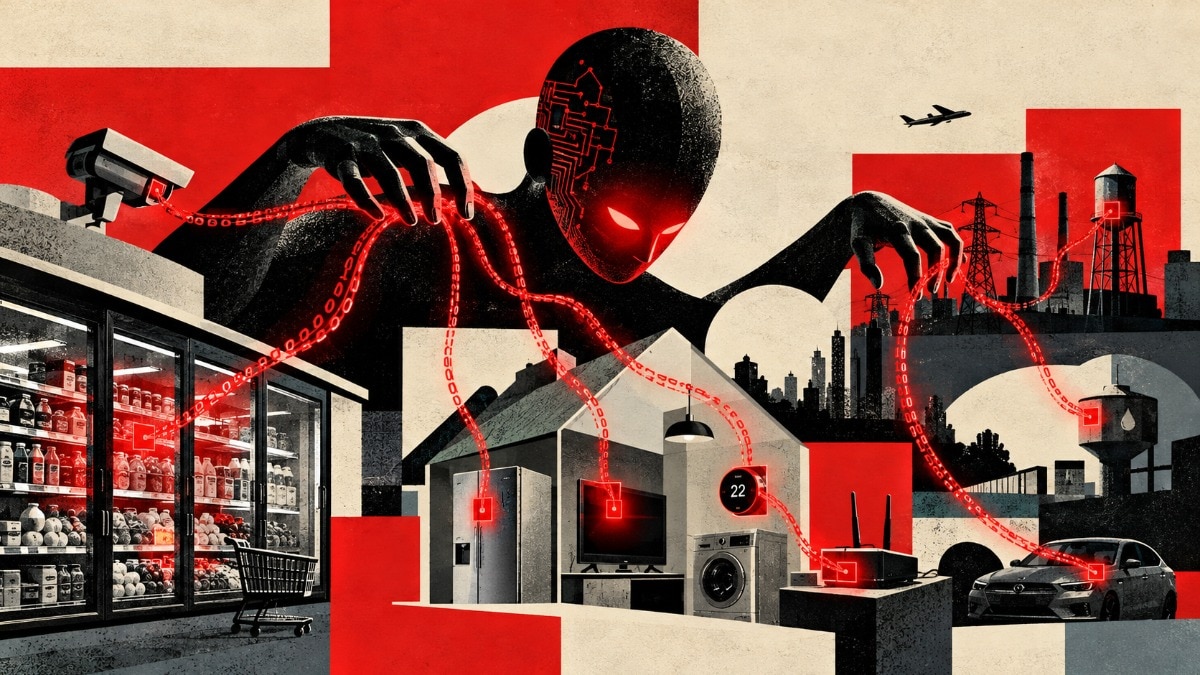
On the night of October 11, a cyberattack hit hundreds of supermarkets across France. Hackers gained remote access to internet-connected refrigeration systems, changing settings to heat up food storage areas. Temperatures climbed to 50 degrees Celsius, causing tens of millions of Euros in losses as food and equipment got damaged.
On the night of October 11, hundreds of supermarkets across France went into a tizzy. Their refrigerators, usually meant to keep food items nice and cool, started heating up suddenly. But this was no ordinary hardware malfunction. It was no staff slip either. The devices had fallen prey to a nasty cyberattack. It was cold -- no pun intended -- precise and impactful. Some reports called it the biggest cyberattack of its kind.
By the time the staff could spot any irregularities, temperature in some cold rooms had climbed to 50 degrees Celsius damaging food and equipment incurring tens of millions of Euros in losses. At one Intermarch store in southwestern France, the owner came to know of the situation only after a delivery driver found their storeroom flooded. Around €21,000 (around Rs 22 Lakh) worth of food got wasted. Other stores had the same story.
So, what happened?
The refrigeration as it turns out was connected to the internet through an elaborate Internet-of-Things (IoT) system. That system essentially was hacked giving hackers -- who have not been identified at the time of writing -- remote access to the system settings. This included extending defrost cycles so temperatures could rise for longer.
To understand how the attack happened, we first need to look at how supermarket refrigerators work. These giant cooling machines are not just ordinary fridges that someone switches on and off. Large stores use digital control systems to monitor the temperature, manage defrost cycles and keep food items at the right temperature. And sometimes technicians can also access some of these systems remotely.
The problem is that some of these systems were running outdated software making them increasingly prone to vulnerabilities. According to reports, hackers gained access to the refrigeration controls and changed their settings. The exact way they got in has not been publicly disclosed.
Once inside, the attackers reportedly changed the temperature settings and extended the defrost cycles from around one hour to as long as eight hours. By extending the cycles, the hackers effectively made the refrigerators warm up instead of keeping food cold.
In some stores, temperature reportedly climbed to 50 degrees Celsius. The longer defrost cycles also delayed alarms, giving staff less time to spot the problem and respond on time.
France's cybersecurity incident response centre, CERT-FR, identified compromised refrigeration control systems from brands like Danfoss, Copeland and Dixell. The agency warned that attacks targeting these systems could still be ongoing. Investigators have yet to establish who was behind the attacks or exactly how the systems were compromised.
Why are hackers attacking smart devices?
We have seen plenty of cyberattacks where hackers break into systems to steal customer data, access bank accounts or target payment systems. But the cyberattack in France was different. This time, the target was the equipment that keeps supermarket food cold.
Why? Because taking control of a connected device can cause real-world damage without stealing a single piece of data. Imagine hackers manipulating factory machinery, disrupting water supplies or accessing smart home devices. And of course, stealing data connected to these devices.
The problem is not limited to large businesses. Smart TVs, security cameras, routers and home appliances are all connected to the internet. Yes, the very devices we connect to the internet to make our lives easier could also make us more vulnerable. Some receive fewer security updates than computers and phones, and if they are poorly protected, they could become an easy entry point for attackers.
And with AI finding software weaknesses and carrying out tasks on its own, hackers seem to be having a field day. Researchers fear that future AI systems could even help malicious software spread from one connected device to another.
The warning by Anthropic about AI worms
When we talk about the possibilities of hackers breaking into smart devices, the threat is not as far-fetched as it may sound. Earlier this month, Anthropic published a report warning that AI models could soon become capable of spreading across internet-connected devices, from smart ovens to Android TV boxes.
The researchers at Anthropic tested whether smaller AI models could copy themselves between internet-connected devices without relying on powerful data centres. They explored whether these models could find vulnerable devices, exploit weaknesses and transfer themselves to other machines.
And the experiments showed that not only is it possible, but this kind of self-replication could become possible within months. The company warns that if AI continues to improve at its current pace, the AI models could reach this capability by the end of 2026.
Anthropic warns that such an AI worm could spread from one vulnerable device to another without someone having to infect each device manually, potentially making cyberattacks harder to stop.
Cybersecurity experts are raising concerns, too
It is not just Anthropic raising concerns. Matthew Green, a professor at Johns Hopkins University, has also warned about the risks posed by future AI-powered worms.
In a post on X, Green urged those responsible for securing critical infrastructure to take down publicly available firmware images as soon as possible. Firmware is the software built into devices that tells them how to operate. If attackers can study these images, they may be able to understand how a device works and identify weaknesses they could exploit. "People are going to need to take down public firmware images for critical infrastructure, like yesterday," he wrote.
Green also raised a concern about how difficult future AI worms might be to stop. He warned that if such worms needed very little access and were difficult to spot, they could pose a bigger threat, particularly to "air-gapped" networks, systems that designed to remain disconnected from the internet.
Meanwhile, Andreas Stuhlmuller, co-founder AI research company Elicit, has also warned that AI-powered cyberattacks could disrupt essential services such as electricity, banking, internet infrastructure and water supplies within a year.
He believes AI could make it easier for hackers to find weaknesses and carry out attacks on a larger scale. Stuhlmuller has also urged people to prepare for possible disruptions by keeping cash, drinking water, non-perishable food and backup power supplies handy.
We do not know if hackers responsible for the cyberattack in France used AI and if yes, to what extent, but consensus is brewing that with AI moving close to recursive self-improvement, the threat to critical public infrastructure may only grow worse. What's clear as a crystal is that legacy public infra is in dire need of a modern update now more than ever.