
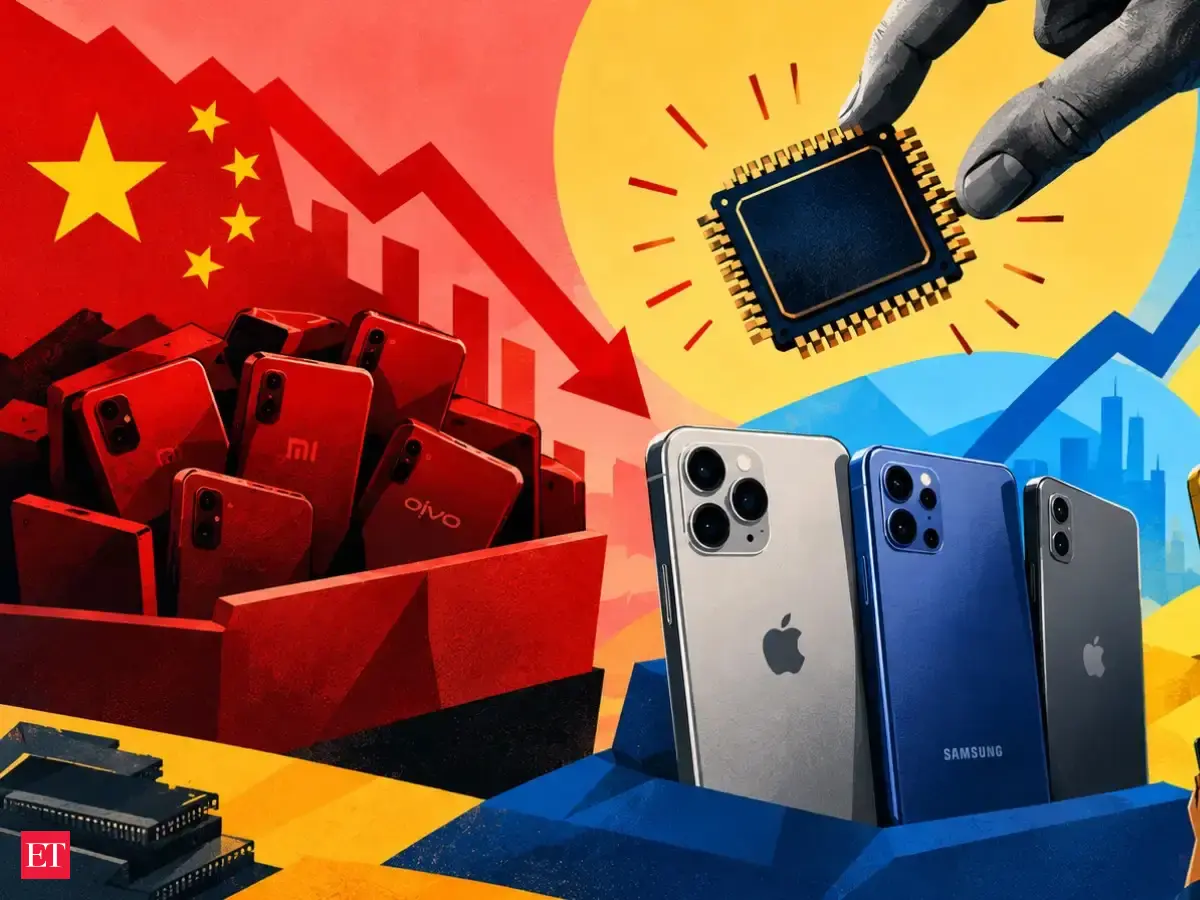
Chinese smartphone brands saw their India market share fall to 67-68% in the July-September quarter. High memory chip costs forced companies like Xiaomi and Vivo to cut budget models. Omdia analyst Sanyam Chaurasia said, "What Chinese OEMs have been doing is that they've been trying to cut down their specs."
Chinese smartphone brands' market share in India decreased to 67-68% in the recent July-September quarter. This decline represents the lowest percentage seen in more than eight years. Companies like Vivo, Oppo, and Xiaomi are reducing their budget models due to high memory chip prices. Domestic brands such as Lava and Ai+ are gaining traction among price-sensitive consumers as a result.
New Delhi: The share of Chinese smartphone brands in the Indian market shrank to 67-68% in the July-September quarter, the lowest in more than eight years, as record-high memory chip prices led them to cut budget models -- a segment that traditionally drove their sales.
Technology market research firm Omdia estimates the share of Chinese brands at 68% in the last quarter, as against 71% in the previous three-month period and 75% a year ago. The peak was 80%, recorded in the April-June quarter of 2020. According to Counterpoint Research, Chinese brands had a 67% share this July-September, the lowest since the first quarter of 2019.
Experts said companies such as
Vivo, Oppo and Xiaomi are cutting down on budget models, the segment most impacted by high memory costs, opening space for domestic players like Lava and Ai+ to capture demand from price-sensitive consumers ahead of Diwali.
"What Chinese OEMs (original equipment manufacturers) have been doing over the last four to five quarters is that they've been trying to cut down their specs to manage their costs. Essentially, cost optimisation through spec cuts," Omdia principal analyst Sanyam Chaurasia told ET.
Samsung, Apple gaining shareManufacturers also reduced the number of models offered in lower price bands, while prioritising mid- and premium-segment sales to support profitability, he said.
Record-high memory prices are changing the dynamics in the smartphone market, experts said, with the Chinese suffering disproportionately due to wafer-thin margins in the industry and big players like Samsung and Apple gaining share due to premium offerings.
Demand exists in the entry-level market, but consumers are reluctant to stretch budgets as device prices rise. Indian brands are taking advantage of this, maintaining their product line-ups with a primary focus on volume growth. According to Counterpoint Research, Indian brands' combined share last quarter increased from 2% a year earlier to 7% in the last quarter ended September 30, their highest since October-December 2018.
Tarun Pathak, research director at Counterpoint Research, said Ai+ and Lava accounted for almost 95% of the contribution within Indian brands, alongside newer entrants such as Mivi and Boltt.
Ai+, launched in July last year, posted a more than fourfold year-on-year increase in shipments in the three months ended September 30. Both Mivi and Boltt were launched in the last quarter.
Smartphone shipments in India fell 20-26% YoY in the July-September quarter to a decade-low of 35.8 million units, according to Counterpoint Research and Omdia, as high memory costs pushed up prices and consumers delayed upgrades.