
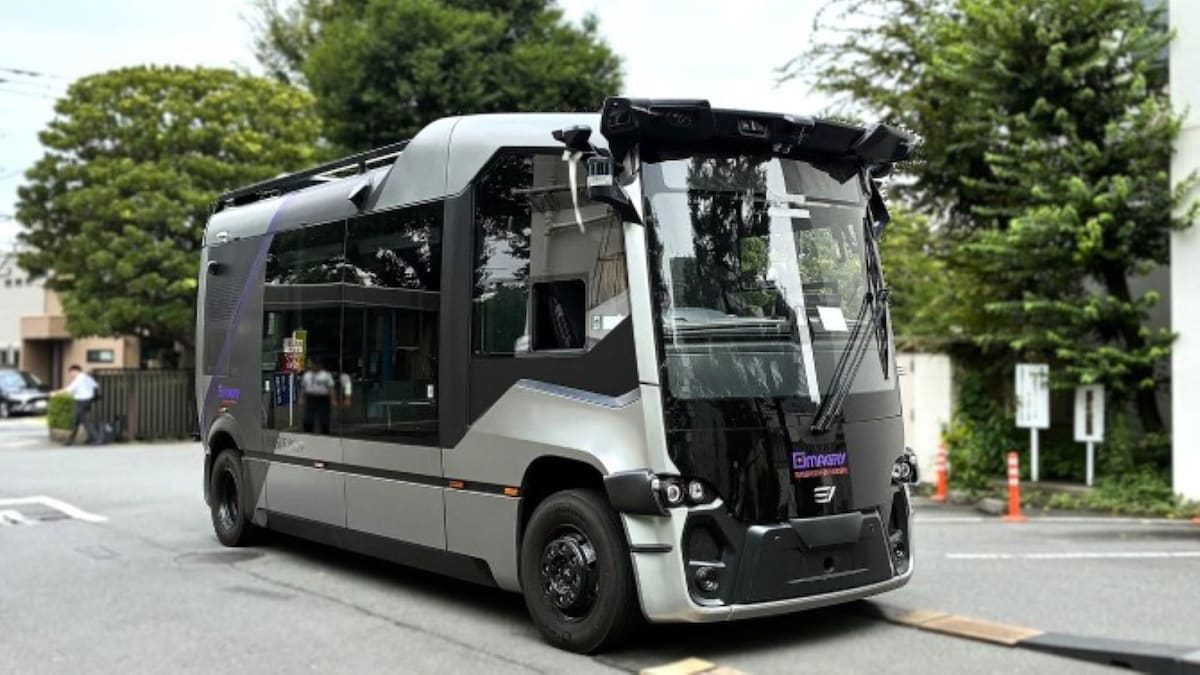
NTT Mobility will test self-driving buses on public roads in Japan starting February 2027. These vehicles use cameras and AI to navigate without costly high-definition maps. The project aims to see if buses can handle real-time traffic and road conditions safely, potentially making autonomous public transport much more practical.
Eliminating reliance on costly pre-built high-definition maps through real-time camera processing aims to slash the deployment time and expenses of launching self-driving buses on new routes. Discover how operators plan to tackle unexpected pedestrian and weather hazards.
Japan is preparing to take another step towards autonomous public transport, with NTT Mobility planning to test self-driving buses on public roads. The trials will begin in February 2027 and will assess whether the buses can operate without relying on high-definition (HD) maps.
The initiative will use artificial intelligence (AI)-based driving technology developed by Israel-based Imagry and an electric bus manufactured by eVersum. According to NTT Mobility, the project aims to assess whether autonomous vehicles can navigate different road conditions without the time and expense involved in creating detailed digital maps for every new route.
The trials will take place on public roads around NTT's Musashino Research and Development Centre in Japan. The initial phase will operate at Level 2 autonomy, meaning a human driver will remain on board to supervise the vehicle and take control when required. The company plans to begin evaluating the system's performance and technical challenges from April 2027, following initial road testing in February.
How does mapless autonomous driving work?
Conventional autonomous vehicles often depend on high-definition 3D maps that contain detailed information about roads, lanes, traffic signals, road markings and surrounding infrastructure. These maps help vehicles understand their location and plan their movements.
However, preparing high-precision maps and adjusting autonomous driving systems to local road and traffic conditions can be time-consuming and expensive when introducing services on new routes.
Imagry's system takes a different approach. According to NTT Mobility, it uses cameras to recognise and reconstruct the surrounding environment in real time, without depending on pre-built HD maps or LiDAR sensors. AI models analyse the road environment, identify obstacles and plan driving movements based on route instructions.
The technology also combines AI-based decision-making with predefined traffic rules, including speed limits, stopping requirements and right-of-way regulations. This hybrid approach is intended to support safe and stable driving while allowing the vehicle to respond to different road layouts and traffic conditions.
Can mapless buses handle unexpected road conditions?
One of the major objectives of the Japanese trials will be to assess how reliably the system responds to changing road environments. NTT Mobility plans to evaluate its performance in left-hand traffic, its ability to recognise Japanese traffic signals and regulations and how it responds to parked vehicles, pedestrians and cyclists.
The trials will also examine how the system performs at night and in adverse weather conditions. Another area of assessment will be the explainability and reliability of AI-driven decisions, including how much the system depends on its training data. NTT Mobility will also examine safety evaluation methods, remote monitoring, regulatory compliance and operating costs before considering commercial deployment.
What does this mean for autonomous public transport?
Removing the need for pre-created HD maps could make autonomous public transport easier to introduce across different regions. Transport operators currently face significant costs and preparation time when mapping new routes and adjusting autonomous driving systems to local road conditions.
NTT Mobility believes mapless technology could reduce these barriers and allow autonomous buses to be deployed more flexibly.
The development also comes as Japan faces a shortage of bus and taxi drivers amid an ageing population. In December 2025, NTT announced the establishment of NTT Mobility, with an ambition to deploy more than 1,000 autonomous buses and cars across Japan by the 2030s.
How far are India and other countries from autonomous buses?
Japan's latest initiative is part of a wider global effort to introduce autonomous vehicles into public transportation. Imagry, whose technology will power the Japanese demonstration, has previously participated in public transport trials in Israel and electric bus testing in Spain. It is also involved in autonomous bus projects in Germany and a RoboShuttle deployment in Latvia. According to NTT Mobility, these international projects are progressing towards commercial driverless operations.
India, meanwhile, is still at an earlier stage of autonomous public transport adoption. While the country has made progress in electric buses, smart mobility and connected transportation, deploying fully autonomous buses on public roads remains challenging. Mixed traffic, unpredictable driving behaviour, pedestrians, two-wheelers, road infrastructure and regulatory requirements present significant obstacles.
Can mapless technology make self-driving transport more practical?
Mapless autonomous driving could address one of the major limitations of conventional self-driving systems: their dependence on digital maps. By using cameras and AI to interpret roads in real time, the technology could reduce the time and cost involved in introducing autonomous vehicles to new routes.
However, these vehicles must be able to detect obstacles, follow traffic rules and handle changing road and weather conditions safely.