
First Global founder Devina Mehra shared her 10 favourite books of 2026. Her list covers topics like artificial intelligence, Indian economic history, and materials science. She said, "It is that time of the year when one gets down to the fun but tough job of shortlisting the best books."
Synopsis
First Global founder and CMD Devina Mehra shares her 10 favourite books of 2026, spanning artificial intelligence, materials science, Indian economic history, economics, investigative journalism, neurosurgery and etymology. From the history and risks of AI to the hidden economic networks that shaped India's past, her reading list brings together diverse perspectives on business, science, society and human behaviour.
It is that time of the year when one gets down to the fun but tough job of shortlisting the best books one has read in the last few months. Here is mine in no particular order:
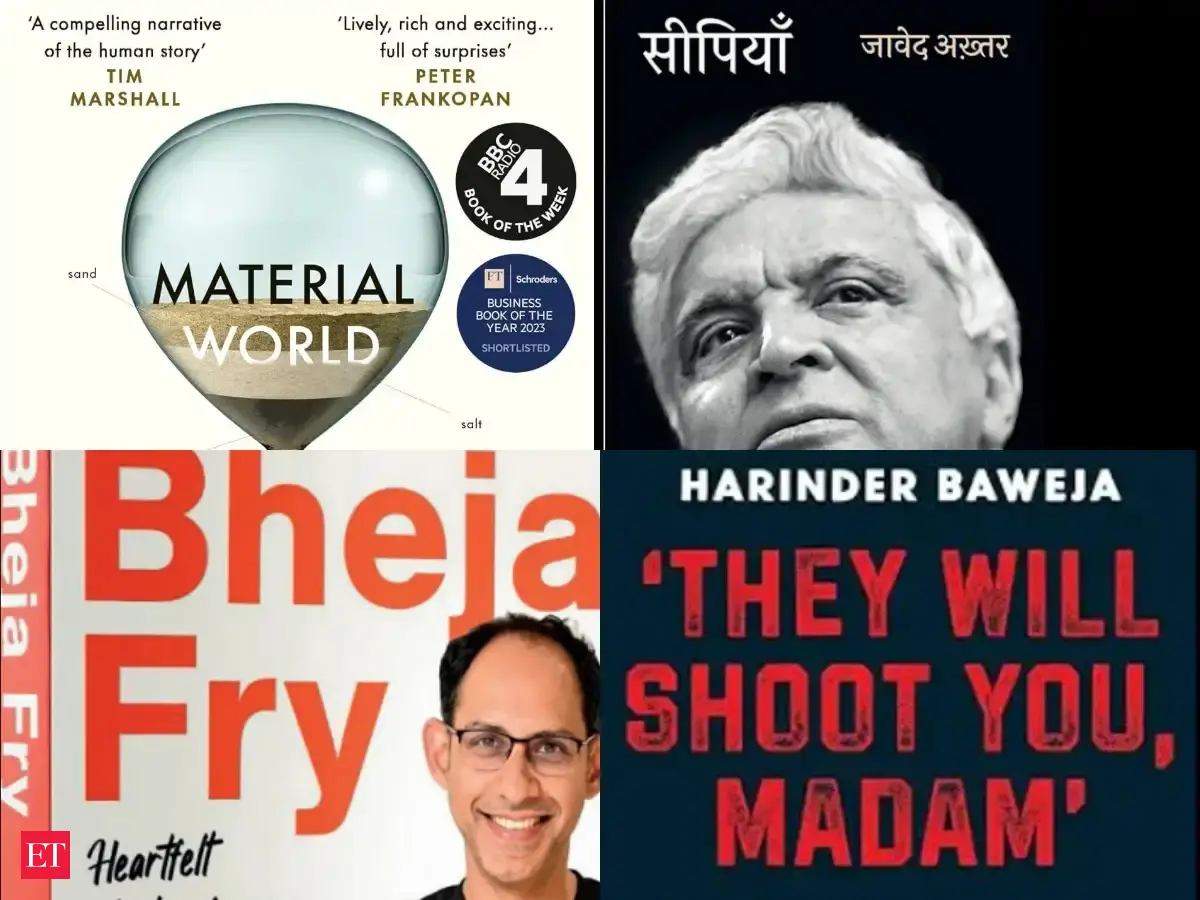
Material World, Ed Conway
Material World by Ed Conway
We think we live in a service-oriented, digital, post-industrial economy but without materials, from steel to silicon to rare metals, there is nothing-no banking, no internet, no power, no telecom. Not even green energy. It is a truth that should have been obvious but is usually ignored.
We know that silicon is needed for semiconductors that go into everything from phones to solar panels, but it is also needed for concrete which builds everything around us.
More electric vehicles mean more copper because electricity moves on copper.
Through the story of six materials-silicon, salt, copper, oil, iron and lithium-Conway's book focuses on how fragile the basis of modern life can be as what is required at each stage of processing is often available at only one or two places on earth.
Live Events
Empire of AI, Karen Hao
Empire of AI
The story of OpenAI from the time it started as a nonprofit becomes the history of much of what has happened in AI. Anthropic, for example, was set up by people who left OpenAI. Elon Musk was involved in OpenAI for a long time and Microsoft still is.
Hao's book also looks at the risks posed by the technology, including its huge environmental footprint with its insatiable hunger for power and water. Then there are problems with models trained on junk data, toxicity and biases. The first major critique came from Google employees, who were eventually fired for writing a paper called "On the Dangers of Stochastic Parrots".
This is a whole different perspective on AI-its capabilities, limitations and impact on many aspects of the world.
Rollercoaster of Hope: The Turnaround Story of Imagicaa, Dhimant Bakshi & Mayuresh Kor
Rollercoaster of Hope by Dhimant Bakshi and Mayuresh Kore
A rollercoaster of a book by two professionals who were thrown at the deep end and trying to turn around a company, Imagicaa, which had become a non-performing asset and was at the National Company Law Tribunal with a real threat of insolvency.
They write about the fight to keep the company running-negotiating with banks, visiting bureaucrats and political bigwigs and fighting the legal battle. The search for a new investor takes the authors to mafia dons, shady brokers and actual legit funds due to their determination to follow every possible lead and a never-say-die attitude. It is the kind of story that is almost never chronicled.
The Wealth Networks, Akshay Chavan
The Wealth Networks by Akshay Chavan
It looks at history through a different lens-an economic lens. And it probes some interesting issues: How beads from South India were found deep in the African heartland. Why Goa was attractive to Europeans because of the horse trade. How the Tirupati temple had a connection to the Vijayanagar empire but outlasted it by centuries. And how Sopara was the richest port when Mumbai was just a collection of swampy villages.
History is about the intersection of political power, trade, economics and, surprisingly, divinity. The rise of Hinduism and the decline of Buddhism and Jainism in various parts of the country have their roots in more earthly considerations. The patterns this book unfolds are fascinating. There is also a reminder that no wealth node lasts forever. Wish history is taught this way rather than as a collection of names and dates!
Economics in One Lesson, Henry Hazlitt
Economics in one lesson by Henry Hazlitt
A classic, where the basic principle is that a good economist looks at both the immediate, visible consequences of a policy on a specific group and the long-term, unseen consequences on all groups. In real life, this means one has to recognise the trade-offs.
For example, if a government builds bridges and roads, they are visible, but what is not visible is that the same money could have been used for, say, education. Go one level further and the money need not have been raised as taxes; in which case it would have remained in private hands and used elsewhere. A similar lens is used for regulations, policies and subsidies which direct money to or away from certain sectors.
It is, of course, an ultra-free market viewpoint but a very thoughtful one.
Extra-Ordinary: Stories of Science from Everyday Life, Aparna Agarwal
Extra-Ordinary: Stories of Science from Everyday Life by Aparna Agarwal
Rather delightfully, each chapter segues into all kinds of magical paths and random lanes. It goes from the lack of naturally occurring blue pigment to peacock feathers to colonial history; from pygmy elephants to giant tortoises to the intersection of Hollywood and black holes which, believe it or not, are in your Wi-Fi router. It talks about the properties of light that make it the best medium to carry messages across extraordinarily long distances; how an understanding of biology lies beneath the life-like paintings of the masters; the sequentially flowering trees of Bengaluru and much else.
‘They Will Shoot You Madam’: My Life Through Conflict Harinder Baweja
They will shoot you, Madam by Harinder Baweja
This memoir is an illustration of my conviction that you have to be slightly unhinged to be an investigative journalist. Imagine visiting the Lashkar-e-Taiba headquarters, interviewing Chhota Rajan, being among the first to enter the Golden Temple along with the security forces after Operation Black Thunder and going around strife-torn Kashmir to check out claims that many Hindu temples had been destroyed (turned out not a single one had been harmed by Muslims).
Seepiyaan, Javed Akhtar
Seepiyan by Javed Akhtar
Akhtar expounds the timeless brilliance and wisdom of dohas by Kabir, Abdul Rahim Khan-i-Khana, Bihari and Vrind. Human nature has not changed in thousands of years and that is why great literature endures. The poets express profound spiritual and social truths in two lines: direct, piercing and often with unforgettable metaphors.
Bheja Fry, Mazda Turel
Bheja Fry by Dr. Mazda Turel
A renowned neurosurgeon has written a collection of bite-sized, real-life essays and anecdotes. What makes them remarkable is that they are not just about clinical details but about characters, human relationships, emotions, personalities. And the detective work that it sometimes takes to get to the root of a problem. People are at the heart of these stories-their identities, memories, fear, faith, resilience and humour.
The Etymologicon, Mark Forsyth
The Etymologicon by Mark Forsyth
The origins of words are always fascinating, not the least because where they start from and where they end up sometimes have little to do with each other.
We know the words and phrases that have come from Shakespeare's writings, but do we know what we have to thank John Milton for? Disregard, undesirable, sensuous, persona, fragrance, jubilant, criticise, unconvincing, lovelorn, stunning, cooking, terrific, debauchery and more. Talking of novel wording, Milton invented the very word "wording". Coming to businesses, why does a huge oil company have a seashell as its logo? And what does Starbucks have to do with Yorkshire and whaling?
And at the next cocktail party, you can regale or bore your friends with a titbit: brandy, vodka and whiskey all have the same meaning-water of life. The book is written splendidly with typical British humour. It is the detours, fun asides and randomness that make for the most enjoyment.
Devina Mehra is founder and CMD of First Global and author of Money, Myths and Mantras.
(You can now subscribe to our Economic Times WhatsApp channel)
Is CoreWeave's movement signalling a return of the AI trade?
How India’s INR22.5 lakh crore gold loan boom is hiding a big hole
KYC and KYB: Pidilite's margin keeps finding its way back, though costlier raw materials can knock it off course – Part 2 of 3
Business of Odd Things: The farm that needs no land, freshwater, or fertiliser
KYC and KYB: Inside Pidilite, the company that turned Fevicol into a word for a strong bond – Part 1 of 3
Seoul halts trading, Nifty has its best week since 2021: Money leaving the AI trade – will it land in India?