
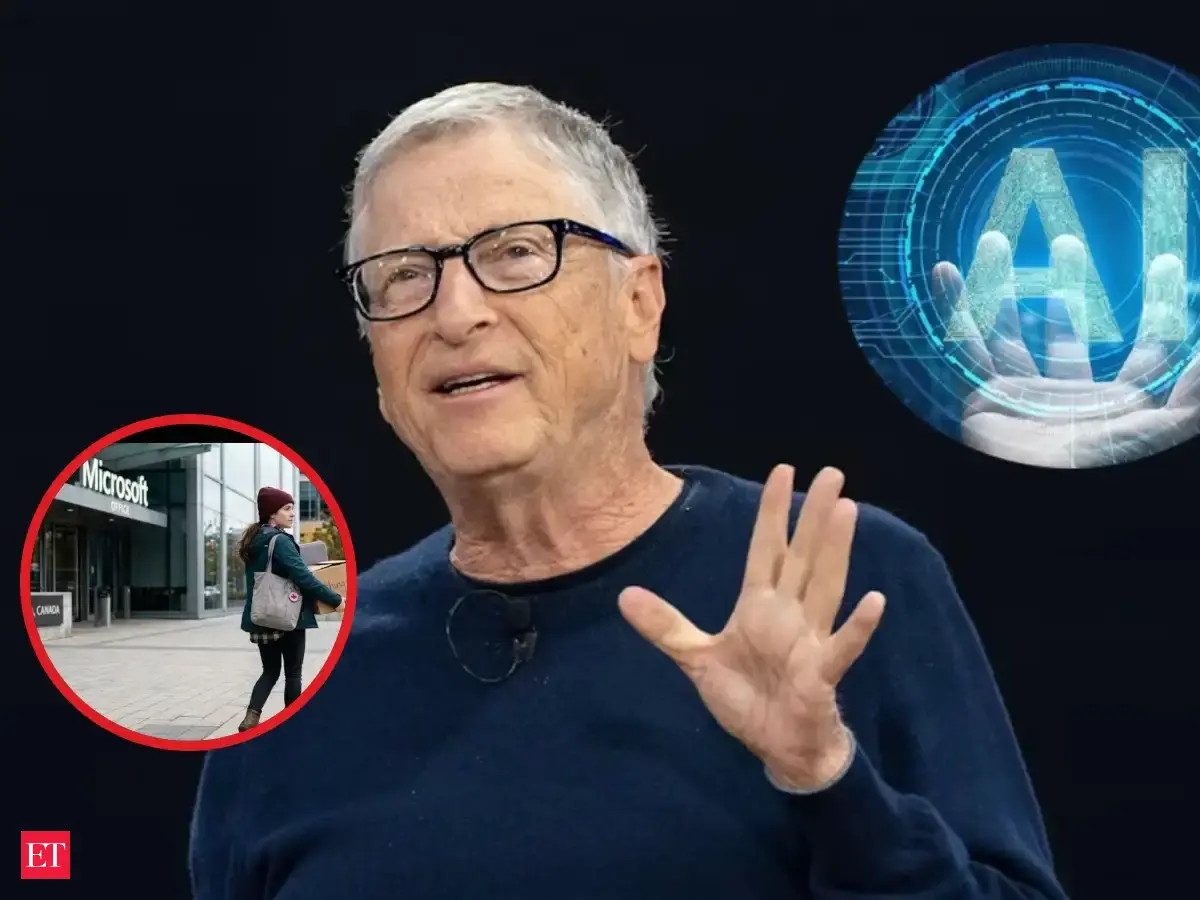
Bill Gates warned that the next 20 years could be the most tumultuous in human history as AI and robots reshape jobs. He said, "The period before society fully adjusts to AI could be exceptionally turbulent." Meanwhile, Microsoft is reportedly offering buyouts to 60,000 employees, sparking concerns about future work.
Synopsis
Bill Gates has warned that the next 20 years could be among the most tumultuous periods in human history as artificial intelligence and robots transform jobs and industries. The Microsoft co-founder believes AI could eventually create widespread abundance, but the transition may lead to job losses, economic uncertainty and a crisis of purpose for many workers. He has suggested shorter working hours, earlier retirement and selective AI adoption as possible ways to manage the disruption.
Bill Gates has warned that the world could face an unprecedented period of disruption over the next two decades as artificial intelligence (AI) and robots reshape jobs, industries and everyday life. The Microsoft co-founder believes AI could eventually create a world of abundance, but the transition could leave many people struggling to find work and purpose. Gates shared his concerns during an appearance on the latest episode of the Decoder podcast. He said the period before society fully adjusts to AI could be exceptionally turbulent, with some people benefiting from technological advances while others face significant losses. His warning comes as Microsoft, the tech giant Gates co-founded, is reported to be offering buyouts to around 60,000 employees, bringing fresh attention to the future of jobs in the technology sector.
Bill Gates warns of massive AI-driven job disruption
Gates believes the impact of AI will extend well beyond the technology industry. Jobs involving repetitive tasks, information processing and customer interactions could face significant pressure as machines become faster and cheaper. He specifically pointed to telephone sales, customer support and accounting as areas where AI could replace much of the work currently handled by people. According to Gates, AI systems could perform these tasks at a fraction of the cost while delivering results more quickly and accurately.
The disruption may not stop with office-based employment. Gates also warned that humanoid robots could eventually take over several jobs that require physical labour. Advances in robotics could make it possible for machines to build houses, grow food and perform surgery. If these technologies become sufficiently capable and affordable, businesses may have fewer reasons to rely on human workers for many essential services.
Gates acknowledged that such a future would depend partly on the choices society makes about the pace and extent of technological development.
Live Events
You Might Also Like:
No layoffs in 101 years: CEO of a company that has never laid off workers says businesses should cut costs elsewhere instead of firing employees
Why the AI transition could be difficult for workers
The central concern for Gates is not simply whether AI will make people more productive. It is how society will manage the transition when machines can perform a growing number of tasks that currently provide people with jobs and incomes. He described the coming 20 years as a period likely to produce both winners and losers. While businesses could benefit from lower costs and greater efficiency, workers whose roles become automated may struggle to find alternative employment.
The challenge could be particularly serious if technological advances move faster than workers can retrain or industries can create new opportunities. Gates has also argued that employment serves a purpose beyond earning a salary. Work gives people a reason to get up each morning, helps them build relationships and offers opportunities to solve problems and create something meaningful.
That is why the prospect of machines performing most economically necessary work raises questions that go beyond productivity. Even if AI makes goods and services more affordable, people could still struggle with a loss of identity, purpose and social connection.
Gates raises questions about human purpose in an AI-powered world
Gates also reflected on how AI could change the role of people who currently dedicate their lives to solving difficult problems. He cited his own work in philanthropy, including efforts to combat malaria and address other humanitarian challenges. He suggested that it would be unsettling if AI eventually became capable of handling such responsibilities more effectively than humans.
You Might Also Like:
What is the difference between buyout and layoff? Microsoft offers buyout to 60,000 employees; check what it means for workers
His concern highlights a broader question: what happens when machines can outperform people in areas that have traditionally given them a sense of achievement? Gates suggested that activities such as art, sports, cooking and childcare could remain important human pursuits, even if AI eventually becomes capable of performing them better.
In such a scenario, people might choose to continue these activities because they value the experience, relationships and personal satisfaction involved, rather than because machines can't do them. The distinction could become increasingly important if future generations have access to technology capable of handling much of the work required to sustain modern life.
Could shorter working hours protect jobs?
Gates believes societies may need to consider new ways of organising employment as AI becomes more capable. Measures such as earlier retirement and limits on working hours could help preserve opportunities for human workers. Instead of expecting everyone to work the same hours as they do today, governments and employers could explore ways to distribute available work among more people.
Such changes would require difficult decisions about incomes, productivity and how the benefits of automation are shared. They could also force policymakers to reconsider long-standing assumptions about the relationship between employment and economic growth. However, Gates' comments do not suggest that these changes will happen automatically. Their implementation would depend on how businesses, governments and communities respond to technological advances.
Gates says some people may choose to limit AI use
Gates also raised the possibility that some communities may deliberately restrict their use of AI. He suggested that people could adopt an approach similar to the Amish, who are known for selectively accepting modern technologies in line with their traditions and values. Such communities might choose to use AI for certain practical tasks while avoiding it in areas where they want to preserve human involvement.
(You can now subscribe to our Economic Times WhatsApp channel)
KYC and KYB: Inside Damani’s Avenue Supermarts that refuses to charge more – Part 1 of 3
Will oil turn into a lingering problem? Is the world economy, India, or the market prepared?
KYB and KYC: Business behind the wealth creator called ‘Divi’s Lab’ – Part 2, concluding
KYB and KYC: Business behind the wealth creator called “Divi’s Lab” – Part 1
The global business of promising more
One company, 2 words. Bond yield and CDS: Will they decide the fate of global markets?