
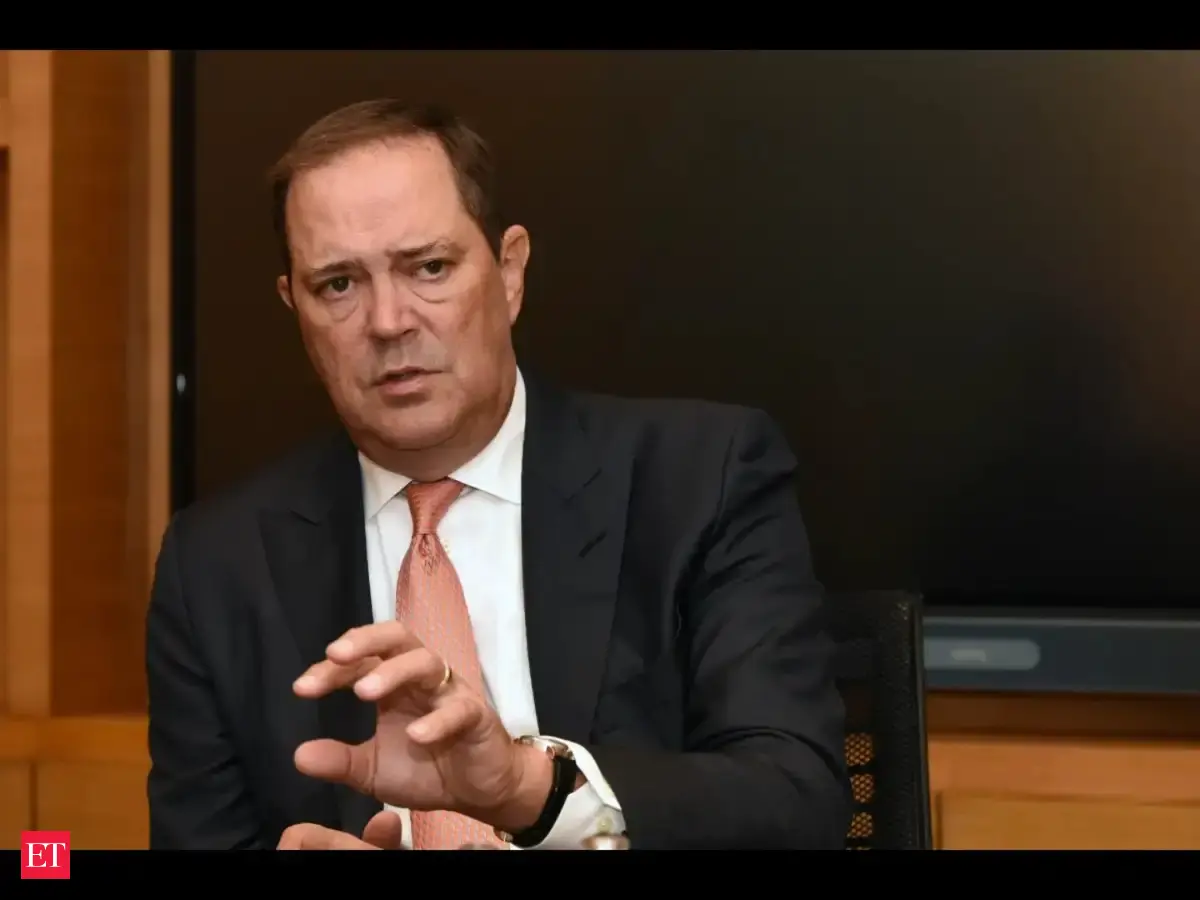
Cisco Systems exceeded its $1 billion production target in India, said CEO Chuck Robbins. He noted that large companies now lead AI funding, though many startups could fail as the technology evolves. Robbins said, "It will be bigger than the internet," as the firm discusses new goals with the government.
Cisco Systems has exceeded its initial target of $1 billion in production from India and is now in discussions with the government about the next goal, said Chuck Robbins, chief executive officer of the US networking and cybersecurity company that reported $63 billion in revenue for fiscal 2026. In an interview with Subhayan Chakraborty and Surabhi Agarwal, Robbins, who is on an India visit, said artificial intelligence will be bigger than the internet and that it's being driven by large companies with strong balance sheets, but warned that many startups and capital could disappear. Edited excerpts:
What is Cisco's progress on the commitment to generating more than $1 billion in production and exports from the Chennai factory?
We had set a target for capacity coming out of the factory, which we've already exceeded. We started with a single product and expanded to six products now. We're having conversations with some of the ministers about our next goal. But you should assume that it'll be a multiple of our initial target.
You said in January that AI will be bigger than the internet, but warned that there would be a lot of carnage ahead. Where are we now?
Compared to the internet build-out, one thing is very different for the AI rollout. The vast majority of investments are being done by hugely successful companies that have incredibly strong balance sheets.
They view this as an existential issue. During the internet days, we saw a lot of companies that were trying to build business models around the internet which weren't sustainable long-term, and those companies struggled, after which the longer-term players came in. You saw the iPhone get built in 2007 and the entire app ecosystem that got built around that. We are yet to see all of that for AI. We've seen AI companies that have come up, whose technology is not even needed three months later. This thing is moving quickly, and you are going to see those companies fall off. Capital will be misplaced or lost. But there's going to be a lot of winners. It will be bigger than the internet.
There are concerns that AI adoption is not matching with the investment in compute...
I don't think the benefits of AI are reflected in how much compute you have. Hopefully, over time, you will be getting much higher benefits for lower compute consumption. From a use case perspective, there are two ways one can look at it as a CEO. You can look at it as a cost reduction lever, whereby AI can be used to be more productive, doing more at a lower cost, driving more innovation, and delivering more to customers for the same amount of money that I'm delivering today. Secondly, using any sort of infrastructure as a gauge of success. That's our gauge of success because we sell a lot of infrastructure. Over time, we would want to scale the benefits in an exponential fashion while the infrastructure costs remain more linear in their growth.
India is seeing major investment in data centres. What kind of an opportunity does that present for you?
We work with those data centre providers to help them with the technology that goes into those data centres. Cisco commands roughly 15-20% of the spend on all technology that goes into a data centre, including the optics, connectivity and security. Cisco has the ability to deliver certain parts of our portfolio on a sovereign basis. Sovereignty around the world has an interesting set of meanings depending on who you're talking to. Good news about India is there is one definition. We're talking to partners about data centre builds, and we'll be delivering some of our technology so they can be used in that way.
Policymakers are discussing the need for India to tighten its regulations for trusted source suppliers for data centres. How does that affect Cisco?
We would welcome it. We're doing this in other places around the world today. Many countries have trusted-source validation.
Does the US model of AI regulation, and the calls by other nations for developing sovereign AI, impede the ability of conglomerates like Cisco to operate in various jurisdictions?
The more countries want to build their sovereign infrastructure and their own AI models, the more opportunity is created for new infrastructure on a global scale. Assuming the need for more infrastructure globally, our job is to continue to show up and operate within these countries as if we were local, leveraging the trust we have built up over the last 30-40 years, to help become the trusted infrastructure provider for those countries. It's impossible for every country at this stage to themselves build all the tech infrastructure that's needed.
Do you think the pushback to data centre build outs over constraints of land, power and water could restrict the ability of a company like Cisco to expand in that space?
Companies that are building these data centres need to do a better job engaging with the local community. They need to provide solutions that are going to make it more beneficial to the local community to have the data centre built. That includes alternative sources of power, work agreements and work on the rate at which energy costs rise.
What are the areas where you feel India would be a good fit for manufacturing?
On the surface, we believe India is a great place to do manufacturing. We really want to try to help bring more of the ecosystem here for manufacturing, so that an expansive footprint of technology manufacturing can be created here. That's something that we continue to want to work on. It cuts down on transit costs, and also creates more jobs here in India.
How are you evolving your operations with the explosion in cyber threats?
We have to work more closely with our customers. We need to develop new technology that actually creates shields around some of this stuff until it can be protected. We're working on them now, and some are already in the pilot phase of testing with our customers. Regulation applies to people who are law-abiding. Regulation doesn't apply to those who don't care about the law in the first place.
India's national cybersecurity agency has mandated a six-hour reporting window for all kinds of cybersecurity incidents. Is this feasible?
I don't want to speak to this specific regulation because I'm not that familiar with it. But there is a discussion that needs to be had around what is prudent relative to disclosures. With some of the models, we're able to scan our code at a pace that we've never seen before. So, we're identifying vulnerabilities, as are our competitors. We and the entire industry cannot come up with patches at the pace that we're able to identify the vulnerabilities. So, if we're forced to report those vulnerabilities, without having the patches yet, we create a risk. AI is democratising the ability to be a real adversary. You don't have to be a cybersecurity expert anymore to actually be a very successful adversary.
What will be the future of the cybersecurity services business overall, if AI is democratising cyber capabilities?
I think there will be a handful of large platform players that are going to really win in the long term. And I believe we'll be one of them because I'm supposed to believe that. But I also believe it because the common denominator that AI agents move across in an enterprise is the network. The industry is beginning to really believe that security embedded in the network, doing real-time agentic observability is the only way you're going to really have true security.
Have you had any discussions with the Indian government on how Cisco can partner on AI sovereignty, specifically for data centres?
Those discussions start after this interview (laughs). There's a lot of discussion around what sovereignty means in the AI world. Does it mean running models locally even if those models weren't built here, how to treat frontier models or open weight models, and models from different origin countries. We don't have clarity yet on what those requirements would look like. But we can support any and all of those. I think validation and a regulatory framework for models will become the main question on which the Indian government is going to have to really make decisions on. Industry can help them think through that, and we're going to offer that. We're neutral when it comes to that.
What framework of overall technological sovereignty will work in a country like India?
Sometimes, the sovereignty debate gets a lot of creep, and people get into things like needing to turn over the operations of the cloud service locally, which can be complicated. The two primary things that we have always been consistent on -- our need to ensure the ongoing operations of the technology that we're acquiring, and the flow and the export of data. We need to have control over the fact that that technology will continue to operate and it's in our control as to whether it's operating or not.
AI sovereignty has many definitions around the world. Good news is, there is only one in India.
(This story has not been edited by economictimes.com and is auto-generated from a syndicated feed we subscribe to.)