
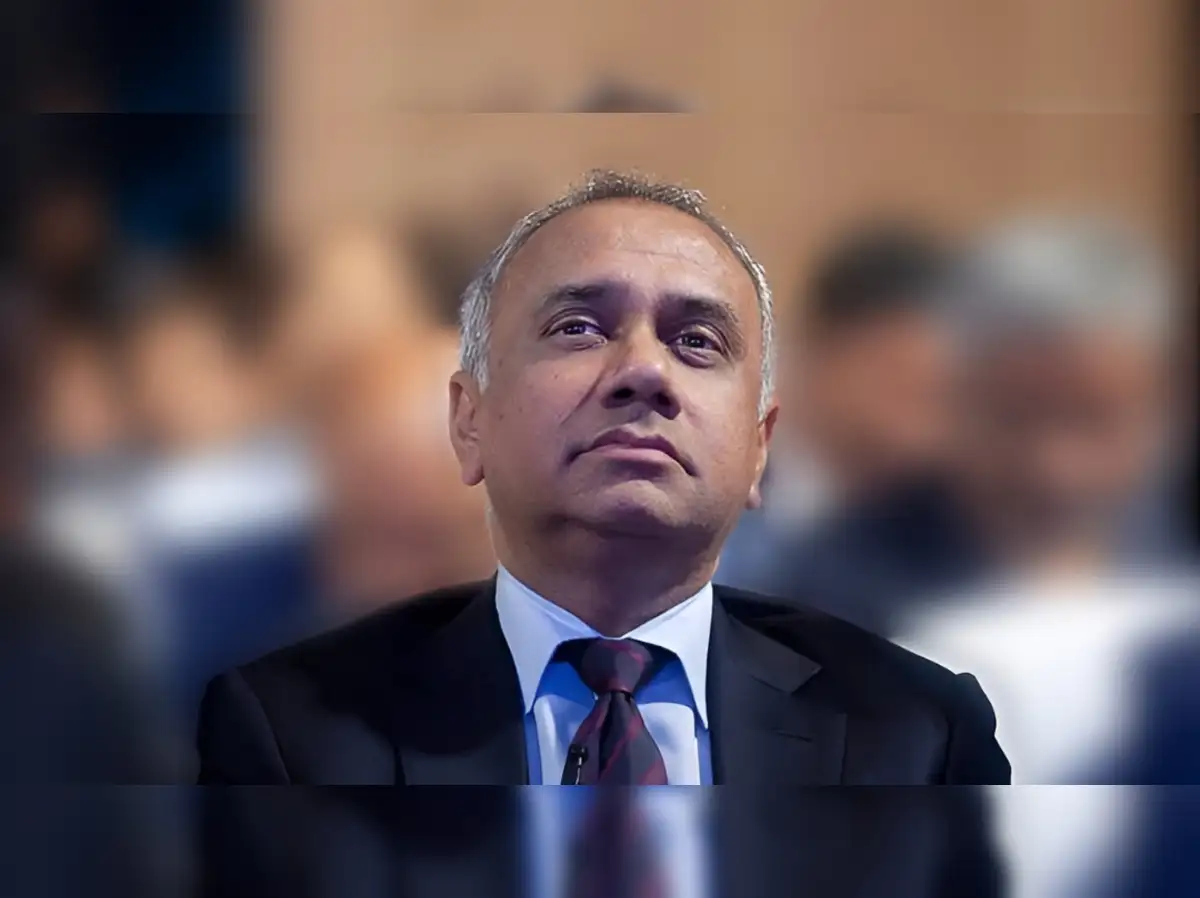
Infosys CEO Salil Parekh said AI services may account for almost half of the company's work in two to three years. Speaking on Tuesday, he noted that AI demand is growing at a fantastic pace. The firm already hired 20,000 graduates this year to help clients deploy these new technologies.
Parekh said the business, which includes building AI agents, coding work and modernising old technology for clients, is small relative to the company's size but growing so fast that it could account for 20-30% of Infosys' work within a few quarters if the current pace continues.
Infosys' AI services, which accounted for over 8% of its revenue last quarter and are growing at a double-digit rate sequentially, are likely to drive almost half of its work in two to three years, CEO and MD Salil Parekh said on Tuesday.
Parekh said the business, which includes building AI agents, coding work and modernising old technology for clients, is small relative to the company's size but growing so fast that it could account for 20-30% of Infosys' work within a few quarters if the current pace continues.
"It (AI services) is growing at a fantastic pace. If you sort of extrapolate that by a few quarters, you already start to see that's 20-30% of our work in a few quarters, and maybe in two or three years, almost half of our work," Parekh said at the Bloomberg New Economy Forum 2026.
He said the growth showed there was "a huge demand" for such services.
Responding to questions about the viability of India's IT services industry as AI advances, Parekh said, "My own sense is it is good news for Infosys, and by sort of that same view, good news for the tech services in India".
Infosys hired 20,000 college graduates last year and plans to hire another 20,000 this financial year, Parekh said.
These graduates are trained in AI and then work with clients to deploy the technology and manage change.
Of Infosys' 3 lakh employees, about 80,000 are already working on coding tools for clients and on some internal projects, he said.
Asked how companies were adopting AI, Parekh said enterprise clients are already good users of AI services.
With strong demand and capacity still being built, clients are now looking at whether they could use lower-cost tokens for the same work, considering cheaper or open-weight models instead of the most recent ones, he said.
Asked whether physical infrastructure was keeping pace with AI and cloud advancements, Parekh said data had become critical to the AI ecosystem.
Stricter sovereign data and cloud requirements are further restricting some of the capacity build-outs, he said.
He also flagged risks in the build-out of data centres. Chips are "massively expensive" today and facing tremendous competition, and it is unclear how long the capacity being built would remain useful.
New foundation models taking a different approach from the two large closed-model companies could make inference costs several times cheaper, which would also affect overall capacity, he said.
"Today the demand is fantastic, but these are some of the risks that could play out," Parekh said, adding that the impact could become visible five to ten years later.
He said another risk was a backlash against the build-out of AI, especially in Western markets, and that the social response needed to be balanced with the economic drivers, which "may be out of sync right now".