
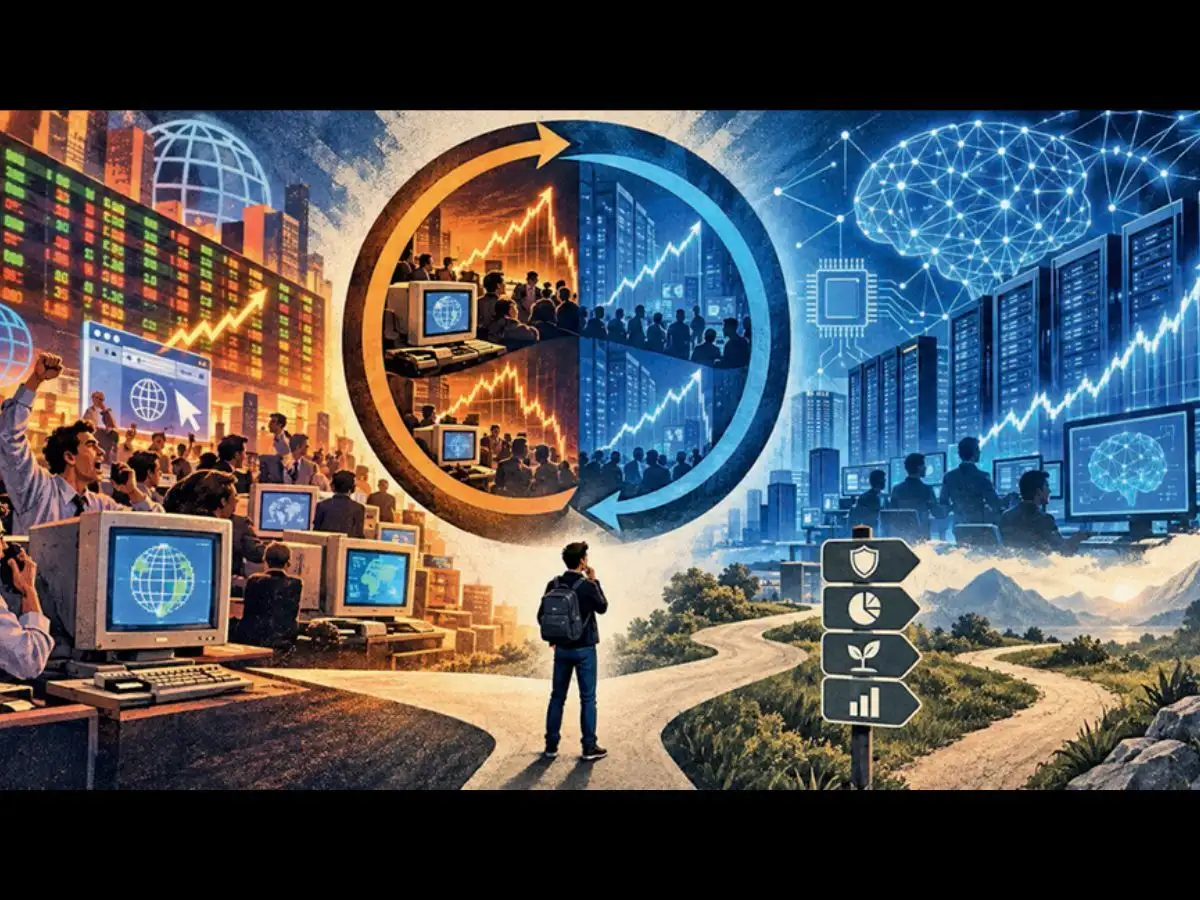
Microsoft made a voluntary exit offer to 60,000 employees while spending $175 billion on artificial intelligence capacity. Investors remain confused about whether this AI shift is a boon or a bubble. Experts suggest that small investors should ignore the hype, as no one truly knows how these big investments end.
Synopsis
What should the small investor do about this AI revolution in the making? The simple answer is nothing. No one can tell whether AI is a boon, a disaster, or a bubble. It’s probably all of these, but it’s impossible to tell when, or in what order. The temptation to invest on the news is always there, but at this point, our job is to ignore the machine that will keep producing these stories
Listen to this article in summarized format
As we know by now, Microsoft has made a voluntary exit offer to 60,000 employees—roughly a fourth of its workforce. That doesn’t mean it’s sacking a quarter of its employees. When it made a similar offer to 9,000 employees earlier this year, about 30% accepted. The interesting part is that these offers are coming in the same year it’s spending about $175 billion (or Rs.15 lakh crore) to build artificial intelligence (AI) capacity.
What I find fascinating in the social media commentary on this business is that, depending on which doom-monger you believe, you could end up with one of two opposite impressions of what is going on. One type sees this as evidence that AI is doing so much effective work in big companies (at least in the software industry) that they need far fewer people and, in the near future, will hardly need any. The other camp believes that the huge investments in AI are ruining these companies’ finances and that these investments are so far from paying off that they are heading for a disaster.
Both views can’t be correct, and the eagerness with which people embrace one or the other tells me no one knows anything. In fact, my mind goes back almost 30 years to the last time the world thought the future was being built.
Global Crossing debacle
In the late 1990s, when it became clear that the internet would become a major global phenomenon, a small number of companies decided that, in the years to come, an enormous global network of fibre-optic cable would be needed. They borrowed huge sums of money to lay this fibre across oceans and continents.
The poster boy of that age was a wonderfully named company, Global Crossing, which was founded in 1997. Global Crossing spent more than $10 billion laying fibre crisscrossing the globe and peaked at around $50 billion at the height of the dotcom boom in early 2000. In that era, bandwidth was called the ‘new oil’, and everyone was certain demand would be limitless and that whoever owned the data pipes would dominate the future.
As it turned out, demand was limitless, but the timing was all wrong. Data traffic arrived years after the loans became due, so in early 2002, just two years after its peak valuation, Global Crossing filed for one of the largest bankruptcies in history. Much of the fibre-optic cable that it laid down sat dark and unused for years. But others bought that fibre cheaply in the bankruptcy, and it’s still in use. So, it’s entirely possible my words are being carried to you on it. The backbone of the modern internet was built, the people who did so went bankrupt, but the asset eventually did its job.
What the future holds
This was not even the first time something like this had happened. The British railway mania of the 1840s was a similar story: investors got wiped out, but they funded the first generation of railway lines that carried that economy for decades afterwards.
While my stories sound like ‘all’s well that ends well’, they don’t help those trying to invest today. The large amount of money pouring into AI data centres and other assets will eventually be useful, and even indispensable, but that doesn’t mean the gains will accrue to those borrowing and spending today.
So what should the small investor do about this revolution in the making? The simple answer is, nothing. Neither you, nor I, and possibly no one in the world, can tell whether AI is a boon, a disaster, or a bubble. It’s probably all of these, but it’s impossible to tell when, or in what order. The temptation to invest on the news is always there, but at this point, from an investment standpoint, our job is to ignore the machine that will keep producing these stories.
As usual, in my advice, dullness will protect us. We should own businesses (via equity or equity funds) we understand well enough to hold through years of noise or, when we need to, sell despite it. Instead of trying to predict the future, let our savings rate and patience do the work. I’m confident about broad, low-cost investments because they’ve always worked. Use AI to be a better investor, not as something to invest in. Right now, that’s what it’s good for.