
Parrying has become a popular combat mechanic in modern video games, but its origins trace back to older titles. Epyx’s Summer Games II in 1985 used the term to describe blocking attacks. Later, games like The Mysterious Murasame Castle in 1986 and Prince of Persia in 1989 helped shape the feature.
If you've ever played literally any game with combat in the last few years, chances are you already know what a parry is. It's that little window where instead of running or blocking like a total coward, you hit the exact right button at the exact right time and suddenly the fight flips in your favor. It feels amazing when you land it, and... absolutely brutal when you don't.
But this hasn't always been the case. I recently realized something very obvious: parrying wasn't always everywhere in gaming. Somewhere along the way, developers looked at combat and decided, "What if instead of just blocking, you could punish someone for attacking you?" That idea has taken all sorts of forms, from old-school fighting games to some of the biggest RPGs around.
Finding the first person to put it in a game is trickier. Does a well-timed sword block count? Does it need to stagger the attacker? What about batting away a projectile?
Depending on where you draw those lines, you get a different family tree. The interesting part is how those branches grew.
So Where Does the Word Parry Even Come From?
The word "parry" wasn't always a gaming word. It's borrowed from fencing, with roots in the French parer, meaning "to ward off." This makes sense once you think about it. Fencing is literally two people trying to land a hit on each other while also trying not to get hit themselves, and that's, well, a pretty good pitch for a video game.
One early example is a straight-up fencing sports game. Epyx's Summer Games II (1985) had a foil event in which you positioned your blade and swept aside an incoming attack. A successful block briefly immobilized the opponent's foil, giving you an opening to strike. Its manual explicitly discusses parrying, too. The terminology and the idea were already there, even if the controls and rhythm weren't what a Sekiro player would expect.
Then there's The Mysterious Murasame Castle, released for Japan's Famicom Disk System in 1986. Takamaru could use his katana to deflect incoming projectiles. That's another branch of the idea: timing an attack to protect yourself, without necessarily putting the enemy into a special stagger state.
Prince of Persia followed in 1989 with sword fights built around advancing, retreating, striking, and parrying. You had to read an opponent's swing and time your defense, then choose when to strike back. It wasn't waiting for a later game to make it a "real" parry. It was an earlier, less elaborate version of a familiar exchange.
Prince of Persia's early ports put reading an opponent's sword within a much larger platforming adventure.
By the mid-1990s, fighting games were making weapon defense part of a more elaborate mind game. Samurai Shodown II (1994), for example, included a command for catching an opponent's sword while disarmed. It's an important stop on this tour, but that isn't the same thing as the universal tap-forward parry Street Fighter III would later popularize. Calling one game the undisputed inventor means ignoring older examples - or defining them out of contention.
Weaponlord (1995) deserves more than a passing mention here. Developed by Visual Concepts and published by Namco, it had "thrust blocks" that turned defense into an opening. Namco's Soul Edge, the mid-1990s predecessor to Soulcalibur, also made timed defense central through Guard Impact. This wasn't simply two unrelated teams arriving at the same idea.
In a retrospective interview, Weaponlord co-designer James Goddard said his team showed Namco its weapon and parry systems and that the publisher adapted ideas from their work. That's a developer's account of influence, rather than proof that every detail of Guard Impact came straight from Weaponlord. But it makes the historical connection much more interesting than a coincidence.
Weaponlord's combat ideas took shape on paper before they reached the screen.
When Fighting Games Made the Parry Famous
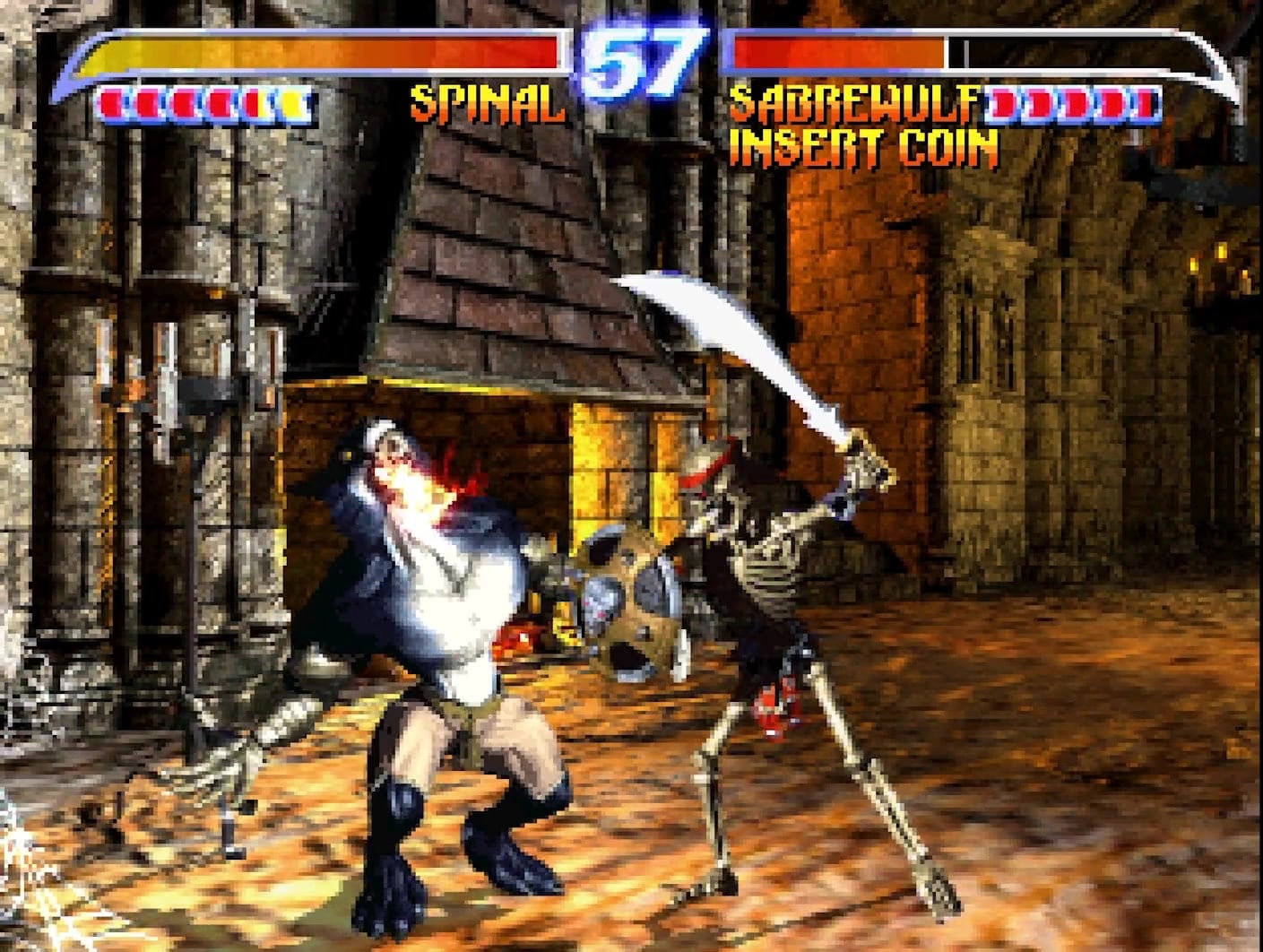
Killer Instinct 2 (1996) brought its own version, complete with serious stakes. Parry a standing normal attack and you could follow with a special move that dizzied the opponent, opening the door for a huge combo. The parry set up that punishment; it didn't automatically deliver the dizzy all by itself.
But if you ask gamers which series made parrying famous, plenty will say Street Fighter. The series introduced it in Street Fighter III: New Generation in 1997. Players tapped toward the opponent for a high parry or down for a low one, just as an attack connected. Unlike blocking, a successful parry prevented chip damage and let you turn the exchange around without spending a defensive meter.
Street Fighter III: 3rd Strike (1999) added another wrinkle: Guard Parry, commonly called a Red Parry. This let you switch from blocking into parrying during an attack sequence, with especially demanding timing. It's a specific variation, rather than the name for every Street Fighter III parry.
Then came Evo Moment #37 in 2004, aka one of the greatest comeback moments in competitive gaming. Playing Ken against Justin Wong's Chun-Li, Daigo Umehara had so little health left that simply blocking her super would have finished him. Instead, he parried all 15 hits and countered to win the round. You don't need a spreadsheet of frame data to understand why the room lost its mind.
The official Evo Events recording of Moment #37. Every successful parry keeps Ken alive; the counterattack completes the comeback.
Tekken was developing its own variations alongside all this. Tekken 3 (1997) gave select characters, including Ling Xiaoyu, low-parry options. Tekken Tag Tournament's 1999 arcade release made the low parry universal: every character could time a down-forward input to redirect susceptible low attacks.
The combo mechanics need a little untangling. Tekken 6 introduced Bound, a bounce that extended combos. Its Bloodline Rebellion update made successful low parries put opponents into that state, using up the normal Bound extension. Tekken 7 replaced Bound as the main combo extender with Screw, also called Tailspin. Low parries still used the old bounce, so a Screw extension remained available afterward. Tekken 8 then introduced Tornado, and its low parry immediately uses that state, leaving you without another ordinary Tornado extension in the follow-up combo.
The names sound like weather reports, but the point is simple: the reward for reading a low attack changes with the surrounding combat system. Character-specific moves add more variety. "Sabaki," for example, describes an attack with a built-in parry window during its startup. These different kinds of parry don't all catch the same attacks or lead to the same punishment.
Parrying Goes RPG with Dark Souls
Tekken and Street Fighter can duke it out over who refined the mechanic best, but parrying didn't stay confined to fighting games. In action RPGs, the series most people will point to is Dark Souls, though this part of FromSoftware's history goes back one game further, to Demon's Souls (2009). Its high-risk, high-reward parry-and-riposte system helped establish a familiar ritual: invite a hit, knock it aside, then make the attacker regret it.
Dark Souls (2011) carried that idea forward and made it feel even more deliberate. With suitable equipment in your left hand, you used the parry action as a parryable attack reached you. Nail it, and the enemy was vulnerable to a critical riposte at close range. It sounds simple written out like that. It feels rather less simple when something twice your size is trying to rearrange your face.
Dark Souls II (2014) changed the timing and handling again. Different tools have different startup, active, and recovery periods, so learning one parry doesn't mean you've learned them all. Your choice of equipment could make that familiar gamble feel very different.
Next came Bloodborne in 2015, and FromSoftware changed the flavor completely. In place of the familiar shield-first approach, you had a firearm in your off hand. A well-timed shot could interrupt a susceptible enemy mid-attack and open it up for a close-range visceral attack. You're still reading an incoming blow and gambling on the timing. You're just doing it with a gun.
Bloodborne put a gun where Souls players were used to keeping a shield.
That fits a game which also lets you regain recently lost health by immediately striking back. Bloodborne wants you engaged, aggressive, and very aware of how close you are to dying. It doesn't make every enemy attack parryable, and firing from a safe distance won't magically put you in position for the follow-up.
Dark Souls III followed in 2016, returning to shields and other parrying tools within its faster-paced Souls combat. Small shields, fist weapons, and parrying daggers offered different timing and practical trade-offs.
And Then Sekiro Put Deflection at the Center
Hidetaka Miyazaki directed Demon's Souls, Dark Souls, and Bloodborne, so by the time Sekiro: Shadows Die Twice came out in 2019, it was pretty clear the guy loved high-stakes, high-drama counterplay. In Dark Souls, parrying was already one of the flashiest things you could learn. Sekiro made that exchange the rhythm of the whole fight.
You play as a shinobi trying to rescue your kidnapped lord in a fictional, supernatural version of Sengoku-era Japan. There are still other tools: stealth, dodging, combat arts, and a prosthetic arm full of extremely unfriendly gadgets. But you can't build your way into a completely different weapon class or summon another player to do the hard part. Learning to stand your ground matters much more.
FromSoftware and Activision's gameplay overview shows how deflection, posture, and the shinobi's other tools fit together.
The system works through something called Posture. Attacks and successful deflections build up the enemy's Posture gauge until their stance breaks, exposing them to a Deathblow. Health still matters, too: wounded enemies recover their Posture more slowly, so wearing them down can make the decisive break easier.
Press guard just before a blow lands and you deflect it. Press early and keep holding, and an ordinary block may save you - at a higher Posture cost. Press too late and you still get hit. Add perilous attacks that demand a different response, and suddenly that apparently forgiving safety net feels a lot smaller.
What makes it work so well is how the animations, enemy attack patterns, and metallic back-and-forth all reinforce the same rhythm. When it clicks, you stop feeling like you're waiting for permission to attack. You're participating in the entire exchange. When it doesn't click... well, the title did warn you about dying.
Sekiro won Game of the Year at The Game Awards in 2019, and years later it's still a touchstone for deflection-focused combat.
At This Point, You Can Parry Anything
Other action RPGs have kept running with the idea. Star Wars Jedi: Fallen Order (2019) and Jedi: Survivor (2023) let you do it with a lightsaber. Nioh 2 (2020) has weapon-specific counter skills, alongside its separate Burst Counter system. Elden Ring (2022) offers traditional parrying tools and skills such as Carian Retaliation, with timing that varies by the tool you choose. Wo Long: Fallen Dynasty (2023) goes further toward making deflection a constant part of combat.
Then there's Lies of P (2023), which wraps its Perfect Guard system in a moody Belle Époque aesthetic. Nail the timing and you prevent damage while helping push an enemy toward a stagger opportunity. You can still dodge or use an ordinary guard, but there's a reason people keep bringing Sekiro into the conversation.
Resident Evil 4's remake (2023) even lets Leon parry enemy attacks with his knife, including the spectacularly ridiculous ability to stop a chainsaw. Apparently, a sufficiently well-timed kitchen utensil can solve almost anything.
Nine Sols followed in 2024, bringing deflection-focused combat into a 2D exploration-and-platforming adventure. Its developers explicitly cite Sekiro, but this isn't just the same Posture bar squeezed sideways. Successful deflections build Qi, which you can spend on talisman attacks. Defense becomes fuel for offense in a different way.
And then there's Clair Obscur: Expedition 33 (2025), which puts demanding dodges and parries inside turn-based battles. Your party still takes turns selecting attacks and abilities, but an enemy's turn doesn't mean it's time to put the controller down.
In Expedition 33, the enemy's turn is still your problem.
That broader concept has plenty of history. Super Mario RPG (1996) already used timed defensive commands, and Paper Mario: The Thousand-Year Door (2004) went further with Superguard. Its tighter timing could negate damage from compatible attacks and even hurt the attacker. A conventional timed guard that reduces damage and a tougher defensive command that completely turns the hit around were already sharing the same battle system.
What Clair Obscur does particularly well is make that choice dramatic, readable, and central to almost every encounter. Dodging gives you more timing leeway. Parrying asks for more precision, and parrying an entire enemy combo rewards you with a powerful counterattack. Long, differently paced attack strings make the enemy's animation something you have to learn, rather than a flourish you watch between menu selections.
The official Flying Waters gameplay demonstration shows turn-based decisions alongside real-time defensive inputs.
I can see why that pulls some action-game players into a genre they'd normally skip, and why others would rather their turn-based RPG asked less of their reflexes. Either way, the achievement isn't inventing timed defense. It's making a familiar idea feel like the star of a very different kind of game.
And it's not just the headline-grabbing releases. Blasphemous (2019) folds parrying into its brutal, gothic combat. Thymesia (2022) makes deflection and dodging major defensive choices. Smaller indie and game-jam projects have built their entire premise around getting that one satisfying exchange right.
With that many games leaning on it, parrying has naturally spawned its own corner of the internet. Look for high-level gameplay and you'll find players turning supposedly terrifying bosses into demonstrations of rhythm and timing. Watching someone like ONGBAL can make you feel that you understand a fight perfectly. Recreating it yourself is, unfortunately, a separate purchase.
So, What's Next for the Parry?
Some of what used to be "next" is already here. Capcom's Onimusha: Way of the Sword launched on early September, bringing the series back with sword clashes and timed defense at the center of its appeal.
Phantom Blade Zero arrived in late October, bringing fast wuxia-style combat and plenty of opportunities to turn an attack back on its owner. Nexon's Vindictus: Defying Fate, meanwhile, is targeting 2027. Its characters have distinct defensive tools, so it would be misleading to describe every one of them as another Sekiro protagonist.
Further out, the Stellar Blade sequel now has a name, Stellar Blade: Blood Rain. It's still in development without an announced release date, and its final combat balance is something we'll have to judge when we can play it.
Batara: Fate Unbound likewise has no announced release date, but its developers are explicitly pitching parry-focused combat. That's a pretty good indication of how much weight this one mechanic now carries.
If you zoom out for a second, you realize how wild this all is. "Has a good parry system" can be more than a footnote in a review. It's become its own marketing pitch, the same way "open world" or "roguelike" has turned into shorthand for entire design philosophies. So yes, it's safe to say the parry isn't going anywhere anytime soon. And frankly, I don't think we want it to.