
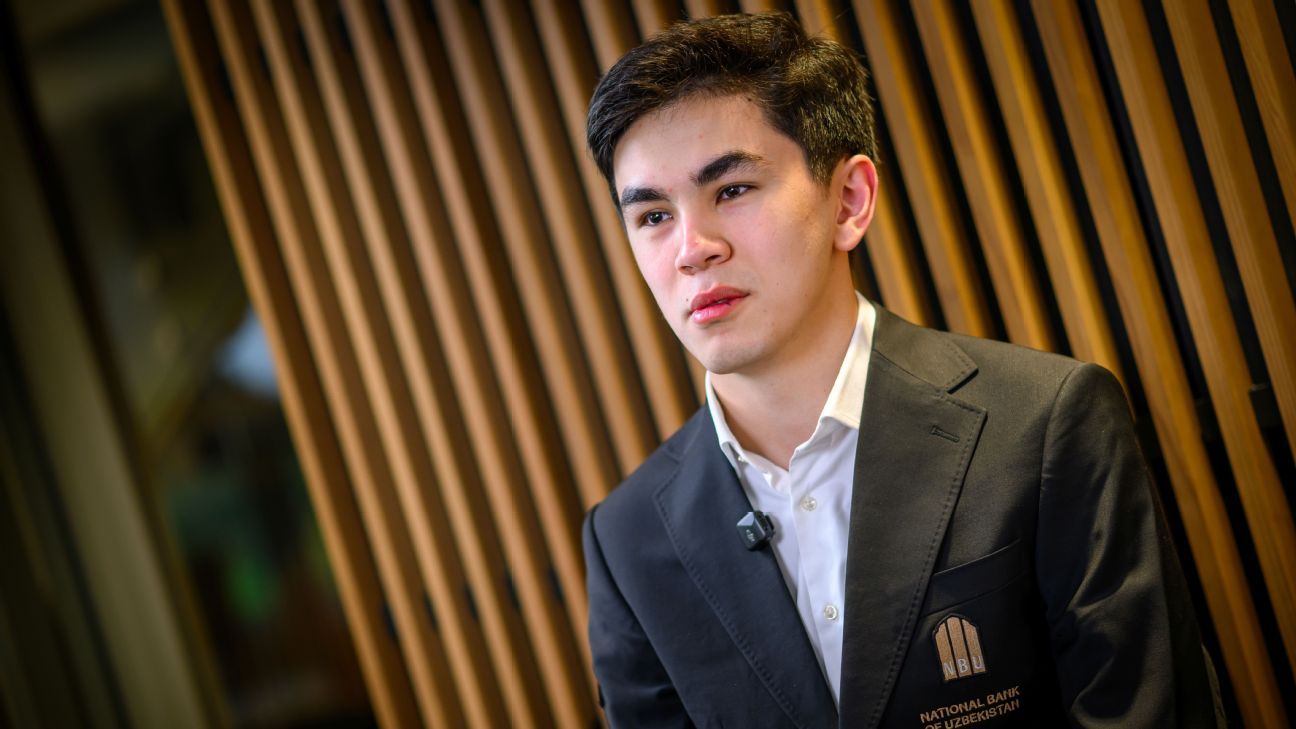
The FIDE World Championship match starts in Geneva on Tuesday afternoon, featuring the youngest players in chess history. Reigning champion D Gukesh faces challenger Javokhir Sindarov. Sindarov had an incredible 2026, dominating the Candidates tournament. His coach Roman Vidonyak said, "A year ago, he wouldn't be able to defend the way he does now."
When the FIDE World Championship match kicks off in Geneva on Tuesday afternoon, it will be the youngest world championship match in the history of chess.
On one side is the reigning world champion D Gukesh, 20 years old. And his challenger turns 21 midway through the match.
That challenger is Uzbekistan's Javokhir Sindarov, who has had an incredible 2026, including one of the best ever performances at a FIDE Candidates tournament. Sindarov finished that tournament with 10 points in 14 rounds, the highest score in the history of the Candidates tournament under the current format. The tally included six wins and eight draws; five of those wins came in the first six rounds, effectively ending the tournament there itself.
The difference between Sindarov and the rest was stark; Sindarov's opponents would often be found down an hour or more on the clock when he wouldn't have exhausted even ten minutes of his time.
Part of that was down to his preparation, but that was only the base. Once he was out of those openings, his attacking edge through middle-games and endgames made sure he was untouchable.
Candidates tournaments are generally decided on ability to handle pressure, the nerves growing as the tournament nears its end. Sindarov eliminated that by having the tournament all but wrapped up in the first six games. After that, he showed nous and technique, as he stayed unbeaten for the rest of the tournament, and left a strong field - including Hikaru Nakamura, Fabiano Caruana, R Praggnanandhaa, Anish Giri, and Wei Yi - fighting for the meaningless second place.
While he has always had the attacking nous and the ability to conjure up wins from different positions, he has now combined that with big improvements in his defensive understanding and his ability to play out draws.
A year ago, he wouldn't be able to defend the way he does now, his coach Roman Vidonyak said in an interview with ChessBase India. Vidonyak noted that in that one year, he made Sindarov play out more than 200 positions in defence, and made him play it out through to the end. Vidonyak called it one of the most important skills to have for a player that goes through his coaching system.
The attacking instinct and the ability to find creative solutions to win games were always there. Pair that with the newfound defensive stability, and there's a player with almost no weaknesses.
It's no surprise then, that from the FIDE World Cup in Goa in November 2025 to the Candidates to the Olympiad, Sindarov hasn't known anything other than winning in the last year.
Just like Gukesh in 2024, he comes into his first world championship match in the form of his (admittedly short) career.
Just like Gukesh, Sindarov also became a grandmaster before his teens. He was 12 years, 10 months, and 10 days old, the second-youngest to become grandmaster at the time. A year later, he lost that spot to Gukesh.
He was an integral part of Uzbekistan's Olympiad and Asian Games medal-winning teams, but remained on the cusp of elite. The move to elite level happened in 2025, when he breached the 2700 ELO rating mark for the first time in his career (he's currently rated 2782).
That rise coincided with Sindarov and Vidonyak coming together. Their partnership began in January 2025, and in the space of a couple of years, Vidonyak has already become what Sindarov calls one of the most important people in his life.
Speaking to Chessbase India, Vidonyak explained that his partnership with Sindarov began when he was looking for a sparring partner for Vladimir Fedoseev, who he was then coaching.
After some time with Sindarov, Fedoseev told Vidonyak that the young Uzbek reminded him of the former world champion Mikhail Botvinnik.
Sindarov has since committed himself to Vidonyak's training methods, and the results are there for all to see. "I think he doesn't only work on chess," says Sindarov of Vidonyak. "We are working on many other things as well. I'm happy that I have such a good person, and hopefully we will work for a long time."
Scarily for the competition, Vidonyak doesn't think that Sindarov is anywhere near his best yet and has plenty left to work on.
"I separate grandmaster skills into 17 parts. For every part, I have thousands of very special positions to train this skill. We train the skills with evaluations. My evaluation score is from C minus, the lowest, up to A plus," he told ChessBase India. At the moment, he said, Sindarov is at B in most skills.
Sindarov's rise is closely entwined with the rise of Uzbekistan in the chess world. He was integral to Uzbekistan winning the FIDE Olympiad on home soil in September as well. It was Uzbekistan's second title in three years, the first coming in Chennai in 2022, when Sindarov was 16 years old.
He's now a superstar in Uzbekistan. "I remember when I won Candidates, I could not even go somewhere because all the people come, 'Hey, you're that guy who won this tournament, I know you,'" Sindarov, smiling, told ESPN.
After that Candidates win, Sindarov was seen beaming in an interaction with Uzbek President Shavkat Mirziyoyev.
President Shavkat #Mirziyoyev held a telephone call with chess player @GMJSindarov and congratulated him on his historic victory at the @FIDE_chess Candidates Tournament. https://t.co/TpQs5oJMCh
- Shavkat Mirziyoyev's Press-service (@president_uz) April 15, 2026
"And I'm proud that our president is always supporting the young generation. And I'm really happy with all of the situation," Sindarov said. "Uzbekistan is not such a big country. That's why these things like Candidates for our country is massive, and that's why I was a hero in my country."
It's a sentiment that Sindarov's compatriot Nodirbek Abdusattorov echoes. Speaking on the sidelines of the Chennai Grand Masters tournament in July, Abdusattorov said Sindarov's 2026 was inspirational, and left no one in doubt that he would be a part of Sindarov's team in preparations for the world championship match.
"If Javokhir can become world champion, I think it's going to be an exceptional year for Uzbekistan," Abdusattorov said.
That camaraderie within the Uzbek elite chess ranks is a result of their shared histories. That shared history began with GM Rustam Kasimdzhanov, who became the FIDE World Champion in 2004 - a title before the unification of the FIDE World Championship and the Professional Chess Association's Classical World Championship.
That was the beginning of the chess boom in Uzbekistan, Abdusattorov says. Seeing Kasimdzhanov presented with national honours by the president inspired many parents to bring their kids to chess circles, he says.
So, much like India's current generation had a godfather in Viswanathan Anand, Uzbekistan's have had Kasimdzhanov, who was also the captain in Uzbekistan's Olympiad victory this year.
Sindarov calls Kasimdzhanov the person because of whom chess is popular in Uzbekistan.
Kasimdzhanov's kids, then, will form a large part of Sindarov's team for this world championship match, just as they did for the Candidates tournament, for which Abdusattorov said he had taken part in camps with Sindarov, while Mukhiddin Madaminov has been Sindarov's second for a while now. Nodirbek Yakubboev and Shamsiddin Vokhidov could also be a part of Sindarov's team.
"Of course, I have played a lot (against them), but in general, I used to spend time with them a lot outside of chess. And we become friends. We have a fantastic relationship in our team, and everyone supports each other," Sindarov says.
The likes of Madaminov and the rest of his team have done a sterling job this year, and of course, none more so than during the Candidates tournament.
Of course, a world championship match is a different beast altogether, but one can be sure that his team will once again leave no stone unturned in terms of preparations to catch Gukesh off-guard.
Sindarov's preparation for the World Championship match has been a little different to Gukesh's. The world champion has picked his tournaments in 2026, playing two tournaments in the second half of the year - the Chennai Grand Masters, and then the Olympiad.
Sindarov, meanwhile, has done the exact opposite. He's played a lot of tournaments, traveled the world, and even as late as the end of October, he featured in the Clutch Chess Championship, which he won against Hikaru Nakamura, Fabiano Caruana and R Praggnanandhaa.
"I feel fine to play. Right now, more tournaments, I feel comfortable," Sindarov told ESPN on the sidelines of the Global Chess League in Bengaluru in early September.
He has felt comfortable for all of 2026, and that is why he justifiably comes into this match as the favourite to take the title from Gukesh. Gukesh is fighting the form book, of course, but he's also fighting an opponent who will surely be well-prepared, and knows how to beat the best players.
In the last year, Gukesh's chess has been marred by errors of judgement, mostly errors in judging risk. He's well known as a player who's willing to sometimes take worse positions in order to try and force a win. Against Sindarov, that could prove counter-productive. Throughout the World Cup and the Candidates, Sindarov generally showed a clutch ability to consistently convert better positions into wins, with solid endgame technique.
A debut world championship, of course, means that Sindarov will have to deal with mental aspects that he hasn't done so far in his career. Whether he's capable of doing so or not, we'll find out in the next three weeks in Geneva.
If Sindarov manages to do that, it will of course be his greatest triumph, but also a triumph for all of Uzbekistan.